

592
order of dominance. Mangrove communities with more than three mangrove genus
are classified as mixed mangrove communities. In some cases the term “Sparse” has
also been used to represent the mangroves which have density between 10 and 20%.
Zoning also includes condition assessment in the form of density-wise classification
of the communities. Mangroves have been classified in four density classes, viz.,
very dense (>70% cover), moderately dense (40–70% cover), dense (10–40%) and
degraded (<10% cover).
As per this spatial inventory on 1:25,000 scale, using Resourcesat-1 data of
2005–2007 timeframe, the area under mangrove cover for Indian coast is 495,620 ha
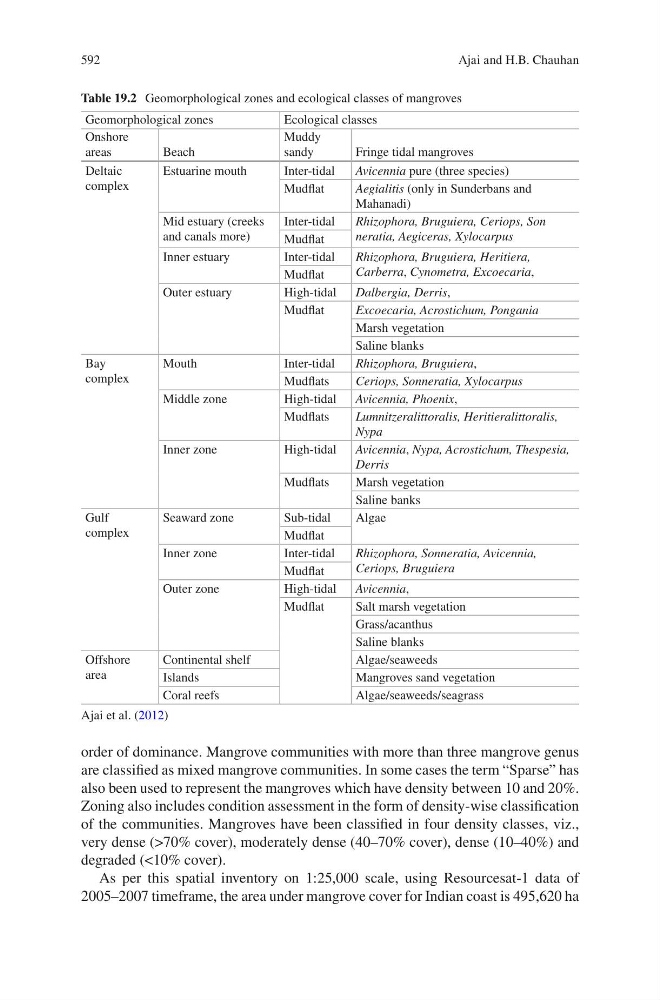
Table 19.2 Geomorphological zones and ecological classes of mangroves
Geomorphological zones
Ecological classes
Onshore
areas
Beach
Muddy
sandy
Fringe tidal mangroves
Deltaic
complex
Estuarine mouth
Inter-tidal
Avicennia pure (three species)
Mudflat
Aegialitis (only in Sunderbans and
Mahanadi)
Mid estuary (creeks
and canals more)
Inter-tidal
Rhizophora, Bruguiera, Ceriops, Son
neratia, Aegiceras, Xylocarpus
Mudflat
Inner estuary
Inter-tidal
Rhizophora, Bruguiera, Heritiera,
Carberra, Cynometra, Excoecaria,
Mudflat
Outer estuary
High-tidal Dalbergia, Derris,
Mudflat
Excoecaria, Acrostichum, Pongania
Marsh vegetation
Saline blanks
Bay
complex
Mouth
Inter-tidal
Rhizophora, Bruguiera,
Mudflats
Ceriops, Sonneratia, Xylocarpus
Middle zone
High-tidal Avicennia, Phoenix,
Mudflats
Lumnitzeralittoralis, Heritieralittoralis,
Nypa
Inner zone
High-tidal Avicennia, Nypa, Acrostichum, Thespesia,
Derris
Mudflats
Marsh vegetation
Saline banks
Gulf
complex
Seaward zone
Sub-tidal
Algae
Mudflat
Inner zone
Inter-tidal
Rhizophora, Sonneratia, Avicennia,
Ceriops, Bruguiera
Mudflat
Outer zone
High-tidal Avicennia,
Mudflat
Salt marsh vegetation
Grass/acanthus
Saline blanks
Offshore
area
Continental shelf
Algae/seaweeds
Islands
Mangroves sand vegetation
Coral reefs
Algae/seaweeds/seagrass
Ajai et al. (2012)
Ajai and H.B. Chauhan