

440
14.3.2 Lake Ecosystem
A lake is a body of water or other liquid of considerable size surrounded entirely by
land. A vast majority of lakes on Earth are fresh water, and most lie in the Northern
Hemisphere at higher latitudes. In ecology the environment of a lake is referred to
as lacustrine. Large lakes are occasionally referred to as “inland seas” and small
seas are occasionally referred to as lakes. Smaller lakes tend to put the word “lake”
after the name, as in Green Lake, while larger lakes often invert the word order.
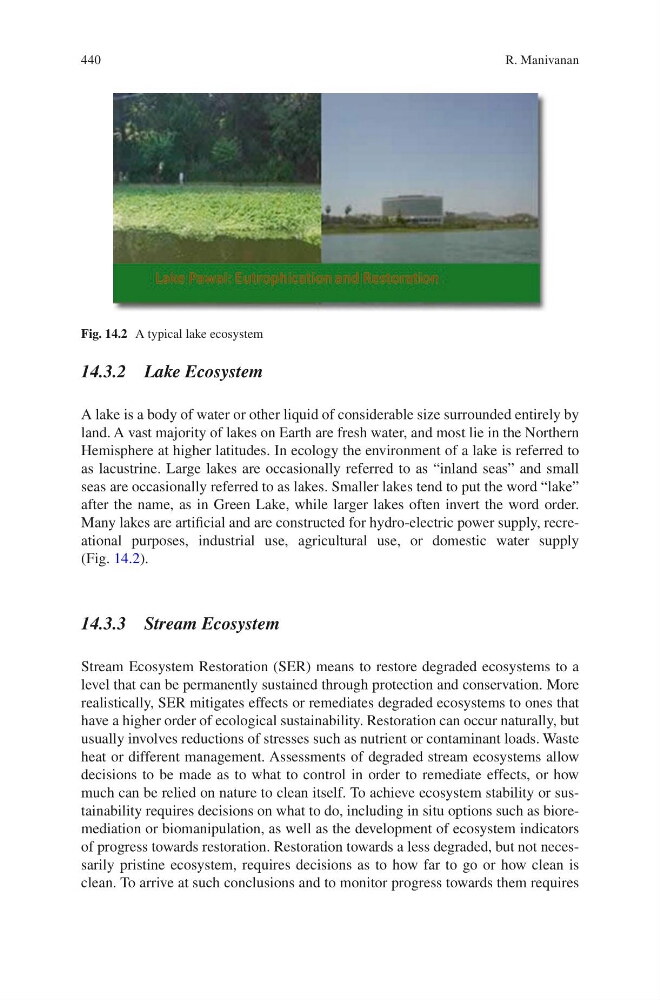
Many lakes are artificial and are constructed for hydro-electric power supply, recreational purposes, industrial use, agricultural use, or domestic water supply
(Fig. 14.2).
14.3.3 Stream Ecosystem
Stream Ecosystem Restoration (SER) means to restore degraded ecosystems to a
level that can be permanently sustained through protection and conservation. More
realistically, SER mitigates effects or remediates degraded ecosystems to ones that
have a higher order of ecological sustainability. Restoration can occur naturally, but
usually involves reductions of stresses such as nutrient or contaminant loads. Waste
heat or different management. Assessments of degraded stream ecosystems allow
decisions to be made as to what to control in order to remediate effects, or how
much can be relied on nature to clean itself. To achieve ecosystem stability or sustainability requires decisions on what to do, including in situ options such as bioremediation or biomanipulation, as well as the development of ecosystem indicators
of progress towards restoration. Restoration towards a less degraded, but not necessarily pristine ecosystem, requires decisions as to how far to go or how clean is
clean. To arrive at such conclusions and to monitor progress towards them requires
Fig. 14.2 A typical lake ecosystem
R. Manivanan
14.3.2 Lake Ecosystem
A lake is a body of water or other liquid of considerable size surrounded entirely by
land. A vast majority of lakes on Earth are fresh water, and most lie in the Northern
Hemisphere at higher latitudes. In ecology the environment of a lake is referred to
as lacustrine. Large lakes are occasionally referred to as “inland seas” and small
seas are occasionally referred to as lakes. Smaller lakes tend to put the word “lake”
after the name, as in Green Lake, while larger lakes often invert the word order.
Many lakes are artificial and are constructed for hydro-electric power supply, recreational purposes, industrial use, agricultural use, or domestic water supply
(Fig. 14.2).
14.3.3 Stream Ecosystem
Stream Ecosystem Restoration (SER) means to restore degraded ecosystems to a
level that can be permanently sustained through protection and conservation. More
realistically, SER mitigates effects or remediates degraded ecosystems to ones that
have a higher order of ecological sustainability. Restoration can occur naturally, but
usually involves reductions of stresses such as nutrient or contaminant loads. Waste
heat or different management. Assessments of degraded stream ecosystems allow
decisions to be made as to what to control in order to remediate effects, or how
much can be relied on nature to clean itself. To achieve ecosystem stability or sustainability requires decisions on what to do, including in situ options such as bioremediation or biomanipulation, as well as the development of ecosystem indicators
of progress towards restoration. Restoration towards a less degraded, but not necessarily pristine ecosystem, requires decisions as to how far to go or how clean is
clean. To arrive at such conclusions and to monitor progress towards them requires
Fig. 14.2 A typical lake ecosystem
R. Manivanan