

441
the development of indicators of ecosystem health, stability and sustainability. If
these criteria are met, the ecosystem can be declared as remediated to acceptable
conditions, perhaps even restored.
The level of protection or control or regulation required to reach this state is
dependent on the recovery or restoration of the ecosystem and the state that needs
to be maintained. Restoration means that degraded aquatic ecosystems are remediated to some level of stability or sustainability involving minimization of stresses,
in situ treatments, and probably conservation of components of the total aquatic
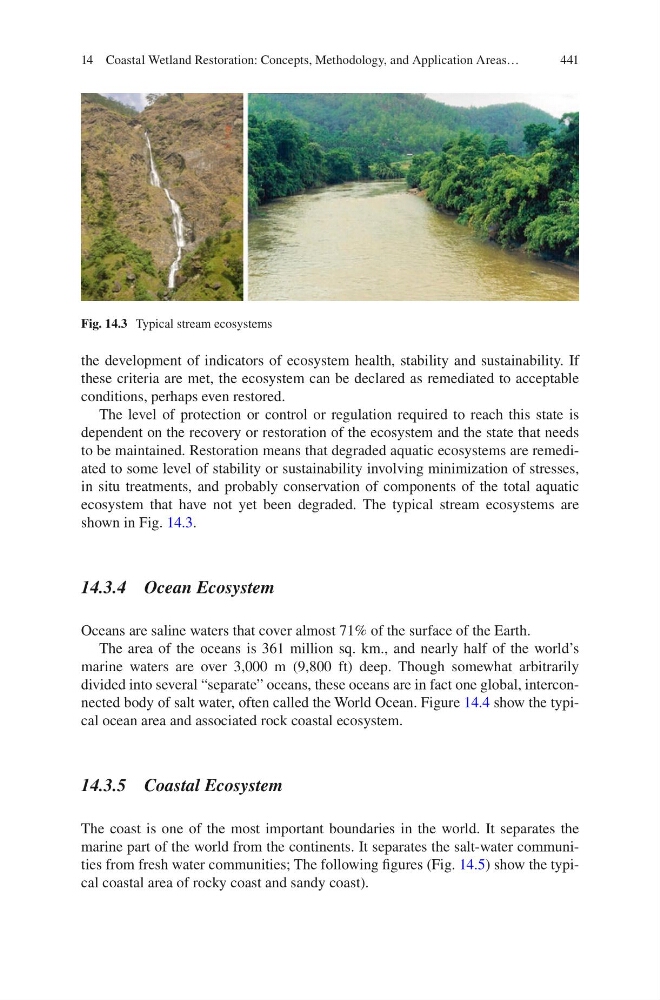
ecosystem that have not yet been degraded. The typical stream ecosystems are
shown in Fig. 14.3.
14.3.4 Ocean Ecosystem
Oceans are saline waters that cover almost 71% of the surface of the Earth.
The area of the oceans is 361 million sq. km., and nearly half of the world’s
marine waters are over 3,000 m (9,800 ft) deep. Though somewhat arbitrarily
divided into several “separate” oceans, these oceans are in fact one global, interconnected body of salt water, often called the World Ocean. Figure 14.4 show the typical ocean area and associated rock coastal ecosystem.
14.3.5 Coastal Ecosystem
The coast is one of the most important boundaries in the world. It separates the
marine part of the world from the continents. It separates the salt-water communities from fresh water communities; The following figures (Fig. 14.5) show the typical coastal area of rocky coast and sandy coast).
Fig. 14.3 Typical stream ecosystems
14 Coastal Wetland Restoration: Concepts, Methodology, and Application Areas…
the development of indicators of ecosystem health, stability and sustainability. If
these criteria are met, the ecosystem can be declared as remediated to acceptable
conditions, perhaps even restored.
The level of protection or control or regulation required to reach this state is
dependent on the recovery or restoration of the ecosystem and the state that needs
to be maintained. Restoration means that degraded aquatic ecosystems are remediated to some level of stability or sustainability involving minimization of stresses,
in situ treatments, and probably conservation of components of the total aquatic
ecosystem that have not yet been degraded. The typical stream ecosystems are
shown in Fig. 14.3.
14.3.4 Ocean Ecosystem
Oceans are saline waters that cover almost 71% of the surface of the Earth.
The area of the oceans is 361 million sq. km., and nearly half of the world’s
marine waters are over 3,000 m (9,800 ft) deep. Though somewhat arbitrarily
divided into several “separate” oceans, these oceans are in fact one global, interconnected body of salt water, often called the World Ocean. Figure 14.4 show the typical ocean area and associated rock coastal ecosystem.
14.3.5 Coastal Ecosystem
The coast is one of the most important boundaries in the world. It separates the
marine part of the world from the continents. It separates the salt-water communities from fresh water communities; The following figures (Fig. 14.5) show the typical coastal area of rocky coast and sandy coast).
Fig. 14.3 Typical stream ecosystems
14 Coastal Wetland Restoration: Concepts, Methodology, and Application Areas…