

439
documented that riverine systems are intimately coupled with and created by the
characteristics of their catchments basins, or watersheds. The concept of the coastal
wetland restoration includes four-dimensional processes that connect the longitudinal (upwelling-downwelling), lateral (longshore), and vertical (cross shore) dimensions, each differing temporally.
Coastal wetland restoration is an integral part of a broad, region-based approach
for achieving federal, state and local goals (Lewis 1982a, b). Specifically, coastal
wetland restoration is the re-establishment of chemical, physical, biological and
microbiological components of an coastal ecosystem that have been compromised by
stressors such as point or nonpoint sources of pollution, habitat degradation, hydro
modification, and others.
14.3 Types of Ecosystems
The hydro ecosystems are classified into various types based on their flow, salty
nature, volume etc. The following sub-chapters are discussed about the nature, characteristics, current speed, direction, status like polluted, non polluted etc.
14.3.1 River Ecosystem
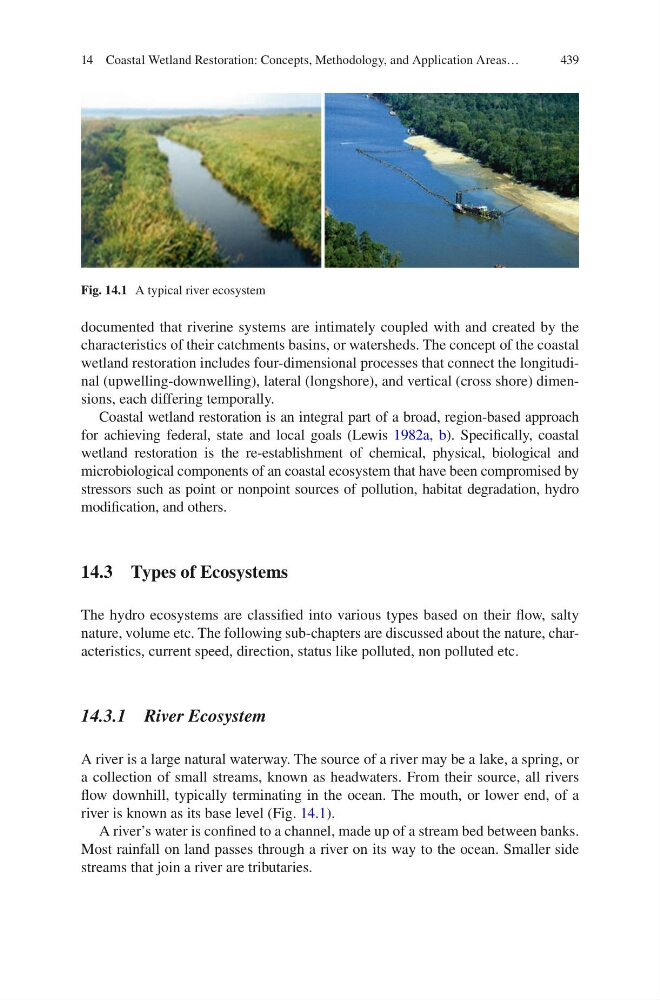
A river is a large natural waterway. The source of a river may be a lake, a spring, or
a collection of small streams, known as headwaters. From their source, all rivers
flow downhill, typically terminating in the ocean. The mouth, or lower end, of a
river is known as its base level (Fig. 14.1).
A river’s water is confined to a channel, made up of a stream bed between banks.
Most rainfall on land passes through a river on its way to the ocean. Smaller side
streams that join a river are tributaries.
Fig. 14.1 A typical river ecosystem
14 Coastal Wetland Restoration: Concepts, Methodology, and Application Areas…
documented that riverine systems are intimately coupled with and created by the
characteristics of their catchments basins, or watersheds. The concept of the coastal
wetland restoration includes four-dimensional processes that connect the longitudinal (upwelling-downwelling), lateral (longshore), and vertical (cross shore) dimensions, each differing temporally.
Coastal wetland restoration is an integral part of a broad, region-based approach
for achieving federal, state and local goals (Lewis 1982a, b). Specifically, coastal
wetland restoration is the re-establishment of chemical, physical, biological and
microbiological components of an coastal ecosystem that have been compromised by
stressors such as point or nonpoint sources of pollution, habitat degradation, hydro
modification, and others.
14.3 Types of Ecosystems
The hydro ecosystems are classified into various types based on their flow, salty
nature, volume etc. The following sub-chapters are discussed about the nature, characteristics, current speed, direction, status like polluted, non polluted etc.
14.3.1 River Ecosystem
A river is a large natural waterway. The source of a river may be a lake, a spring, or
a collection of small streams, known as headwaters. From their source, all rivers
flow downhill, typically terminating in the ocean. The mouth, or lower end, of a
river is known as its base level (Fig. 14.1).
A river’s water is confined to a channel, made up of a stream bed between banks.
Most rainfall on land passes through a river on its way to the ocean. Smaller side
streams that join a river are tributaries.
Fig. 14.1 A typical river ecosystem
14 Coastal Wetland Restoration: Concepts, Methodology, and Application Areas…