

331
data have been used to develop Escoffier analyses for each and to investigate if the
time to reach stable configurations can be estimated.
10.3.2 Ocean Tidal Constituents Control Data
If the tidal constituents in the ocean vary over time then it could be expected that
those within estuaries would follow suit. Therefore it is important to normalize the
basis for tidal analysis. For the NSW estuaries exemplified herein, the selected control data set for the histories of amplitude and phase of the major ocean spring tidal
constituents was that represented by the Sydney Harbor tidal data, a large, relatively
deep, drowned river valley estuary with a reliable and stable tidal gauging station.
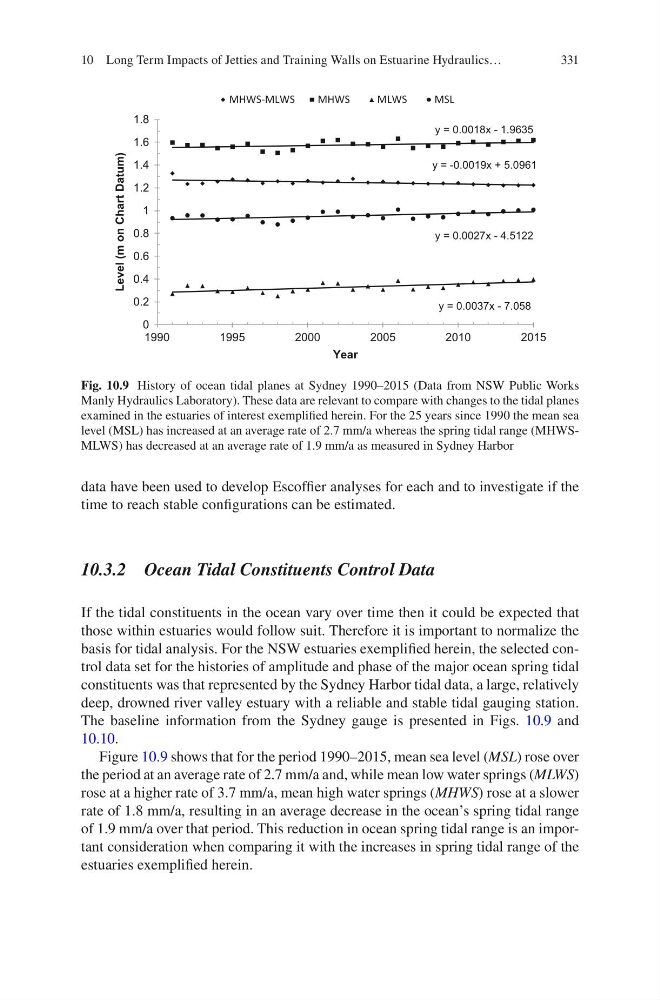
The baseline information from the Sydney gauge is presented in Figs. 10.9 and
10.10.
Figure 10.9 shows that for the period 1990–2015, mean sea level (MSL) rose over
the period at an average rate of 2.7 mm/a and, while mean low water springs (MLWS)
rose at a higher rate of 3.7 mm/a, mean high water springs (MHWS) rose at a slower
rate of 1.8 mm/a, resulting in an average decrease in the ocean’s spring tidal range
of 1.9 mm/a over that period. This reduction in ocean spring tidal range is an important consideration when comparing it with the increases in spring tidal range of the
estuaries exemplified herein.
y = -0.0019x + 5.0961
y = 0.0018x - 1.9635
y = 0.0037x - 7.058
y = 0.0027x - 4.5122
0
0.2
0.4
0.6
0.8
1
1.2
1.4
1.6
1.8
1990
1995
2000
2005
2010
2015
Level (m on Chart Datum)
Year
MHWS-MLWS
MHWS
MLWS
MSL
Fig. 10.9 History of ocean tidal planes at Sydney 1990–2015 (Data from NSW Public Works
Manly Hydraulics Laboratory). These data are relevant to compare with changes to the tidal planes
examined in the estuaries of interest exemplified herein. For the 25 years since 1990 the mean sea
level (MSL) has increased at an average rate of 2.7 mm/a whereas the spring tidal range (MHWSMLWS) has decreased at an average rate of 1.9 mm/a as measured in Sydney Harbor
10 Long Term Impacts of Jetties and Training Walls on Estuarine Hydraulics…
data have been used to develop Escoffier analyses for each and to investigate if the
time to reach stable configurations can be estimated.
10.3.2 Ocean Tidal Constituents Control Data
If the tidal constituents in the ocean vary over time then it could be expected that
those within estuaries would follow suit. Therefore it is important to normalize the
basis for tidal analysis. For the NSW estuaries exemplified herein, the selected control data set for the histories of amplitude and phase of the major ocean spring tidal
constituents was that represented by the Sydney Harbor tidal data, a large, relatively
deep, drowned river valley estuary with a reliable and stable tidal gauging station.
The baseline information from the Sydney gauge is presented in Figs. 10.9 and
10.10.
Figure 10.9 shows that for the period 1990–2015, mean sea level (MSL) rose over
the period at an average rate of 2.7 mm/a and, while mean low water springs (MLWS)
rose at a higher rate of 3.7 mm/a, mean high water springs (MHWS) rose at a slower
rate of 1.8 mm/a, resulting in an average decrease in the ocean’s spring tidal range
of 1.9 mm/a over that period. This reduction in ocean spring tidal range is an important consideration when comparing it with the increases in spring tidal range of the
estuaries exemplified herein.
y = -0.0019x + 5.0961
y = 0.0018x - 1.9635
y = 0.0037x - 7.058
y = 0.0027x - 4.5122
0
0.2
0.4
0.6
0.8
1
1.2
1.4
1.6
1.8
1990
1995
2000
2005
2010
2015
Level (m on Chart Datum)
Year
MHWS-MLWS
MHWS
MLWS
MSL
Fig. 10.9 History of ocean tidal planes at Sydney 1990–2015 (Data from NSW Public Works
Manly Hydraulics Laboratory). These data are relevant to compare with changes to the tidal planes
examined in the estuaries of interest exemplified herein. For the 25 years since 1990 the mean sea
level (MSL) has increased at an average rate of 2.7 mm/a whereas the spring tidal range (MHWSMLWS) has decreased at an average rate of 1.9 mm/a as measured in Sydney Harbor
10 Long Term Impacts of Jetties and Training Walls on Estuarine Hydraulics…