

330
Alternatively, if the topography is favorable, saltmarsh communities may migrate
upstream into tributaries as may mangroves.
10.3 Impacts on Estuarine Hydraulics
10.3.1 Introduction
An estuary experiencing an unstable scouring or shoaling mode will have a tidal
prism, channel cross-sectional area and hydraulic radius that are all varying with
time, even if the banks are fixed by training walls, in which case the bed of the channel is the variable parameter for cross section and hydraulic radius. While it may be
possible using the Escoffier inlet stability theory to identify that an estuary may be
prone to such instability, it is not possible always to predict if an estuary is unstable,
what the ultimate stable configuration may be and when that may be reached.
Should the amplitudes of the major tidal constituents measured within an estuary
be increasing, this would be an indicator of increasing tidal prism. Similarly, should
the phase lags of the major tidal constituents be decreasing, this would be an indicator also that the tidal wave is penetrating the estuary more efficiently, implying
increasing tidal prism or improved efficiency of the tidal conveyance in the entrance
channel. Conversely, should the amplitudes of the major tidal constituents be
decreasing and/or their phase lags increasing, this would be an indicator of decreasing tidal prism and, possibly, an unstable shoaling mode. The rates of change of
these parameters may be used to estimate the time it may take to reach a stable state.
In the following, the time histories of the variations in the spring tidal constituents of three estuaries with jettied entrances in New South Wales, Australia are
examined; two are relatively large and the other an order of magnitude smaller. The
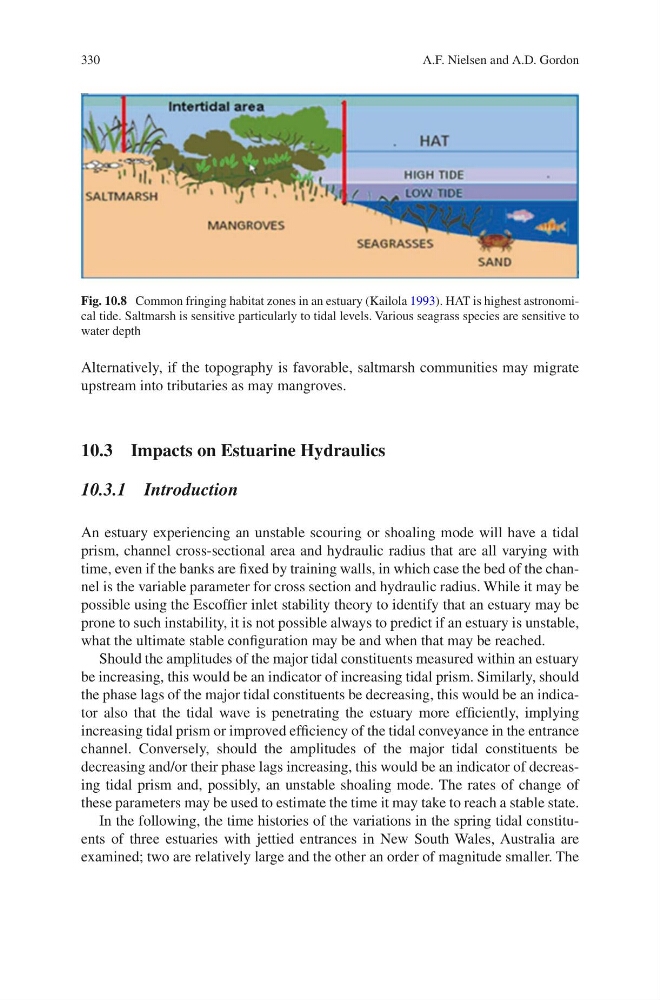
Fig. 10.8 Common fringing habitat zones in an estuary (Kailola 1993). HAT is highest astronomical tide. Saltmarsh is sensitive particularly to tidal levels. Various seagrass species are sensitive to
water depth
A.F. Nielsen and A.D. Gordon
Alternatively, if the topography is favorable, saltmarsh communities may migrate
upstream into tributaries as may mangroves.
10.3 Impacts on Estuarine Hydraulics
10.3.1 Introduction
An estuary experiencing an unstable scouring or shoaling mode will have a tidal
prism, channel cross-sectional area and hydraulic radius that are all varying with
time, even if the banks are fixed by training walls, in which case the bed of the channel is the variable parameter for cross section and hydraulic radius. While it may be
possible using the Escoffier inlet stability theory to identify that an estuary may be
prone to such instability, it is not possible always to predict if an estuary is unstable,
what the ultimate stable configuration may be and when that may be reached.
Should the amplitudes of the major tidal constituents measured within an estuary
be increasing, this would be an indicator of increasing tidal prism. Similarly, should
the phase lags of the major tidal constituents be decreasing, this would be an indicator also that the tidal wave is penetrating the estuary more efficiently, implying
increasing tidal prism or improved efficiency of the tidal conveyance in the entrance
channel. Conversely, should the amplitudes of the major tidal constituents be
decreasing and/or their phase lags increasing, this would be an indicator of decreasing tidal prism and, possibly, an unstable shoaling mode. The rates of change of
these parameters may be used to estimate the time it may take to reach a stable state.
In the following, the time histories of the variations in the spring tidal constituents of three estuaries with jettied entrances in New South Wales, Australia are
examined; two are relatively large and the other an order of magnitude smaller. The
Fig. 10.8 Common fringing habitat zones in an estuary (Kailola 1993). HAT is highest astronomical tide. Saltmarsh is sensitive particularly to tidal levels. Various seagrass species are sensitive to
water depth
A.F. Nielsen and A.D. Gordon