

323
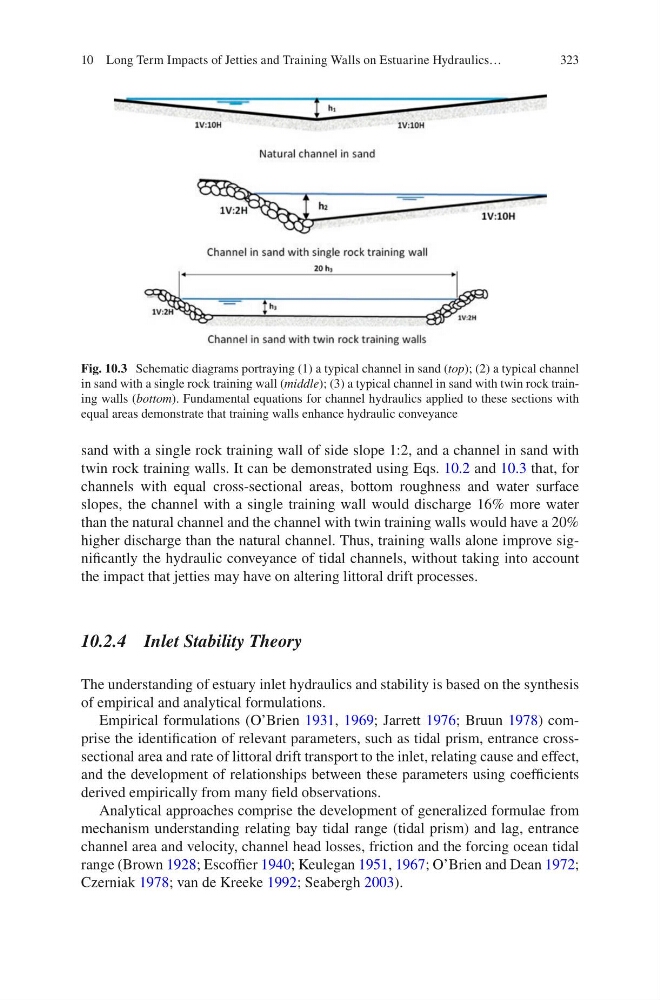
sand with a single rock training wall of side slope 1:2, and a channel in sand with
twin rock training walls. It can be demonstrated using Eqs. 10.2 and 10.3 that, for
channels with equal cross-sectional areas, bottom roughness and water surface
slopes, the channel with a single training wall would discharge 16% more water
than the natural channel and the channel with twin training walls would have a 20%
higher discharge than the natural channel. Thus, training walls alone improve significantly the hydraulic conveyance of tidal channels, without taking into account
the impact that jetties may have on altering littoral drift processes.
10.2.4 Inlet Stability Theory
The understanding of estuary inlet hydraulics and stability is based on the synthesis
of empirical and analytical formulations.
Empirical formulations (O’Brien 1931, 1969; Jarrett 1976; Bruun 1978) comprise the identification of relevant parameters, such as tidal prism, entrance crosssectional area and rate of littoral drift transport to the inlet, relating cause and effect,
and the development of relationships between these parameters using coefficients
derived empirically from many field observations.
Analytical approaches comprise the development of generalized formulae from
mechanism understanding relating bay tidal range (tidal prism) and lag, entrance
channel area and velocity, channel head losses, friction and the forcing ocean tidal
range (Brown 1928; Escoffier 1940; Keulegan 1951, 1967; O’Brien and Dean 1972;
Czerniak 1978; van de Kreeke 1992; Seabergh 2003).
Fig. 10.3 Schematic diagrams portraying (1) a typical channel in sand (top); (2) a typical channel
in sand with a single rock training wall (middle); (3) a typical channel in sand with twin rock training walls (bottom). Fundamental equations for channel hydraulics applied to these sections with
equal areas demonstrate that training walls enhance hydraulic conveyance
10 Long Term Impacts of Jetties and Training Walls on Estuarine Hydraulics…
sand with a single rock training wall of side slope 1:2, and a channel in sand with
twin rock training walls. It can be demonstrated using Eqs. 10.2 and 10.3 that, for
channels with equal cross-sectional areas, bottom roughness and water surface
slopes, the channel with a single training wall would discharge 16% more water
than the natural channel and the channel with twin training walls would have a 20%
higher discharge than the natural channel. Thus, training walls alone improve significantly the hydraulic conveyance of tidal channels, without taking into account
the impact that jetties may have on altering littoral drift processes.
10.2.4 Inlet Stability Theory
The understanding of estuary inlet hydraulics and stability is based on the synthesis
of empirical and analytical formulations.
Empirical formulations (O’Brien 1931, 1969; Jarrett 1976; Bruun 1978) comprise the identification of relevant parameters, such as tidal prism, entrance crosssectional area and rate of littoral drift transport to the inlet, relating cause and effect,
and the development of relationships between these parameters using coefficients
derived empirically from many field observations.
Analytical approaches comprise the development of generalized formulae from
mechanism understanding relating bay tidal range (tidal prism) and lag, entrance
channel area and velocity, channel head losses, friction and the forcing ocean tidal
range (Brown 1928; Escoffier 1940; Keulegan 1951, 1967; O’Brien and Dean 1972;
Czerniak 1978; van de Kreeke 1992; Seabergh 2003).
Fig. 10.3 Schematic diagrams portraying (1) a typical channel in sand (top); (2) a typical channel
in sand with a single rock training wall (middle); (3) a typical channel in sand with twin rock training walls (bottom). Fundamental equations for channel hydraulics applied to these sections with
equal areas demonstrate that training walls enhance hydraulic conveyance
10 Long Term Impacts of Jetties and Training Walls on Estuarine Hydraulics…