

324
10.2.4.1 Empirical Formulations
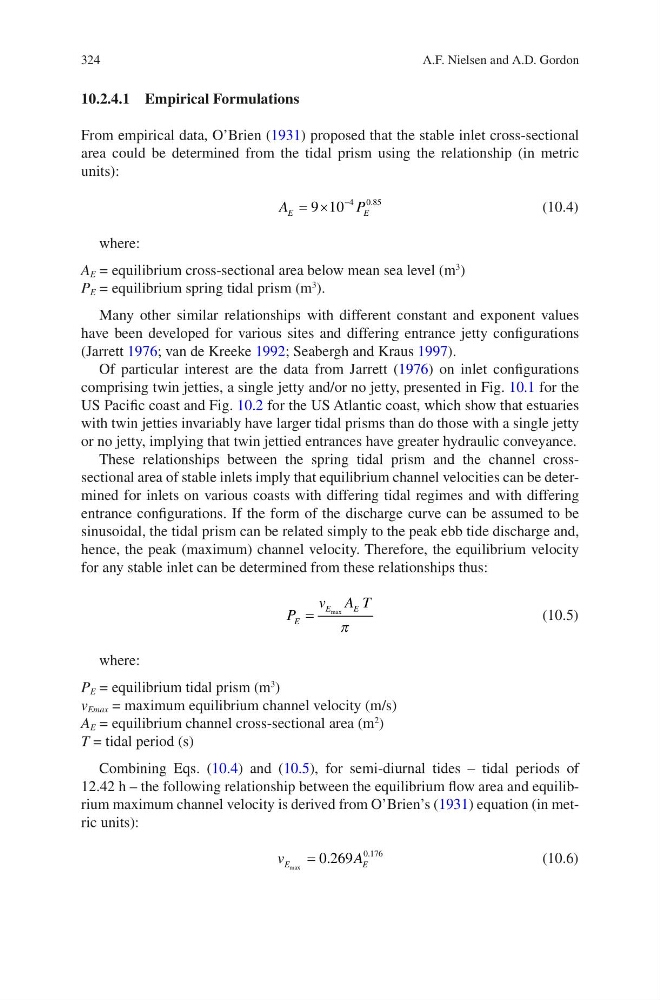
From empirical data, O’Brien (1931) proposed that the stable inlet cross-sectional
area could be determined from the tidal prism using the relationship (in metric
units):
A
P
E
E
= ×
−
9 10
4 085 .
(10.4)
where:
A E = equilibrium cross-sectional area below mean sea level (m
3
)
P E = equilibrium spring tidal prism (m
3
).
Many other similar relationships with different constant and exponent values
have been developed for various sites and differing entrance jetty configurations
(Jarrett 1976; van de Kreeke 1992; Seabergh and Kraus 1997).
Of particular interest are the data from Jarrett (1976) on inlet configurations
comprising twin jetties, a single jetty and/or no jetty, presented in Fig. 10.1 for the
US Pacific coast and Fig. 10.2 for the US Atlantic coast, which show that estuaries
with twin jetties invariably have larger tidal prisms than do those with a single jetty
or no jetty, implying that twin jettied entrances have greater hydraulic conveyance.
These relationships between the spring tidal prism and the channel crosssectional area of stable inlets imply that equilibrium channel velocities can be determined for inlets on various coasts with differing tidal regimes and with differing
entrance configurations. If the form of the discharge curve can be assumed to be
sinusoidal, the tidal prism can be related simply to the peak ebb tide discharge and,
hence, the peak (maximum) channel velocity. Therefore, the equilibrium velocity
for any stable inlet can be determined from these relationships thus:
P
v A T
E
E
E
=
max
π
(10.5)
where:
P E = equilibrium tidal prism (m
3
)
v Emax = maximum equilibrium channel velocity (m/s)
A E = equilibrium channel cross-sectional area (m
2
)
T = tidal period (s)
Combining Eqs. (10.4) and (10.5), for semi-diurnal tides – tidal periods of
12.42 h – the following relationship between the equilibrium flow area and equilibrium maximum channel velocity is derived from O’Brien’s (1931) equation (in metric units):
v
A
E
E
max
.
.
= 0 269
0 176
(10.6)
A.F. Nielsen and A.D. Gordon
10.2.4.1 Empirical Formulations
From empirical data, O’Brien (1931) proposed that the stable inlet cross-sectional
area could be determined from the tidal prism using the relationship (in metric
units):
A
P
E
E
= ×
−
9 10
4 085 .
(10.4)
where:
A E = equilibrium cross-sectional area below mean sea level (m
3
)
P E = equilibrium spring tidal prism (m
3
).
Many other similar relationships with different constant and exponent values
have been developed for various sites and differing entrance jetty configurations
(Jarrett 1976; van de Kreeke 1992; Seabergh and Kraus 1997).
Of particular interest are the data from Jarrett (1976) on inlet configurations
comprising twin jetties, a single jetty and/or no jetty, presented in Fig. 10.1 for the
US Pacific coast and Fig. 10.2 for the US Atlantic coast, which show that estuaries
with twin jetties invariably have larger tidal prisms than do those with a single jetty
or no jetty, implying that twin jettied entrances have greater hydraulic conveyance.
These relationships between the spring tidal prism and the channel crosssectional area of stable inlets imply that equilibrium channel velocities can be determined for inlets on various coasts with differing tidal regimes and with differing
entrance configurations. If the form of the discharge curve can be assumed to be
sinusoidal, the tidal prism can be related simply to the peak ebb tide discharge and,
hence, the peak (maximum) channel velocity. Therefore, the equilibrium velocity
for any stable inlet can be determined from these relationships thus:
P
v A T
E
E
E
=
max
π
(10.5)
where:
P E = equilibrium tidal prism (m
3
)
v Emax = maximum equilibrium channel velocity (m/s)
A E = equilibrium channel cross-sectional area (m
2
)
T = tidal period (s)
Combining Eqs. (10.4) and (10.5), for semi-diurnal tides – tidal periods of
12.42 h – the following relationship between the equilibrium flow area and equilibrium maximum channel velocity is derived from O’Brien’s (1931) equation (in metric units):
v
A
E
E
max
.
.
= 0 269
0 176
(10.6)
A.F. Nielsen and A.D. Gordon