

322
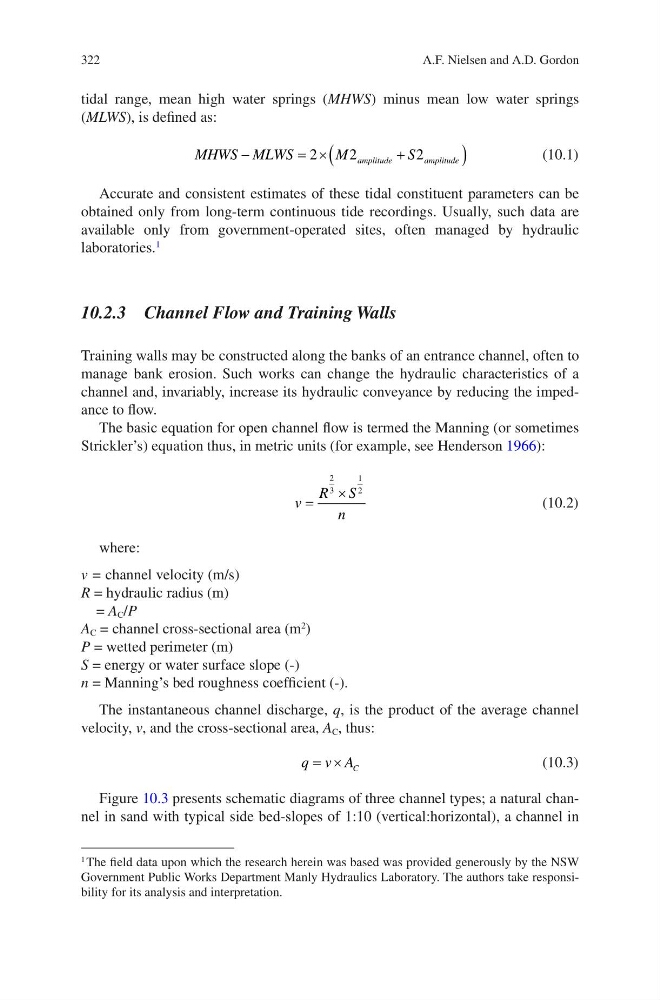
tidal range, mean high water springs (MHWS) minus mean low water springs
(MLWS), is defined as:
MHWS MLWS
M
S
amplitude
amplitude
−
= ×
+
(
)
2
2
2
(10.1)
Accurate and consistent estimates of these tidal constituent parameters can be
obtained only from long-term continuous tide recordings. Usually, such data are
available only from government-operated sites, often managed by hydraulic
laboratories.
1
10.2.3 Channel Flow and Training Walls
Training walls may be constructed along the banks of an entrance channel, often to
manage bank erosion. Such works can change the hydraulic characteristics of a
channel and, invariably, increase its hydraulic conveyance by reducing the impedance to flow.
The basic equation for open channel flow is termed the Manning (or sometimes
Strickler’s) equation thus, in metric units (for example, see Henderson 1966):
v
R S
n
=
×
2
3
1
2
(10.2)
where:
v = channel velocity (m/s)
R = hydraulic radius (m)
= A C /P
A C = channel cross-sectional area (m
2
)
P = wetted perimeter (m)
S = energy or water surface slope (-)
n = Manning’s bed roughness coefficient (-).
The instantaneous channel discharge, q, is the product of the average channel
velocity, v, and the cross-sectional area, A C , thus:
q v A C
= ×
(10.3)
Figure 10.3 presents schematic diagrams of three channel types; a natural channel in sand with typical side bed-slopes of 1:10 (vertical:horizontal), a channel in
1 The field data upon which the research herein was based was provided generously by the NSW
Government Public Works Department Manly Hydraulics Laboratory. The authors take responsibility for its analysis and interpretation.
A.F. Nielsen and A.D. Gordon
tidal range, mean high water springs (MHWS) minus mean low water springs
(MLWS), is defined as:
MHWS MLWS
M
S
amplitude
amplitude
−
= ×
+
(
)
2
2
2
(10.1)
Accurate and consistent estimates of these tidal constituent parameters can be
obtained only from long-term continuous tide recordings. Usually, such data are
available only from government-operated sites, often managed by hydraulic
laboratories.
1
10.2.3 Channel Flow and Training Walls
Training walls may be constructed along the banks of an entrance channel, often to
manage bank erosion. Such works can change the hydraulic characteristics of a
channel and, invariably, increase its hydraulic conveyance by reducing the impedance to flow.
The basic equation for open channel flow is termed the Manning (or sometimes
Strickler’s) equation thus, in metric units (for example, see Henderson 1966):
v
R S
n
=
×
2
3
1
2
(10.2)
where:
v = channel velocity (m/s)
R = hydraulic radius (m)
= A C /P
A C = channel cross-sectional area (m
2
)
P = wetted perimeter (m)
S = energy or water surface slope (-)
n = Manning’s bed roughness coefficient (-).
The instantaneous channel discharge, q, is the product of the average channel
velocity, v, and the cross-sectional area, A C , thus:
q v A C
= ×
(10.3)
Figure 10.3 presents schematic diagrams of three channel types; a natural channel in sand with typical side bed-slopes of 1:10 (vertical:horizontal), a channel in
1 The field data upon which the research herein was based was provided generously by the NSW
Government Public Works Department Manly Hydraulics Laboratory. The authors take responsibility for its analysis and interpretation.
A.F. Nielsen and A.D. Gordon