

321
10.2.2 Tidal Constituents
The tidal signature in a waterway is a characteristic, sinusoidal oscillation comprising either two main cycles per day (semi-diurnal tides), one cycle per day (diurnal
tides), or a combination of the two (mixed tides).
The underlying principle of tidal analysis is that a time series of tidal oscillations
can be deconstructed into a series of regular sinusoids, usually represented by the
cosine function, each having the period of oscillation of the celestial forcing that
gives rise to it. The tidal harmonic constants comprise the amplitude and phase of
the individual cosine waves, each of which represents a tidal constituent identified
by its period.
While there may be scores of tidal constituents computed for a tidal harmonic
analysis, the following are the major contributors to the astronomical tidal stage
variation:
M2 − principal lunar semi-diurnal constituent
S2 – principal solar semi-diurnal constituent
K1 − luni-solar declinational diurnal constituent
O1 − lunar declinational diurnal constituent.
Empirical and analytical formulations for estuary hydraulic analyses rely on
good estimates of the estuary’s tidal planes, either to determine accurately the spring
tidal prism or to determine accurately the bay-to-ocean tidal range ratio. The spring
0.0E+00
1.0E+08
2.0E+08
3.0E+08
4.0E+08
5.0E+08
6.0E+08
7.0E+08
8.0E+08
9.0E+08
1.0E+09
0
10,000
20,000
30,000
40,000
50,000
Tidal Prism (m 3
)
Equilibrium Cross-secƟonal Area (m 2 )
Unjettied, One Jetty
Twin Jetties
A E =1.584 x10
-4
P E
0.95
P E =10,010xA E
1.05
A E =2.261x10
-5
P E
1.07
P E =21,970xA E
0.93
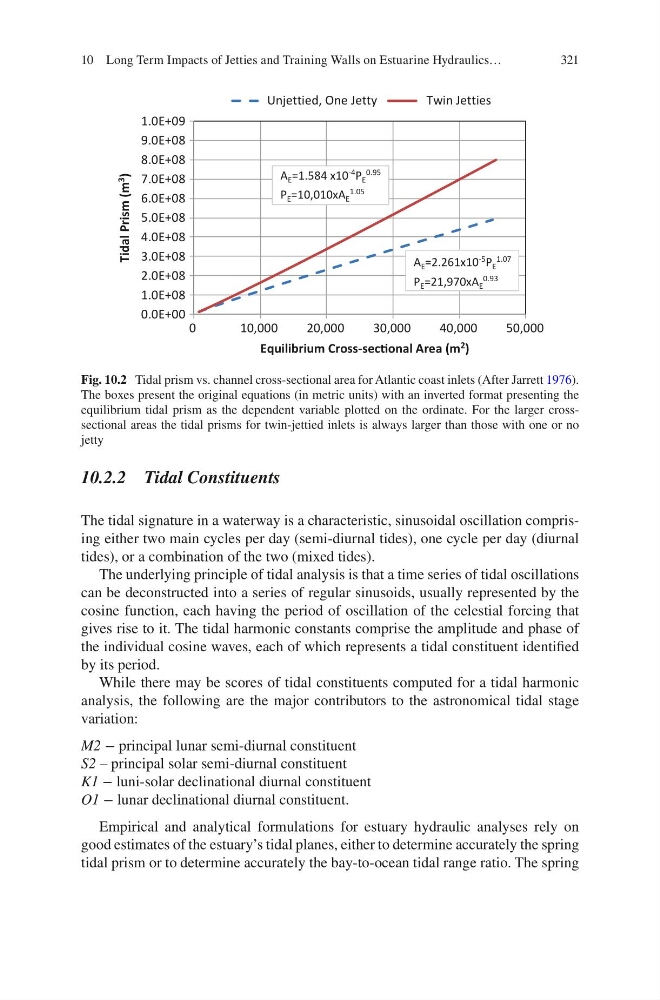
Fig. 10.2 Tidal prism vs. channel cross-sectional area for Atlantic coast inlets (After Jarrett 1976).
The boxes present the original equations (in metric units) with an inverted format presenting the
equilibrium tidal prism as the dependent variable plotted on the ordinate. For the larger crosssectional areas the tidal prisms for twin-jettied inlets is always larger than those with one or no
jetty
10 Long Term Impacts of Jetties and Training Walls on Estuarine Hydraulics…
10.2.2 Tidal Constituents
The tidal signature in a waterway is a characteristic, sinusoidal oscillation comprising either two main cycles per day (semi-diurnal tides), one cycle per day (diurnal
tides), or a combination of the two (mixed tides).
The underlying principle of tidal analysis is that a time series of tidal oscillations
can be deconstructed into a series of regular sinusoids, usually represented by the
cosine function, each having the period of oscillation of the celestial forcing that
gives rise to it. The tidal harmonic constants comprise the amplitude and phase of
the individual cosine waves, each of which represents a tidal constituent identified
by its period.
While there may be scores of tidal constituents computed for a tidal harmonic
analysis, the following are the major contributors to the astronomical tidal stage
variation:
M2 − principal lunar semi-diurnal constituent
S2 – principal solar semi-diurnal constituent
K1 − luni-solar declinational diurnal constituent
O1 − lunar declinational diurnal constituent.
Empirical and analytical formulations for estuary hydraulic analyses rely on
good estimates of the estuary’s tidal planes, either to determine accurately the spring
tidal prism or to determine accurately the bay-to-ocean tidal range ratio. The spring
0.0E+00
1.0E+08
2.0E+08
3.0E+08
4.0E+08
5.0E+08
6.0E+08
7.0E+08
8.0E+08
9.0E+08
1.0E+09
0
10,000
20,000
30,000
40,000
50,000
Tidal Prism (m 3
)
Equilibrium Cross-secƟonal Area (m 2 )
Unjettied, One Jetty
Twin Jetties
A E =1.584 x10
-4
P E
0.95
P E =10,010xA E
1.05
A E =2.261x10
-5
P E
1.07
P E =21,970xA E
0.93
Fig. 10.2 Tidal prism vs. channel cross-sectional area for Atlantic coast inlets (After Jarrett 1976).
The boxes present the original equations (in metric units) with an inverted format presenting the
equilibrium tidal prism as the dependent variable plotted on the ordinate. For the larger crosssectional areas the tidal prisms for twin-jettied inlets is always larger than those with one or no
jetty
10 Long Term Impacts of Jetties and Training Walls on Estuarine Hydraulics…