

320
modest impact on improving the overall hydraulic efficiency of an entrance. This is
because a component of the gross littoral drift can enter the entrance channel from
the unprotected side. However, twin jetties that intersect the surf-zone increase the
hydraulic conveyance significantly. Such differences are found also on both the
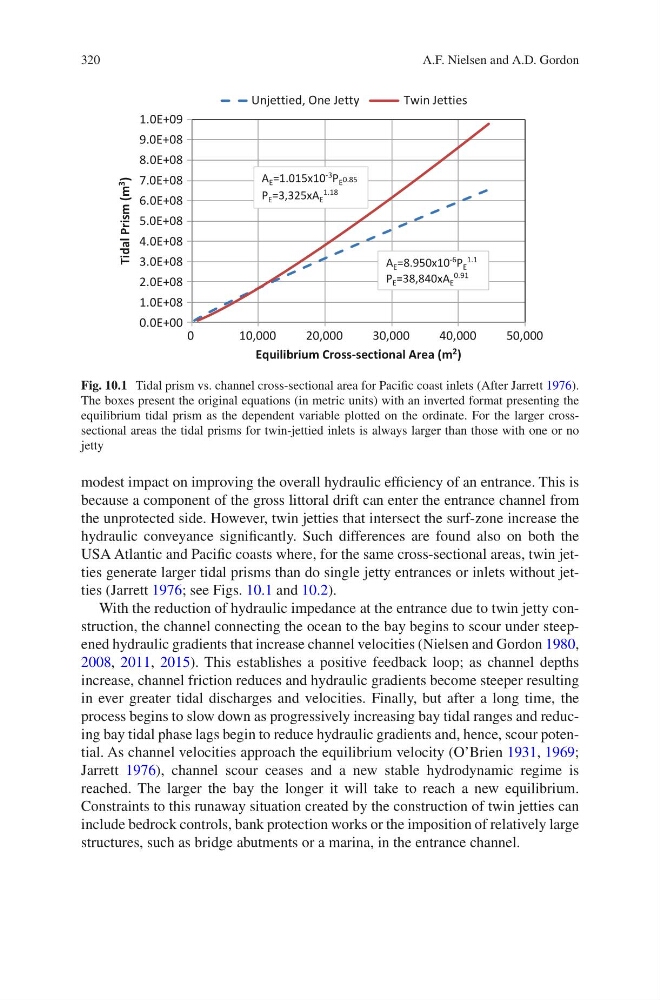
USA Atlantic and Pacific coasts where, for the same cross-sectional areas, twin jetties generate larger tidal prisms than do single jetty entrances or inlets without jetties (Jarrett 1976; see Figs. 10.1 and 10.2).
With the reduction of hydraulic impedance at the entrance due to twin jetty construction, the channel connecting the ocean to the bay begins to scour under steepened hydraulic gradients that increase channel velocities (Nielsen and Gordon 1980,
2008, 2011, 2015). This establishes a positive feedback loop; as channel depths
increase, channel friction reduces and hydraulic gradients become steeper resulting
in ever greater tidal discharges and velocities. Finally, but after a long time, the
process begins to slow down as progressively increasing bay tidal ranges and reducing bay tidal phase lags begin to reduce hydraulic gradients and, hence, scour potential. As channel velocities approach the equilibrium velocity (O’Brien 1931, 1969;
Jarrett 1976), channel scour ceases and a new stable hydrodynamic regime is
reached. The larger the bay the longer it will take to reach a new equilibrium.
Constraints to this runaway situation created by the construction of twin jetties can
include bedrock controls, bank protection works or the imposition of relatively large
structures, such as bridge abutments or a marina, in the entrance channel.
0.0E+00
1.0E+08
2.0E+08
3.0E+08
4.0E+08
5.0E+08
6.0E+08
7.0E+08
8.0E+08
9.0E+08
1.0E+09
0
10,000
20,000
30,000
40,000
50,000
Tidal Prism (m 3
)
Equilibrium Cross-sect¶onal Area (m 2 )
Unjettied, One Jetty
Twin Jetties
A E =1.015x10
-3
P E 0.85
P E =3,325xA E
1.18
A E =8.950x10
-6
P E
1.1
P E =38,840xA E
0.91
Fig. 10.1 Tidal prism vs. channel cross-sectional area for Pacific coast inlets (After Jarrett 1976).
The boxes present the original equations (in metric units) with an inverted format presenting the
equilibrium tidal prism as the dependent variable plotted on the ordinate. For the larger crosssectional areas the tidal prisms for twin-jettied inlets is always larger than those with one or no
jetty
A.F. Nielsen and A.D. Gordon
modest impact on improving the overall hydraulic efficiency of an entrance. This is
because a component of the gross littoral drift can enter the entrance channel from
the unprotected side. However, twin jetties that intersect the surf-zone increase the
hydraulic conveyance significantly. Such differences are found also on both the
USA Atlantic and Pacific coasts where, for the same cross-sectional areas, twin jetties generate larger tidal prisms than do single jetty entrances or inlets without jetties (Jarrett 1976; see Figs. 10.1 and 10.2).
With the reduction of hydraulic impedance at the entrance due to twin jetty construction, the channel connecting the ocean to the bay begins to scour under steepened hydraulic gradients that increase channel velocities (Nielsen and Gordon 1980,
2008, 2011, 2015). This establishes a positive feedback loop; as channel depths
increase, channel friction reduces and hydraulic gradients become steeper resulting
in ever greater tidal discharges and velocities. Finally, but after a long time, the
process begins to slow down as progressively increasing bay tidal ranges and reducing bay tidal phase lags begin to reduce hydraulic gradients and, hence, scour potential. As channel velocities approach the equilibrium velocity (O’Brien 1931, 1969;
Jarrett 1976), channel scour ceases and a new stable hydrodynamic regime is
reached. The larger the bay the longer it will take to reach a new equilibrium.
Constraints to this runaway situation created by the construction of twin jetties can
include bedrock controls, bank protection works or the imposition of relatively large
structures, such as bridge abutments or a marina, in the entrance channel.
0.0E+00
1.0E+08
2.0E+08
3.0E+08
4.0E+08
5.0E+08
6.0E+08
7.0E+08
8.0E+08
9.0E+08
1.0E+09
0
10,000
20,000
30,000
40,000
50,000
Tidal Prism (m 3
)
Equilibrium Cross-sect¶onal Area (m 2 )
Unjettied, One Jetty
Twin Jetties
A E =1.015x10
-3
P E 0.85
P E =3,325xA E
1.18
A E =8.950x10
-6
P E
1.1
P E =38,840xA E
0.91
Fig. 10.1 Tidal prism vs. channel cross-sectional area for Pacific coast inlets (After Jarrett 1976).
The boxes present the original equations (in metric units) with an inverted format presenting the
equilibrium tidal prism as the dependent variable plotted on the ordinate. For the larger crosssectional areas the tidal prisms for twin-jettied inlets is always larger than those with one or no
jetty
A.F. Nielsen and A.D. Gordon