

309
condition of proportionality between the sediment, the profile and the wave that
travel to the coast.
In accordance with Hsu and Evans (1989), a beach has two types of equilibrium
condition: static and dynamic. The dynamic equilibrium exists naturally when the
beach has a continuous supply of sediment that induces a change in the width of
recurring beach. Physically, this represents a coastline that follows a logarithmic
profile, with a fixed point on a border where begin a curved section to the end section that is parallel to the coastline. It can underline with precision that the shape of
a beach in plant, is a measure of how the currents transport the material.
The types of beaches, such as the found in the Mallorquín Lagoon, have been
formed by the morphological evolution resulting from the action of waves and erosion processes over decades, obtaining progressively the shape presented today.
This document attempts to reach a level of understanding of how evolved the beach
front that protects this coastal wetland and attempt to infer the processes of change
and loss of stability that can be achieved by establishing new physical elements in
the littoral system.
9.5.8 Model of Parabolic Curve
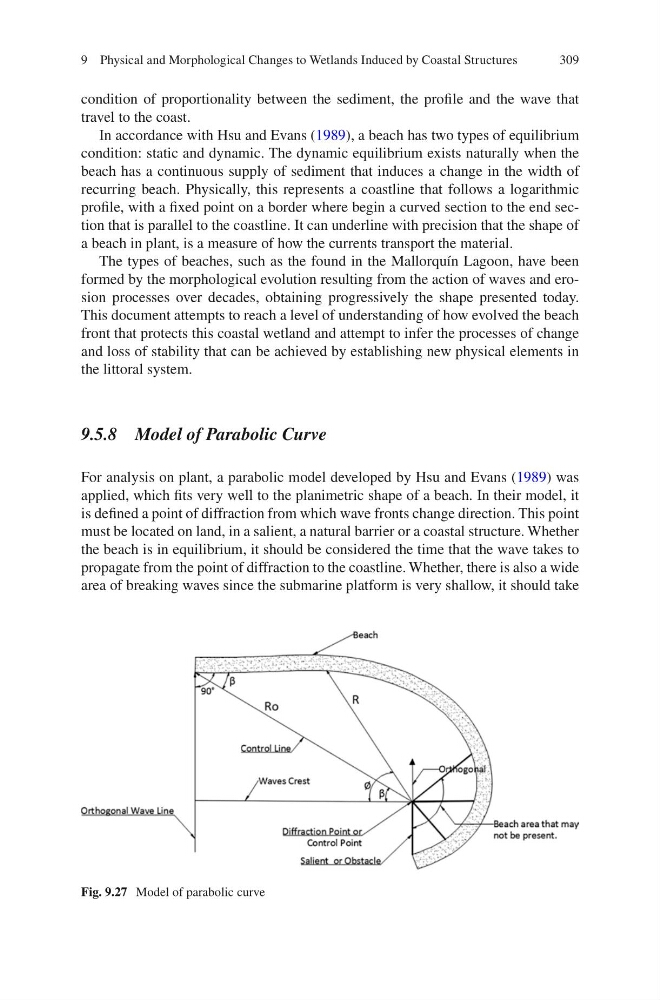
For analysis on plant, a parabolic model developed by Hsu and Evans (1989) was
applied, which fits very well to the planimetric shape of a beach. In their model, it
is defined a point of diffraction from which wave fronts change direction. This point
must be located on land, in a salient, a natural barrier or a coastal structure. Whether
the beach is in equilibrium, it should be considered the time that the wave takes to
propagate from the point of diffraction to the coastline. Whether, there is also a wide
area of breaking waves since the submarine platform is very shallow, it should take
Fig. 9.27 Model of parabolic curve
9 Physical and Morphological Changes to Wetlands Induced by Coastal Structures
condition of proportionality between the sediment, the profile and the wave that
travel to the coast.
In accordance with Hsu and Evans (1989), a beach has two types of equilibrium
condition: static and dynamic. The dynamic equilibrium exists naturally when the
beach has a continuous supply of sediment that induces a change in the width of
recurring beach. Physically, this represents a coastline that follows a logarithmic
profile, with a fixed point on a border where begin a curved section to the end section that is parallel to the coastline. It can underline with precision that the shape of
a beach in plant, is a measure of how the currents transport the material.
The types of beaches, such as the found in the Mallorquín Lagoon, have been
formed by the morphological evolution resulting from the action of waves and erosion processes over decades, obtaining progressively the shape presented today.
This document attempts to reach a level of understanding of how evolved the beach
front that protects this coastal wetland and attempt to infer the processes of change
and loss of stability that can be achieved by establishing new physical elements in
the littoral system.
9.5.8 Model of Parabolic Curve
For analysis on plant, a parabolic model developed by Hsu and Evans (1989) was
applied, which fits very well to the planimetric shape of a beach. In their model, it
is defined a point of diffraction from which wave fronts change direction. This point
must be located on land, in a salient, a natural barrier or a coastal structure. Whether
the beach is in equilibrium, it should be considered the time that the wave takes to
propagate from the point of diffraction to the coastline. Whether, there is also a wide
area of breaking waves since the submarine platform is very shallow, it should take
Fig. 9.27 Model of parabolic curve
9 Physical and Morphological Changes to Wetlands Induced by Coastal Structures