

310
into account the propagated wave refraction (Fig. 9.27). The general expression
describing the parabolic model is:
R
R
C C
C
o
o
= +
æ
è
ç
ö
ø
÷ +
æ
è
ç
ö
ø
÷
1
2
2
b
q
b
q
(9.14)
C o =
-
+
-
+
0 0707 0 0047
0 000349
0 00000875
0 00000004765
2
3
4
.
.
.
.
.
b
b
b
b
C 1
2
3
4
0 9536 0 0078
0 0004879
0 0000182
0 0000001281
=
-
+
-
+
.
.
.
.
.
b
b
b
b
C 3
2
3
4
0 0214 0 0078
0 0003004
0 00001183
0 00000009343
=
-
+
-
+
.
.
.
.
.
b
b
b
b
Where C 0 , C 1 , C 2 C o , C 1 y C 2 are dimensionless coefficients that vary with β. β
is the angle between the control line and the tangent point where the coastline
becomes straight. This angle, generally, is between the ranges from the 10° to the
80°, because it covers most of obliquities with the waves arrives recurrently to
salient beaches R is the radius from the diffraction point to the coastline which has
an angle θ with respect to the wave front. R o that starts in the salient to the point
where the coastline becomes straight.
It is important to note that if the modelling line is adjusted to the actual coastline,
the physical meaning of this result indicates that the beach is in static equilibrium.
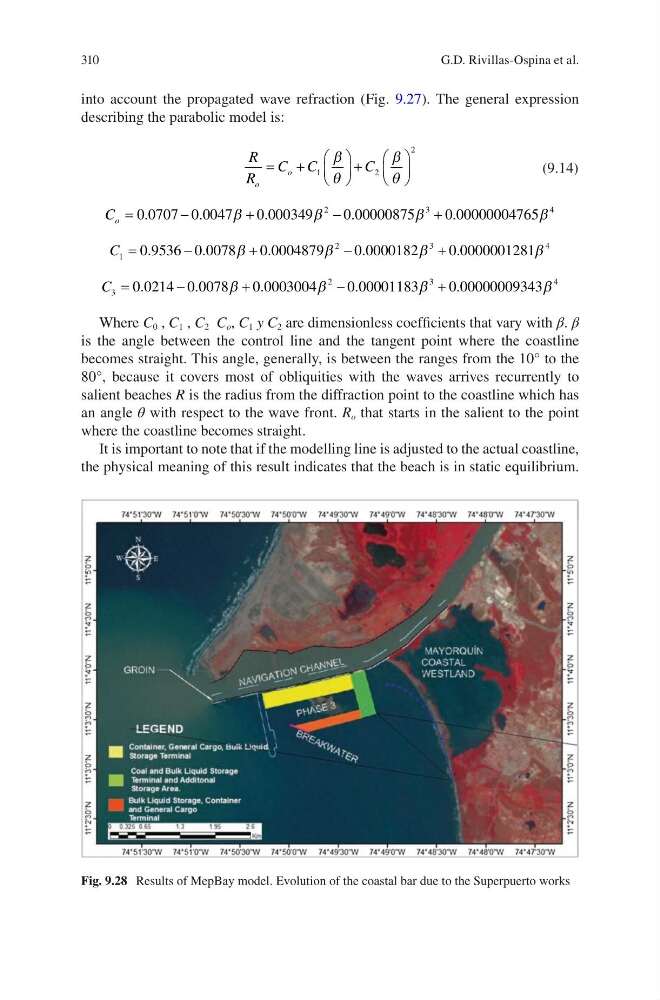
Fig. 9.28 Results of MepBay model. Evolution of the coastal bar due to the Superpuerto works
G.D. Rivillas-Ospina et al.
into account the propagated wave refraction (Fig. 9.27). The general expression
describing the parabolic model is:
R
R
C C
C
o
o
= +
æ
è
ç
ö
ø
÷ +
æ
è
ç
ö
ø
÷
1
2
2
b
q
b
q
(9.14)
C o =
-
+
-
+
0 0707 0 0047
0 000349
0 00000875
0 00000004765
2
3
4
.
.
.
.
.
b
b
b
b
C 1
2
3
4
0 9536 0 0078
0 0004879
0 0000182
0 0000001281
=
-
+
-
+
.
.
.
.
.
b
b
b
b
C 3
2
3
4
0 0214 0 0078
0 0003004
0 00001183
0 00000009343
=
-
+
-
+
.
.
.
.
.
b
b
b
b
Where C 0 , C 1 , C 2 C o , C 1 y C 2 are dimensionless coefficients that vary with β. β
is the angle between the control line and the tangent point where the coastline
becomes straight. This angle, generally, is between the ranges from the 10° to the
80°, because it covers most of obliquities with the waves arrives recurrently to
salient beaches R is the radius from the diffraction point to the coastline which has
an angle θ with respect to the wave front. R o that starts in the salient to the point
where the coastline becomes straight.
It is important to note that if the modelling line is adjusted to the actual coastline,
the physical meaning of this result indicates that the beach is in static equilibrium.
Fig. 9.28 Results of MepBay model. Evolution of the coastal bar due to the Superpuerto works
G.D. Rivillas-Ospina et al.