

299


+


+


+


=


+
æ
è
ç
ö
ø
÷


é
ë
ê
ê
ù
û
ú
ú
+ +
e
e
e
e
s
e
e
e
t
u x
v y
w z
z
z
v
v
P
mol
D
3
B B e
e
e
-
(9.13)
Where Prandtl-Schmidt numbers are σ k = 1 and σ ε = 1.3, P k represents the production of turbulent kinetic energy in cutting flows, ε is the dissipation by turbulent
energy (m
2
/s
3
) and it is the kinetic energy (m
2
/s
2
). The flow of thrust reversal B k
represent the transformation from kinetic to potential energy, and it is associated
with the dissipation of energy and the edge flow respectively.
9.5.2.1 Meshes Deneration; Initial and Boundary Conditions
The numerical model Delf3D permits to use structured, flexible and unstructured
meshes. For this case, it was used flexible structured meshes for the Flow module,
and curvilinear grid for the Wave module considering a general area for the
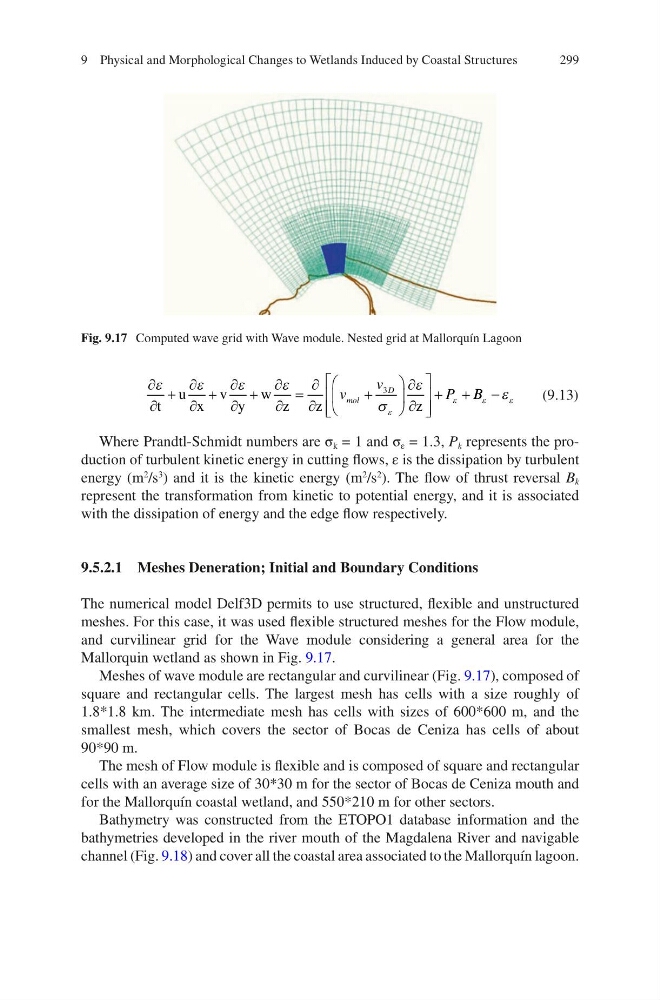
Mallorquin wetland as shown in Fig. 9.17.
Meshes of wave module are rectangular and curvilinear (Fig. 9.17), composed of
square and rectangular cells. The largest mesh has cells with a size roughly of
1.8*1.8 km. The intermediate mesh has cells with sizes of 600*600 m, and the
smallest mesh, which covers the sector of Bocas de Ceniza has cells of about
90*90 m.
The mesh of Flow module is flexible and is composed of square and rectangular
cells with an average size of 30*30 m for the sector of Bocas de Ceniza mouth and
for the Mallorquín coastal wetland, and 550*210 m for other sectors.
Bathymetry was constructed from the ETOPO1 database information and the
bathymetries developed in the river mouth of the Magdalena River and navigable
channel (Fig. 9.18) and cover all the coastal area associated to the Mallorquín lagoon.
Fig. 9.17 Computed wave grid with Wave module. Nested grid at Mallorquín Lagoon
9 Physical and Morphological Changes to Wetlands Induced by Coastal Structures


+


+


+


=


+
æ
è
ç
ö
ø
÷


é
ë
ê
ê
ù
û
ú
ú
+ +
e
e
e
e
s
e
e
e
t
u x
v y
w z
z
z
v
v
P
mol
D
3
B B e
e
e
-
(9.13)
Where Prandtl-Schmidt numbers are σ k = 1 and σ ε = 1.3, P k represents the production of turbulent kinetic energy in cutting flows, ε is the dissipation by turbulent
energy (m
2
/s
3
) and it is the kinetic energy (m
2
/s
2
). The flow of thrust reversal B k
represent the transformation from kinetic to potential energy, and it is associated
with the dissipation of energy and the edge flow respectively.
9.5.2.1 Meshes Deneration; Initial and Boundary Conditions
The numerical model Delf3D permits to use structured, flexible and unstructured
meshes. For this case, it was used flexible structured meshes for the Flow module,
and curvilinear grid for the Wave module considering a general area for the
Mallorquin wetland as shown in Fig. 9.17.
Meshes of wave module are rectangular and curvilinear (Fig. 9.17), composed of
square and rectangular cells. The largest mesh has cells with a size roughly of
1.8*1.8 km. The intermediate mesh has cells with sizes of 600*600 m, and the
smallest mesh, which covers the sector of Bocas de Ceniza has cells of about
90*90 m.
The mesh of Flow module is flexible and is composed of square and rectangular
cells with an average size of 30*30 m for the sector of Bocas de Ceniza mouth and
for the Mallorquín coastal wetland, and 550*210 m for other sectors.
Bathymetry was constructed from the ETOPO1 database information and the
bathymetries developed in the river mouth of the Magdalena River and navigable
channel (Fig. 9.18) and cover all the coastal area associated to the Mallorquín lagoon.
Fig. 9.17 Computed wave grid with Wave module. Nested grid at Mallorquín Lagoon
9 Physical and Morphological Changes to Wetlands Induced by Coastal Structures