

298


=


+


+

N
t
c N , ; , ,
x
c N , ; , ,
y
c
, ; , ,
g x
g y
(
)
,
,
(
)
(
)
s q
s q
s q
x y t
x y t
x y t
g g
g
, ; , , t
N , ; , ,
c N , ; , ,
S
,
,
(
)
(
)
(
)
q
s
s q
s q
q
s q
s
s
x y t
x y t
x y t

+


=
(9.8)
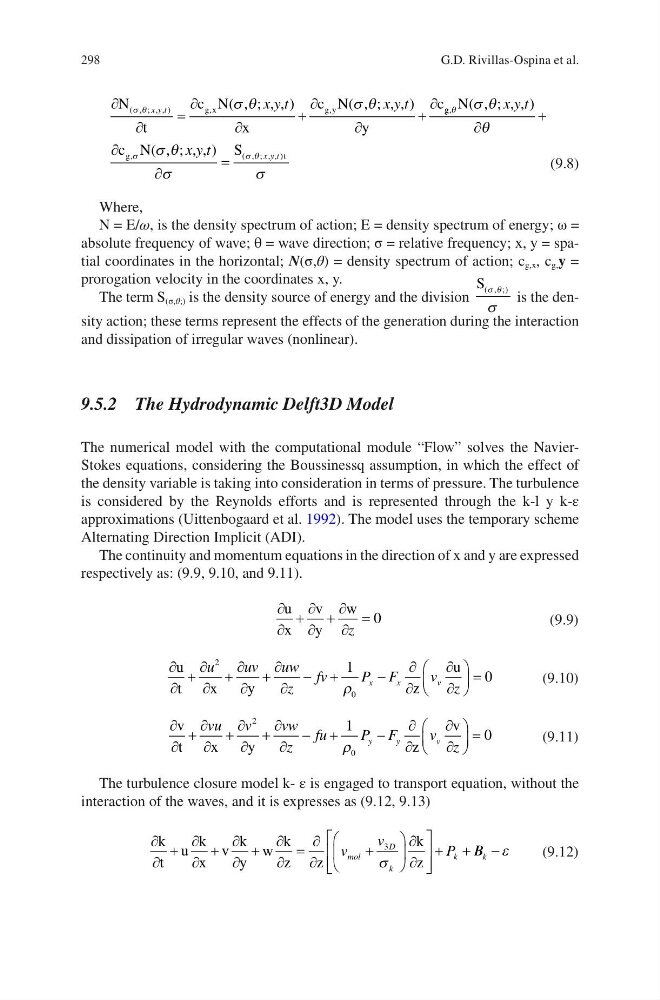
Where,
N = E/ω, is the density spectrum of action; E = density spectrum of energy; ω =
absolute frequency of wave; θ = wave direction; σ = relative frequency; x, y = spatial coordinates in the horizontal; N(σ,θ) = density spectrum of action; c g,x , c g, y =
prorogation velocity in the coordinates x, y.
The term S (σ,θ;) is the density source of energy and the division
S , ;
(
)
s q
s
is the density action; these terms represent the effects of the generation during the interaction
and dissipation of irregular waves (nonlinear).
9.5.2 The Hydrodynamic Delft3D Model
The numerical model with the computational module “Flow” solves the NavierStokes equations, considering the Boussinessq assumption, in which the effect of
the density variable is taking into consideration in terms of pressure. The turbulence
is considered by the Reynolds efforts and is represented through the k-l y k-ε
approximations (Uittenbogaard et al. 1992). The model uses the temporary scheme
Alternating Direction Implicit (ADI).
The continuity and momentum equations in the direction of x and y are expressed
respectively as: (9.9, 9.10, and 9.11).


+


+


=
u
x
v
y
w
z
0
(9.9)


+


+


+


- +
-


æ
è
ç
ö
ø
÷ =
u
t
x
y
z
u
u
uv
uw
z
fv
P F
v z
x
x
v
2
0
1
0
r
(9.10)


+


+


+


- +
-


æ
è
ç
ö
ø
÷ =
v
t
x
y
z
v
vu
v
vw
z
fu
P F
v z
y
y
v
2
0
1
0
r
(9.11)
The turbulence closure model k- ε is engaged to transport equation, without the
interaction of the waves, and it is expresses as (9.12, 9.13)


+


+


+


=


+
æ
è
ç
ö
ø
÷


é
ë
ê
ê
ù
û
ú
ú
+ +
k
t
u
k
x
v
k
y
w
k
z
z
k
z
v
v
P
mol
D
k
k
3
s
B B k - e
(9.12)
G.D. Rivillas-Ospina et al.


=


+


+

N
t
c N , ; , ,
x
c N , ; , ,
y
c
, ; , ,
g x
g y
(
)
,
,
(
)
(
)
s q
s q
s q
x y t
x y t
x y t
g g
g
, ; , , t
N , ; , ,
c N , ; , ,
S
,
,
(
)
(
)
(
)
q
s
s q
s q
q
s q
s
s
x y t
x y t
x y t

+


=
(9.8)
Where,
N = E/ω, is the density spectrum of action; E = density spectrum of energy; ω =
absolute frequency of wave; θ = wave direction; σ = relative frequency; x, y = spatial coordinates in the horizontal; N(σ,θ) = density spectrum of action; c g,x , c g, y =
prorogation velocity in the coordinates x, y.
The term S (σ,θ;) is the density source of energy and the division
S , ;
(
)
s q
s
is the density action; these terms represent the effects of the generation during the interaction
and dissipation of irregular waves (nonlinear).
9.5.2 The Hydrodynamic Delft3D Model
The numerical model with the computational module “Flow” solves the NavierStokes equations, considering the Boussinessq assumption, in which the effect of
the density variable is taking into consideration in terms of pressure. The turbulence
is considered by the Reynolds efforts and is represented through the k-l y k-ε
approximations (Uittenbogaard et al. 1992). The model uses the temporary scheme
Alternating Direction Implicit (ADI).
The continuity and momentum equations in the direction of x and y are expressed
respectively as: (9.9, 9.10, and 9.11).


+


+


=
u
x
v
y
w
z
0
(9.9)


+


+


+


- +
-


æ
è
ç
ö
ø
÷ =
u
t
x
y
z
u
u
uv
uw
z
fv
P F
v z
x
x
v
2
0
1
0
r
(9.10)


+


+


+


- +
-


æ
è
ç
ö
ø
÷ =
v
t
x
y
z
v
vu
v
vw
z
fu
P F
v z
y
y
v
2
0
1
0
r
(9.11)
The turbulence closure model k- ε is engaged to transport equation, without the
interaction of the waves, and it is expresses as (9.12, 9.13)


+


+


+


=


+
æ
è
ç
ö
ø
÷


é
ë
ê
ê
ù
û
ú
ú
+ +
k
t
u
k
x
v
k
y
w
k
z
z
k
z
v
v
P
mol
D
k
k
3
s
B B k - e
(9.12)
G.D. Rivillas-Ospina et al.