

297
9.4.3.1 The Harmonic Analysis of Astronomic Tide
The tide description and prediction is realized by the tide harmonic analysis which
consists in decomposing the registers of sea level in a finite number of waves whose
period and phase has been perfectly established, coinciding with periods of some
astronomic movements related to the Earth, the Moon and the Sun, as it was
described previously.
The method of harmonic analysis consists in obtaining from an hourly register
all data of sea level, the amplitudes and phases of component waves. These parameters are known as harmonic components, due to the assumption where is considered that the responses of seas and oceans to the tidal forces do not change in time
(Dronkers and Schonfeld 1959).
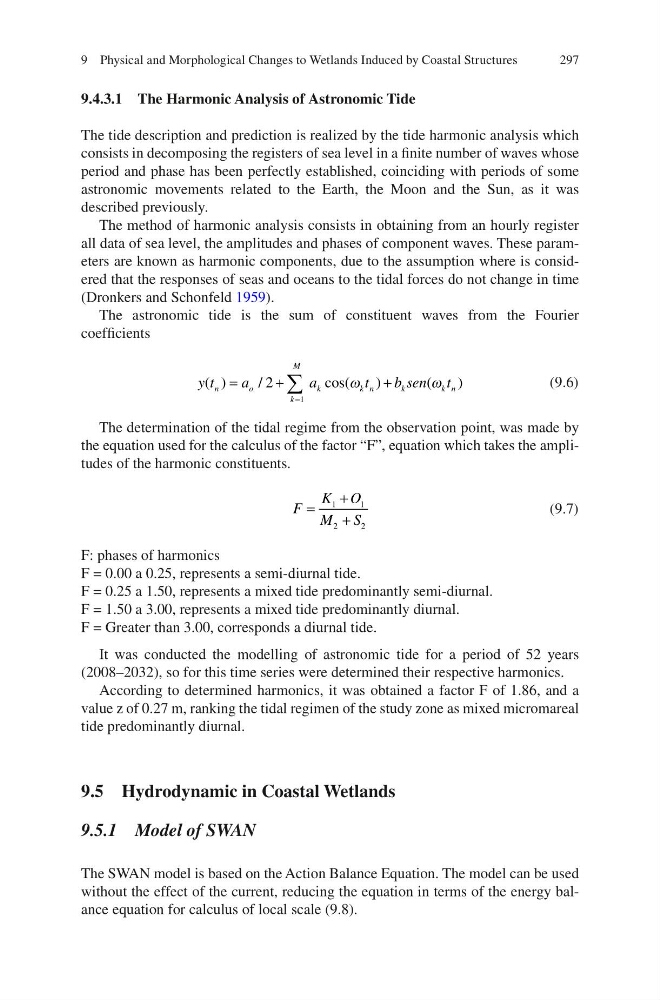
The astronomic tide is the sum of constituent waves from the Fourier
coefficients
y t
a
a
t
b sen t
n
o
k
M
k
kn
k
k n
( )
/
c os(
)
(
)
=
+
+
å
=
2
1
w
w
(9.6)
The determination of the tidal regime from the observation point, was made by
the equation used for the calculus of the factor “F”, equation which takes the amplitudes of the harmonic constituents.
F
K O
M S
=
+
+
1
1
2
2
(9.7)
F: phases of harmonics
F = 0.00 a 0.25, represents a semi-diurnal tide.
F = 0.25 a 1.50, represents a mixed tide predominantly semi-diurnal.
F = 1.50 a 3.00, represents a mixed tide predominantly diurnal.
F = Greater than 3.00, corresponds a diurnal tide.
It was conducted the modelling of astronomic tide for a period of 52 years
(2008–2032), so for this time series were determined their respective harmonics.
According to determined harmonics, it was obtained a factor F of 1.86, and a
value z of 0.27 m, ranking the tidal regimen of the study zone as mixed micromareal
tide predominantly diurnal.
9.5 Hydrodynamic in Coastal Wetlands
9.5.1 Model of SWAN
The SWAN model is based on the Action Balance Equation. The model can be used
without the effect of the current, reducing the equation in terms of the energy balance equation for calculus of local scale (9.8).
9 Physical and Morphological Changes to Wetlands Induced by Coastal Structures
9.4.3.1 The Harmonic Analysis of Astronomic Tide
The tide description and prediction is realized by the tide harmonic analysis which
consists in decomposing the registers of sea level in a finite number of waves whose
period and phase has been perfectly established, coinciding with periods of some
astronomic movements related to the Earth, the Moon and the Sun, as it was
described previously.
The method of harmonic analysis consists in obtaining from an hourly register
all data of sea level, the amplitudes and phases of component waves. These parameters are known as harmonic components, due to the assumption where is considered that the responses of seas and oceans to the tidal forces do not change in time
(Dronkers and Schonfeld 1959).
The astronomic tide is the sum of constituent waves from the Fourier
coefficients
y t
a
a
t
b sen t
n
o
k
M
k
kn
k
k n
( )
/
c os(
)
(
)
=
+
+
å
=
2
1
w
w
(9.6)
The determination of the tidal regime from the observation point, was made by
the equation used for the calculus of the factor “F”, equation which takes the amplitudes of the harmonic constituents.
F
K O
M S
=
+
+
1
1
2
2
(9.7)
F: phases of harmonics
F = 0.00 a 0.25, represents a semi-diurnal tide.
F = 0.25 a 1.50, represents a mixed tide predominantly semi-diurnal.
F = 1.50 a 3.00, represents a mixed tide predominantly diurnal.
F = Greater than 3.00, corresponds a diurnal tide.
It was conducted the modelling of astronomic tide for a period of 52 years
(2008–2032), so for this time series were determined their respective harmonics.
According to determined harmonics, it was obtained a factor F of 1.86, and a
value z of 0.27 m, ranking the tidal regimen of the study zone as mixed micromareal
tide predominantly diurnal.
9.5 Hydrodynamic in Coastal Wetlands
9.5.1 Model of SWAN
The SWAN model is based on the Action Balance Equation. The model can be used
without the effect of the current, reducing the equation in terms of the energy balance equation for calculus of local scale (9.8).
9 Physical and Morphological Changes to Wetlands Induced by Coastal Structures