

229
for implementing new restoration projects in its native distribution range (Cambrollé
et al. 2008; Curado et al. 2013a). However, this species has demonstrated negative
ecological impacts in the Odiel and Tinto joint estuary. It directly and negatively
affects native vegetation, having also negative impacts on bird and macroinvertebrates communities, as well as on sediment dynamics, among others (Curado et al.
2012, 2013b, 2014c; Nieva et al. 2001). In addition, the long-term implications for
marsh development of the invasion of S. densiflora are uncertain, but continued
spread of this alien threatens a significant loss of biodiversity in southern European
salt marshes.
At this point, Spartina densiflora plays a double key role in the Odiel and Tinto
marshes. On one hand, its invasive ability makes it an important threat for the ecosystem conservation, so it should be eradicated from the area, while natural native
vegetation should be recovered. On the other hand, it acts as an ecosystem engineering stabilizing both sediments and soil contamination. Removing the present biomass of S. densiflora from the occupied marshes would have, therefore, two major
impacts on the coastal marsh ecosystem. Firstly, soil contamination would avoid
native species from establish in those areas presently invaded by S. densiflora, so
natural recovery may be really difficult or even not possible by itself. This would
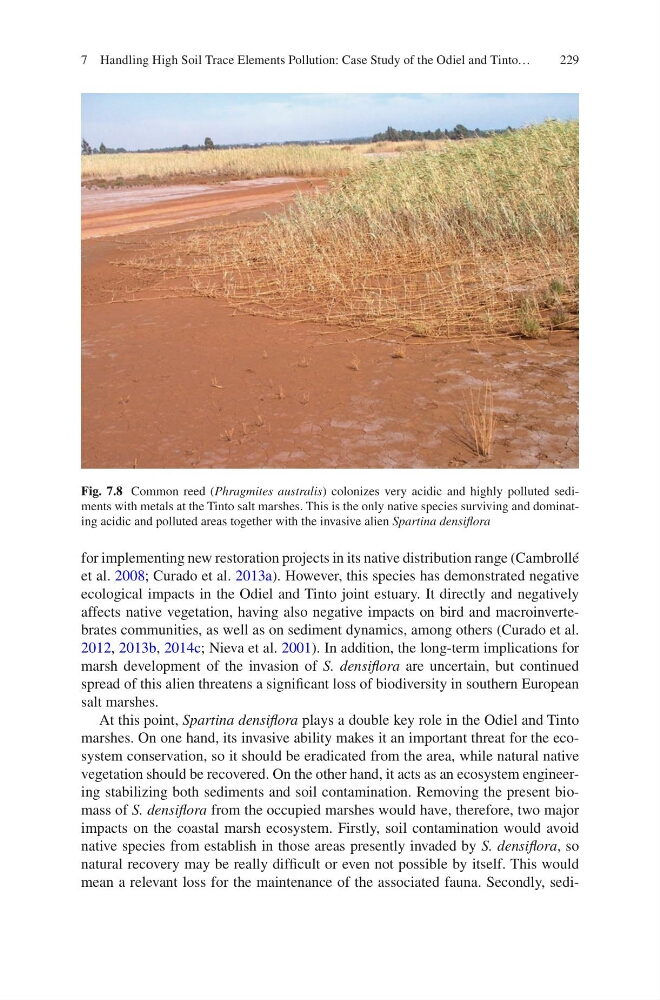
mean a relevant loss for the maintenance of the associated fauna. Secondly, sediFig. 7.8 Common reed (Phragmites australis) colonizes very acidic and highly polluted sediments with metals at the Tinto salt marshes. This is the only native species surviving and dominating acidic and polluted areas together with the invasive alien Spartina densiflora
7 Handling High Soil Trace Elements Pollution: Case Study of the Odiel and Tinto…
for implementing new restoration projects in its native distribution range (Cambrollé
et al. 2008; Curado et al. 2013a). However, this species has demonstrated negative
ecological impacts in the Odiel and Tinto joint estuary. It directly and negatively
affects native vegetation, having also negative impacts on bird and macroinvertebrates communities, as well as on sediment dynamics, among others (Curado et al.
2012, 2013b, 2014c; Nieva et al. 2001). In addition, the long-term implications for
marsh development of the invasion of S. densiflora are uncertain, but continued
spread of this alien threatens a significant loss of biodiversity in southern European
salt marshes.
At this point, Spartina densiflora plays a double key role in the Odiel and Tinto
marshes. On one hand, its invasive ability makes it an important threat for the ecosystem conservation, so it should be eradicated from the area, while natural native
vegetation should be recovered. On the other hand, it acts as an ecosystem engineering stabilizing both sediments and soil contamination. Removing the present biomass of S. densiflora from the occupied marshes would have, therefore, two major
impacts on the coastal marsh ecosystem. Firstly, soil contamination would avoid
native species from establish in those areas presently invaded by S. densiflora, so
natural recovery may be really difficult or even not possible by itself. This would
mean a relevant loss for the maintenance of the associated fauna. Secondly, sediFig. 7.8 Common reed (Phragmites australis) colonizes very acidic and highly polluted sediments with metals at the Tinto salt marshes. This is the only native species surviving and dominating acidic and polluted areas together with the invasive alien Spartina densiflora
7 Handling High Soil Trace Elements Pollution: Case Study of the Odiel and Tinto…