

224
circulation into the food web. In addition, metal uptake by plants depends on various factors such as the plant species, the age and growth stage of the plant, seasonal
variations, the existence of an iron plaque on the roots, metal speciation and bioavailability in the environment, and metal characteristics (Caçador et al. 2000).
The tolerance and accumulation capacity of heavy metals and metalloids have
been explored in different halophytes present in the Odiel and Tinto joint estuary. For
example, Cambrollé et al. (2008) analyzed As, Cu, Fe, Mn, Pb and Zn contents in
sediments and rhizosediments from Odiel and Tinto marshes in different tissues of
the European native Spartina maritima and the invasive alien S. densiflora, concluding that both plants influenced the distribution of metals in the marsh sediments,
showing to have potential use for metal phytostabilization. In this study, it was also
detected that S. densiflora shows higher capability to retain metals around its roots
and to control the uptake or transports of metals than S. maritima, which could be
related with a higher formation of plaques of Fe/Mn (hydro) oxides on its roots. A
ferric oxide/hydroxide precipitate, commonly known as iron plaque, envelops the
roots of a number of wetland plants (Smillie 2015), including various species of
Spartina and Salicornia genus. These plaques consists mainly of Fe/Mn (hydro)
oxides with a large capacity to adsorb metals (Kabata-Pendias and Pendias 2001; Ye
et al. 2003), with the ensuing accumulation of metals in the rhizosphere (Doyle and
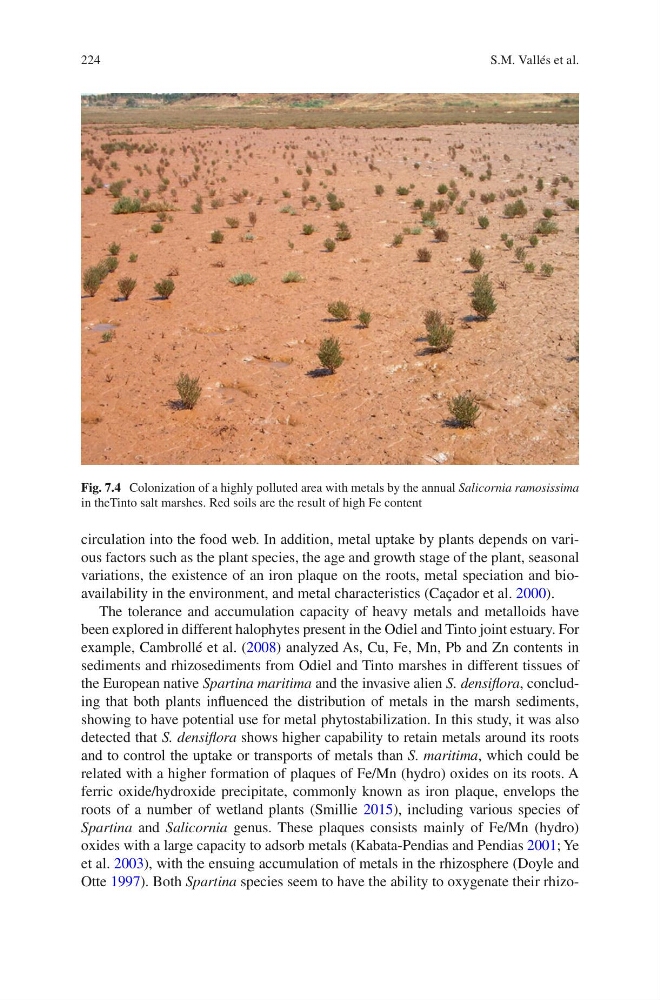
Otte 1997). Both Spartina species seem to have the ability to oxygenate their rhizoFig. 7.4 Colonization of a highly polluted area with metals by the annual Salicornia ramosissima
in theTinto salt marshes. Red soils are the result of high Fe content
S.M. Vallés et al.
circulation into the food web. In addition, metal uptake by plants depends on various factors such as the plant species, the age and growth stage of the plant, seasonal
variations, the existence of an iron plaque on the roots, metal speciation and bioavailability in the environment, and metal characteristics (Caçador et al. 2000).
The tolerance and accumulation capacity of heavy metals and metalloids have
been explored in different halophytes present in the Odiel and Tinto joint estuary. For
example, Cambrollé et al. (2008) analyzed As, Cu, Fe, Mn, Pb and Zn contents in
sediments and rhizosediments from Odiel and Tinto marshes in different tissues of
the European native Spartina maritima and the invasive alien S. densiflora, concluding that both plants influenced the distribution of metals in the marsh sediments,
showing to have potential use for metal phytostabilization. In this study, it was also
detected that S. densiflora shows higher capability to retain metals around its roots
and to control the uptake or transports of metals than S. maritima, which could be
related with a higher formation of plaques of Fe/Mn (hydro) oxides on its roots. A
ferric oxide/hydroxide precipitate, commonly known as iron plaque, envelops the
roots of a number of wetland plants (Smillie 2015), including various species of
Spartina and Salicornia genus. These plaques consists mainly of Fe/Mn (hydro)
oxides with a large capacity to adsorb metals (Kabata-Pendias and Pendias 2001; Ye
et al. 2003), with the ensuing accumulation of metals in the rhizosphere (Doyle and
Otte 1997). Both Spartina species seem to have the ability to oxygenate their rhizoFig. 7.4 Colonization of a highly polluted area with metals by the annual Salicornia ramosissima
in theTinto salt marshes. Red soils are the result of high Fe content
S.M. Vallés et al.