

141
deposition process is due to the constructive wave regime that has stronger swash
than backwash. B.
The deposition is a process in which rocks, soil and sediments are transported
and added to a certain location to form a landmass. The process takes place when
the river becomes flooded after a heavy rain. Debris is deposited along the riverbank
as water spreads. From Fig. 4.4, the profile shows the deposition area at the beach is
stated at 10 m of height at A and 3-m height at location B.
4.5 Coastal Wetland Condition
Coastal wetland includes saltwater and freshwater wetland is located within coastal
watersheds. Wetland types found in coastal watersheds include salt marshes, fresh
marshes and mangrove swamps. According to the webpage of U.S. Environmental
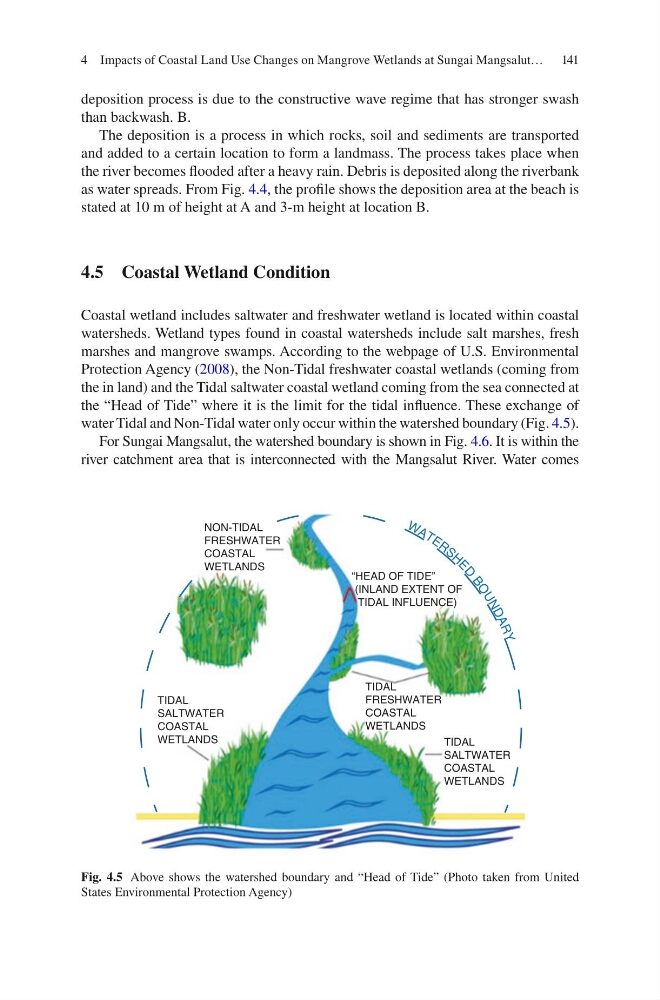
Protection Agency (2008), the Non-Tidal freshwater coastal wetlands (coming from
the in land) and the Tidal saltwater coastal wetland coming from the sea connected at
the “Head of Tide” where it is the limit for the tidal influence. These exchange of
water Tidal and Non-Tidal water only occur within the watershed boundary (Fig. 4.5).
For Sungai Mangsalut, the watershed boundary is shown in Fig. 4.6. It is within the
river catchment area that is interconnected with the Mangsalut River. Water comes
NON-TIDAL
FRESHWATER
COASTAL
WETLANDS
“HEAD OF TIDE”
(INLAND EXTENT OF
TIDAL INFLUENCE)
TIDAL
FRESHWATER
COASTAL
WETLANDS
TIDAL
SALTWATER
COASTAL
WETLANDS
TIDAL
SALTWATER
COASTAL
WETLANDS
W A T E R S H
E
D
B
O
U
N
D
A
R
Y
Fig. 4.5 Above shows the watershed boundary and “Head of Tide” (Photo taken from United
States Environmental Protection Agency)
4 Impacts of Coastal Land Use Changes on Mangrove Wetlands at Sungai Mangsalut…
deposition process is due to the constructive wave regime that has stronger swash
than backwash. B.
The deposition is a process in which rocks, soil and sediments are transported
and added to a certain location to form a landmass. The process takes place when
the river becomes flooded after a heavy rain. Debris is deposited along the riverbank
as water spreads. From Fig. 4.4, the profile shows the deposition area at the beach is
stated at 10 m of height at A and 3-m height at location B.
4.5 Coastal Wetland Condition
Coastal wetland includes saltwater and freshwater wetland is located within coastal
watersheds. Wetland types found in coastal watersheds include salt marshes, fresh
marshes and mangrove swamps. According to the webpage of U.S. Environmental
Protection Agency (2008), the Non-Tidal freshwater coastal wetlands (coming from
the in land) and the Tidal saltwater coastal wetland coming from the sea connected at
the “Head of Tide” where it is the limit for the tidal influence. These exchange of
water Tidal and Non-Tidal water only occur within the watershed boundary (Fig. 4.5).
For Sungai Mangsalut, the watershed boundary is shown in Fig. 4.6. It is within the
river catchment area that is interconnected with the Mangsalut River. Water comes
NON-TIDAL
FRESHWATER
COASTAL
WETLANDS
“HEAD OF TIDE”
(INLAND EXTENT OF
TIDAL INFLUENCE)
TIDAL
FRESHWATER
COASTAL
WETLANDS
TIDAL
SALTWATER
COASTAL
WETLANDS
TIDAL
SALTWATER
COASTAL
WETLANDS
W A T E R S H
E
D
B
O
U
N
D
A
R
Y
Fig. 4.5 Above shows the watershed boundary and “Head of Tide” (Photo taken from United
States Environmental Protection Agency)
4 Impacts of Coastal Land Use Changes on Mangrove Wetlands at Sungai Mangsalut…