

64
Josep Maria Espelta, Santiago Sabat!! and Javier Retana
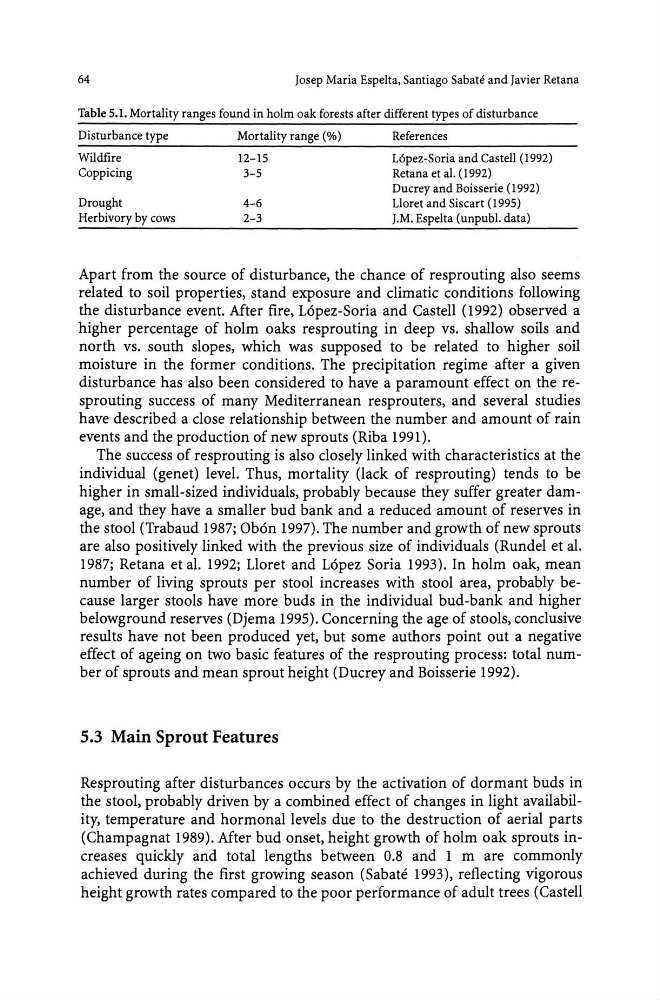
Table 5.1. Mortality ranges found in holm oak forests after different types of disturbance
Disturbance type
Mortality range (%)
References
Wildfire
12-15
L6pez-Soria and Castell (1992)
Coppicing
3-5
Retana et al. (1992)
Drought
Herbivory by cows
4-6
2-3
Ducrey and Boisserie (1992)
Lloret and Siscart (1995)
I.M. Espelta (unpubl. data)
Apart from the source of disturbance, the chance of resprouting also seems
related to soil properties, stand exposure and climatic conditions following
the disturbance event. After fire, L6pez-Soria and Castell (1992) observed a
higher percentage of holm oaks resprouting in deep vs. shallow soils and
north vs. south slopes, which was supposed to be related to higher soil
moisture in the former conditions. The precipitation regime after a given
disturbance has also been considered to have a paramount effect on the resprouting success of plany Mediterranean resprouters, and several studies
have described a close relationship between the number and amount of rain
events and the production of new sprouts (Riba 1991).
The success of resprouting is also closely linked with characteristics at the
individual (genet) level. Thus, mortality (lack of resprouting) tends to be
higher in small-sized individuals, probably because they suffer greater damage, and they have a smaller bud bank and a reduced amount of reserves in
the stool (Trabaud 1987; Ob6n 1997). The number and growth of new sprouts
are also positively linked with the previous size of individuals (Rundel et al.
1987; Retana et al. 1992; Lloret and L6pez Soria 1993). In holm oak, mean
number of living sprouts per stool increases with stool area, probably because larger stools have more buds in the individual bud-bank and higher
belowground reserves (Djema 1995). Concerning the age of stools, conclusive
results have not been produced yet, but some authors point out a negative
effect of ageing on two basic features of the resprouting process: total number of sprouts and mean sprout height (Ducrey and Boisserie 1992).
5.3 Main Sprout Features
Resprouting after disturbances occurs by the activation of dormant buds in
the stool, probably driven by a combined effect of changes in light availability, temperature and hormonal levels due to the destruction of aerial parts
(Champagnat 1989). After bud onset, height growth of holm oak sprouts increases quickly and total lengths between 0.8 and 1 m are commonly
achieved during the first growing season (Sabate 1993), reflecting vigorous
height growth rates compared to the poor performance of adult trees (Castell
Josep Maria Espelta, Santiago Sabat!! and Javier Retana
Table 5.1. Mortality ranges found in holm oak forests after different types of disturbance
Disturbance type
Mortality range (%)
References
Wildfire
12-15
L6pez-Soria and Castell (1992)
Coppicing
3-5
Retana et al. (1992)
Drought
Herbivory by cows
4-6
2-3
Ducrey and Boisserie (1992)
Lloret and Siscart (1995)
I.M. Espelta (unpubl. data)
Apart from the source of disturbance, the chance of resprouting also seems
related to soil properties, stand exposure and climatic conditions following
the disturbance event. After fire, L6pez-Soria and Castell (1992) observed a
higher percentage of holm oaks resprouting in deep vs. shallow soils and
north vs. south slopes, which was supposed to be related to higher soil
moisture in the former conditions. The precipitation regime after a given
disturbance has also been considered to have a paramount effect on the resprouting success of plany Mediterranean resprouters, and several studies
have described a close relationship between the number and amount of rain
events and the production of new sprouts (Riba 1991).
The success of resprouting is also closely linked with characteristics at the
individual (genet) level. Thus, mortality (lack of resprouting) tends to be
higher in small-sized individuals, probably because they suffer greater damage, and they have a smaller bud bank and a reduced amount of reserves in
the stool (Trabaud 1987; Ob6n 1997). The number and growth of new sprouts
are also positively linked with the previous size of individuals (Rundel et al.
1987; Retana et al. 1992; Lloret and L6pez Soria 1993). In holm oak, mean
number of living sprouts per stool increases with stool area, probably because larger stools have more buds in the individual bud-bank and higher
belowground reserves (Djema 1995). Concerning the age of stools, conclusive
results have not been produced yet, but some authors point out a negative
effect of ageing on two basic features of the resprouting process: total number of sprouts and mean sprout height (Ducrey and Boisserie 1992).
5.3 Main Sprout Features
Resprouting after disturbances occurs by the activation of dormant buds in
the stool, probably driven by a combined effect of changes in light availability, temperature and hormonal levels due to the destruction of aerial parts
(Champagnat 1989). After bud onset, height growth of holm oak sprouts increases quickly and total lengths between 0.8 and 1 m are commonly
achieved during the first growing season (Sabate 1993), reflecting vigorous
height growth rates compared to the poor performance of adult trees (Castell