

Resprounting Dynamics
65
et al. 1994) and seedlings (Espelta et al. 1995; Chap. 7). This preferential
growth in height exhibited by sprouts is also reflected by the fact that leaves
in the main axis tend to be larger than those produced on lateral branches
(Sabate 1993). Sprouts also show a higher specific leaf area and nutrient
content (e.g. N, P, K) in leaves and stems compared to the values exhibited by
adult trees (Castell et aI. 1994). Differences between sprouts and adult trees in
leaf morphometry and nutrient content have been assumed to occur because
of the balance between above- and belowground biomass occurring in the
resprouting individuals, favouring a greater amount of resources available to
sprouts and thus higher photosynthetic and growth rates (Canadell 1995).
Nevertheless, these differences tend to narrow quickly during the regeneration process, due both to the tendency to re-equilibrate biomass partitioning
between roots and aerial parts and to the ontogenic ageing occurring during
sprout development (Sabate 1993; Castell et aI. 1994)
Despite these general features of holm oak sprouts, variations may arise
according to the type anq intensity of the disturbance leading to resprouting.
Among other things, different disturbances may vary in their effects on soil
resource availability (Christensen 198n Similarities and differences between
the effects of disturbance-type on the resprouting process of holm oak have
been observed by Sabate (1993) in three experimental treatments in Prades
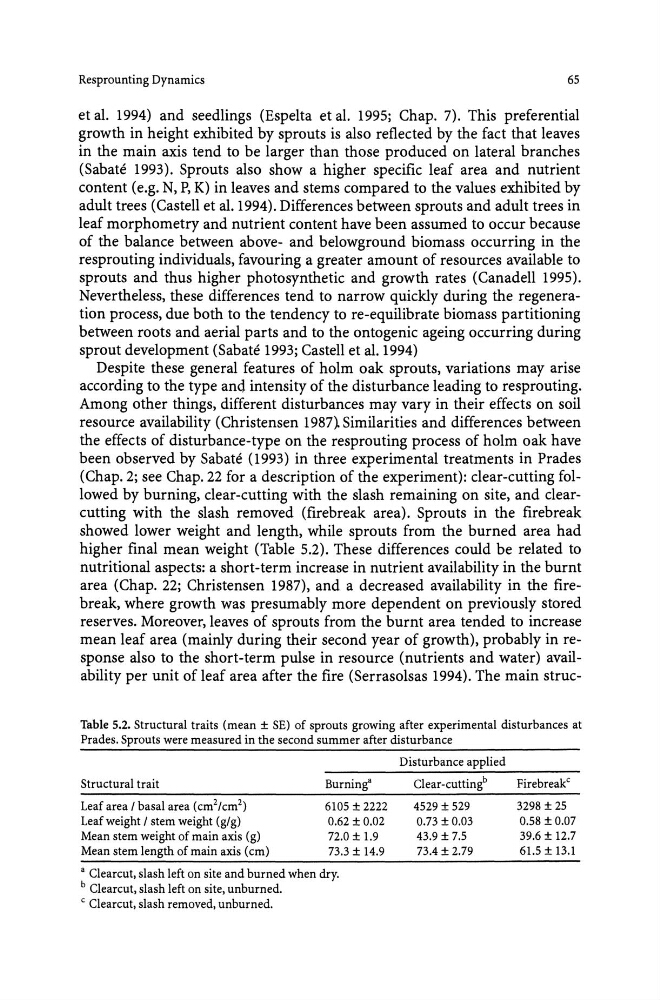
(Chap. 2; see Chap. 22 for a description of the experiment): clear-cutting followed by burning, clear-cutting with the slash remaining on site, and c1earcutting with the slash removed (firebreak area). Sprouts in the firebreak
showed lower weight and length, while sprouts from the burned area had
higher final mean weight (Table 5.2). These differences could be related to
nutritional aspects: a short-term increase in nutrient availability in the burnt
area (Chap. 22; Christensen 1987), and a decreased availability in the firebreak, where growth was presumably more dependent on previously stored
reserves. Moreover, leaves of sprouts from the burnt area tended to increase
mean leaf area (mainly during their second year of growth), probably in response also to the short-term pulse in resource (nutrients and water) availability per unit of leaf area after the fire (Serrasolsas 1994). The main strucTable 5.2. Structural traits (mean ± SE) of sprouts growing after experimental disturbances at
Prades. Sprouts were measured in the second summer after disturbance
Structural trait
Leaf area I basal area (cm 2 /cm 2 )
Leaf weight I stem weight (gig)
Mean stem weight of main axis (g)
Mean stem length of main axis (cm)
Burning"
6105 ± 2222
0.62 ±0.02
72.0 ± 1.9
73.3 ± 14.9
a Clearcut, slash left on site and burned when dry.
b Clearcut, slash left on site, unburned.
C Clearcut, slash removed, unburned.
Disturbance applied
Clear-cutting b
4529 ± 529
0.73 ±0.03
43.9 ± 7.5
73.4 ± 2.79
Firebreak c
3298 ± 25
0.58 ±0.07
39.6 ± 12.7
61.5 ± 13.1
65
et al. 1994) and seedlings (Espelta et al. 1995; Chap. 7). This preferential
growth in height exhibited by sprouts is also reflected by the fact that leaves
in the main axis tend to be larger than those produced on lateral branches
(Sabate 1993). Sprouts also show a higher specific leaf area and nutrient
content (e.g. N, P, K) in leaves and stems compared to the values exhibited by
adult trees (Castell et aI. 1994). Differences between sprouts and adult trees in
leaf morphometry and nutrient content have been assumed to occur because
of the balance between above- and belowground biomass occurring in the
resprouting individuals, favouring a greater amount of resources available to
sprouts and thus higher photosynthetic and growth rates (Canadell 1995).
Nevertheless, these differences tend to narrow quickly during the regeneration process, due both to the tendency to re-equilibrate biomass partitioning
between roots and aerial parts and to the ontogenic ageing occurring during
sprout development (Sabate 1993; Castell et aI. 1994)
Despite these general features of holm oak sprouts, variations may arise
according to the type anq intensity of the disturbance leading to resprouting.
Among other things, different disturbances may vary in their effects on soil
resource availability (Christensen 198n Similarities and differences between
the effects of disturbance-type on the resprouting process of holm oak have
been observed by Sabate (1993) in three experimental treatments in Prades
(Chap. 2; see Chap. 22 for a description of the experiment): clear-cutting followed by burning, clear-cutting with the slash remaining on site, and c1earcutting with the slash removed (firebreak area). Sprouts in the firebreak
showed lower weight and length, while sprouts from the burned area had
higher final mean weight (Table 5.2). These differences could be related to
nutritional aspects: a short-term increase in nutrient availability in the burnt
area (Chap. 22; Christensen 1987), and a decreased availability in the firebreak, where growth was presumably more dependent on previously stored
reserves. Moreover, leaves of sprouts from the burnt area tended to increase
mean leaf area (mainly during their second year of growth), probably in response also to the short-term pulse in resource (nutrients and water) availability per unit of leaf area after the fire (Serrasolsas 1994). The main strucTable 5.2. Structural traits (mean ± SE) of sprouts growing after experimental disturbances at
Prades. Sprouts were measured in the second summer after disturbance
Structural trait
Leaf area I basal area (cm 2 /cm 2 )
Leaf weight I stem weight (gig)
Mean stem weight of main axis (g)
Mean stem length of main axis (cm)
Burning"
6105 ± 2222
0.62 ±0.02
72.0 ± 1.9
73.3 ± 14.9
a Clearcut, slash left on site and burned when dry.
b Clearcut, slash left on site, unburned.
C Clearcut, slash removed, unburned.
Disturbance applied
Clear-cutting b
4529 ± 529
0.73 ±0.03
43.9 ± 7.5
73.4 ± 2.79
Firebreak c
3298 ± 25
0.58 ±0.07
39.6 ± 12.7
61.5 ± 13.1