

Resprounting Dynamics
63
200
A
150 I
....J
0
0
lV)
.......
V)
100
I::l
f
0
0:::
a..
50
V)
Z
0
0
5
10 15 20 25 30 35
.........
30
Cl
B
.:,t
....J
25
0
0
I20
V)
.......
V)
15
I::l
10
0
0:::
a..
+
V)
5
lI
•
S:2
o •
UJ
0
5
10 15 20 25 30 35
$:
YEARS AFTER THINNING
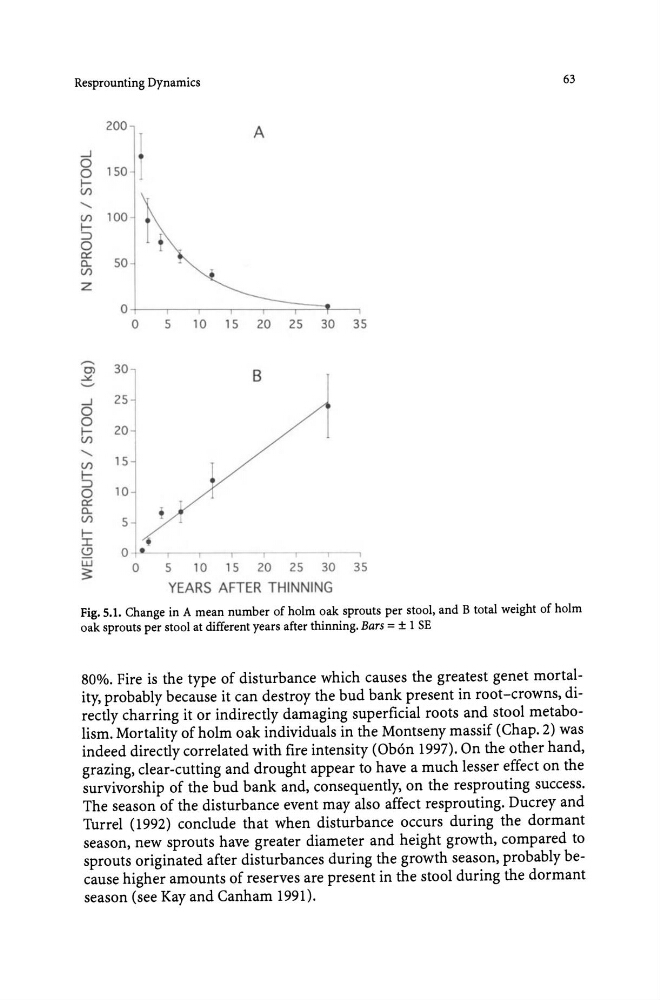
Fig. 5.1. Change in A mean number of holm oak sprouts per stool, and B total weight of holm
oak sprouts per stool at different years after thinning. Bars = ± 1 SE
80%. Fire is the type of disturbance which causes the greatest genet mortality, probably because it can destroy the bud bank present in root-crowns, directly charring it or indirectly damaging superficial roots and stool metabolism. Mortality of holm oak individuals in the Montseny massif (Chap. 2) was
indeed directly correlated with fire intensity (Oban 1997). On the other hand,
grazing, clear-cutting and drought appear to have a much lesser effect on the
survivorship of the bud bank and, consequently, on the resprouting success.
The season of the disturbance event may also affect resprouting. Ducrey and
Turrel (1992) conclude that when disturbance occurs during the dormant
season, new sprouts have greater diameter and height growth, compared to
sprouts originated after disturbances during the growth season, probably because higher amounts of reserves are present in the stool during the dormant
season (see Kay and Canham 1991).
63
200
A
150 I
....J
0
0
lV)
.......
V)
100
I::l
f
0
0:::
a..
50
V)
Z
0
0
5
10 15 20 25 30 35
.........
30
Cl
B
.:,t
....J
25
0
0
I20
V)
.......
V)
15
I::l
10
0
0:::
a..
+
V)
5
lI
•
S:2
o •
UJ
0
5
10 15 20 25 30 35
$:
YEARS AFTER THINNING
Fig. 5.1. Change in A mean number of holm oak sprouts per stool, and B total weight of holm
oak sprouts per stool at different years after thinning. Bars = ± 1 SE
80%. Fire is the type of disturbance which causes the greatest genet mortality, probably because it can destroy the bud bank present in root-crowns, directly charring it or indirectly damaging superficial roots and stool metabolism. Mortality of holm oak individuals in the Montseny massif (Chap. 2) was
indeed directly correlated with fire intensity (Oban 1997). On the other hand,
grazing, clear-cutting and drought appear to have a much lesser effect on the
survivorship of the bud bank and, consequently, on the resprouting success.
The season of the disturbance event may also affect resprouting. Ducrey and
Turrel (1992) conclude that when disturbance occurs during the dormant
season, new sprouts have greater diameter and height growth, compared to
sprouts originated after disturbances during the growth season, probably because higher amounts of reserves are present in the stool during the dormant
season (see Kay and Canham 1991).