

260
Antoni Escarre, Ferran Rodit, Jaume Terradas and Xavier Mayor
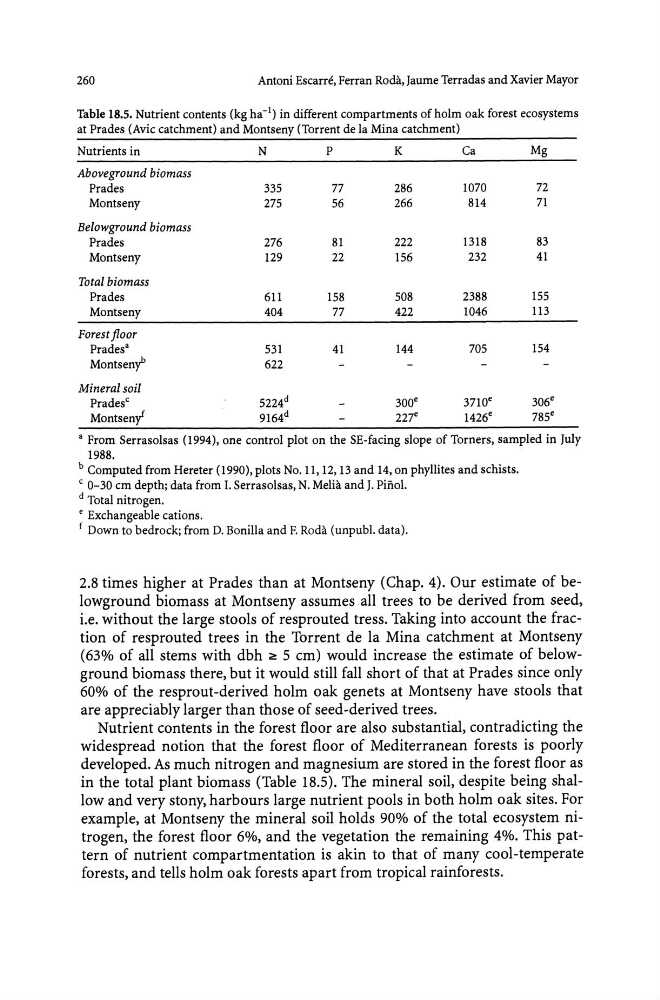
Table 18.5. Nutrient contents (kg ha-') in different compartments of holm oak forest ecosystems
at Prades (Avic catchment) and Montseny (Torrent de la Mina catchment)
Nutrients in
N
P
K
Ca
Mg
Aboveground biomass
Prades
335
77
286
1070
72
Montseny
275
56
266
814
71
Belowground biomass
Prades
276
81
222
1318
83
Montseny
129
22
156
232
41
Total biomass
Prades
611
158
508
2388
155
Montseny
404
77
422
1046
113
Forest floor
Prades'
531
41
144
705
154
MontsenY'
622
Mineral soil
Prades c
5224 d
300 e
3710 e
306 e
Montseny
9164 d
227 e
1426 e
785 e
• From Serrasolsas (1994), one control plot on the SE-facing slope of Tomers, sampled in July
1988.
b Computed from Hereter (1990), plots No. 11, 12, 13 and 14, on phyllites and schists.
c 0-30 cm depth; data from I. Serrasolsas, N. Melia and J. Pinol.
d Total nitrogen.
e Exchangeable cations.
f Down to bedrock; from D. Bonilla and F. Roda (unpub!. data).
2.8 times higher at Prades than at Montseny (Chap. 4). Our estimate of belowground biomass at Montseny assumes all trees to be derived from seed,
i.e. without the large stools of resprouted tress. Taking into account the fraction of resprouted trees in the Torrent de la Mina catchment at Montseny
(63% of all stems with dbh ~ 5 em) would increase the estimate of belowground biomass there, but it would still fall short of that at Prades since only
60% of the resprout-derived holm oak genets at Montseny have stools that
are appreciably larger than those of seed-derived trees.
Nutrient contents in the forest floor are also substantial, contradicting the
widespread notion that the forest floor of Mediterranean forests is poorly
developed. As much nitrogen and magnesium are stored in the forest floor as
in the total plant biomass (Table 18.5). The mineral soil, despite being shallow and very stony, harbours large nutrient pools in both holm oak sites. For
example, at Montseny the mineral soil holds 90% of the total ecosystem nitrogen, the forest floor 6%, and the vegetation the remaining 4%. This pattern of nutrient compartmentation is akin to that of many cool-temperate
forests, and tells holm oak forests apart from tropical rainforests.
Antoni Escarre, Ferran Rodit, Jaume Terradas and Xavier Mayor
Table 18.5. Nutrient contents (kg ha-') in different compartments of holm oak forest ecosystems
at Prades (Avic catchment) and Montseny (Torrent de la Mina catchment)
Nutrients in
N
P
K
Ca
Mg
Aboveground biomass
Prades
335
77
286
1070
72
Montseny
275
56
266
814
71
Belowground biomass
Prades
276
81
222
1318
83
Montseny
129
22
156
232
41
Total biomass
Prades
611
158
508
2388
155
Montseny
404
77
422
1046
113
Forest floor
Prades'
531
41
144
705
154
MontsenY'
622
Mineral soil
Prades c
5224 d
300 e
3710 e
306 e
Montseny
9164 d
227 e
1426 e
785 e
• From Serrasolsas (1994), one control plot on the SE-facing slope of Tomers, sampled in July
1988.
b Computed from Hereter (1990), plots No. 11, 12, 13 and 14, on phyllites and schists.
c 0-30 cm depth; data from I. Serrasolsas, N. Melia and J. Pinol.
d Total nitrogen.
e Exchangeable cations.
f Down to bedrock; from D. Bonilla and F. Roda (unpub!. data).
2.8 times higher at Prades than at Montseny (Chap. 4). Our estimate of belowground biomass at Montseny assumes all trees to be derived from seed,
i.e. without the large stools of resprouted tress. Taking into account the fraction of resprouted trees in the Torrent de la Mina catchment at Montseny
(63% of all stems with dbh ~ 5 em) would increase the estimate of belowground biomass there, but it would still fall short of that at Prades since only
60% of the resprout-derived holm oak genets at Montseny have stools that
are appreciably larger than those of seed-derived trees.
Nutrient contents in the forest floor are also substantial, contradicting the
widespread notion that the forest floor of Mediterranean forests is poorly
developed. As much nitrogen and magnesium are stored in the forest floor as
in the total plant biomass (Table 18.5). The mineral soil, despite being shallow and very stony, harbours large nutrient pools in both holm oak sites. For
example, at Montseny the mineral soil holds 90% of the total ecosystem nitrogen, the forest floor 6%, and the vegetation the remaining 4%. This pattern of nutrient compartmentation is akin to that of many cool-temperate
forests, and tells holm oak forests apart from tropical rainforests.