

GOTILWA: An Integrated Model of Water Dynamics and Forest Growth
169
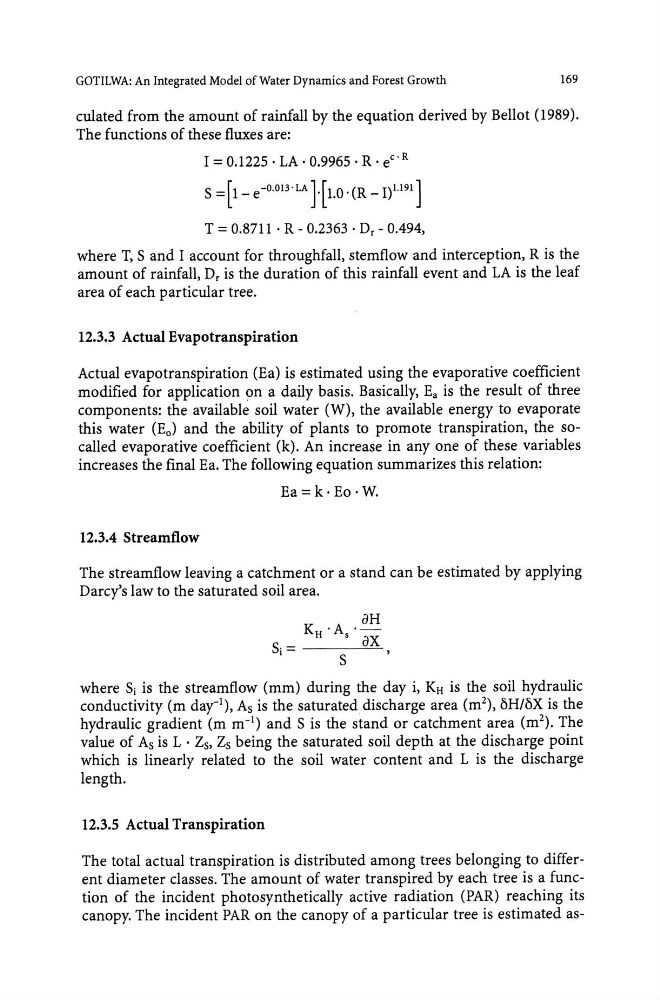
culated from the amount of rainfall by the equation derived by Bellot (1989).
The functions of these fluxes are:
1= 0.1225· LA· 0.9965· R· e,·R
S =[1- e-O.013·LA } [1.0 . (R _ 1)1.191]
T = 0.8711 . R - 0.2363 . Dr - 0.494,
where T, S and I account for throughfall, stemflow and interception, R is the
amount of rainfall, Dr is the duration of this rainfall event and LA is the leaf
area of each particular tree.
12.3.3 Actual Evapotranspiration
Actual evapotranspiration (Ea) is estimated using the evaporative coefficient
modified for application on a daily basis. Basically, Ea is the result of three
components: the available soil water (W), the available energy to evaporate
this water (Eo) and the ability of plants to promote transpiration, the socalled evaporative coefficient (k). An increase in anyone of these variables
increases the final Ea. The following equation summarizes this relation:
Ea=k·Eo·W.
12.3.4 Streamflow
The streamflow leaving a catchment or a stand can be estimated by applying
Darcy's law to the saturated soil area.
K 'A . aH
H
S
ax
S
where Sj is the streamflow (mm) during the day i, KH is the soil hydraulic
conductivity (m day-I), As is the saturated discharge area (m 2 ), bH/bX is the
hydraulic gradient (m m- I ) and S is the stand or catchment area (m 2 ). The
value of As is L . Zs, Zs being the saturated soil depth at the discharge point
which is linearly related to the soil water content and L is the discharge
length.
12.3.5 Actual Transpiration
The total actual transpiration is distributed among trees belonging to different diameter classes. The amount of water transpired by each tree is a function of the incident photosynthetically active radiation (PAR) reaching its
canopy. The incident PAR on the canopy of a particular tree is estimated as-
169
culated from the amount of rainfall by the equation derived by Bellot (1989).
The functions of these fluxes are:
1= 0.1225· LA· 0.9965· R· e,·R
S =[1- e-O.013·LA } [1.0 . (R _ 1)1.191]
T = 0.8711 . R - 0.2363 . Dr - 0.494,
where T, S and I account for throughfall, stemflow and interception, R is the
amount of rainfall, Dr is the duration of this rainfall event and LA is the leaf
area of each particular tree.
12.3.3 Actual Evapotranspiration
Actual evapotranspiration (Ea) is estimated using the evaporative coefficient
modified for application on a daily basis. Basically, Ea is the result of three
components: the available soil water (W), the available energy to evaporate
this water (Eo) and the ability of plants to promote transpiration, the socalled evaporative coefficient (k). An increase in anyone of these variables
increases the final Ea. The following equation summarizes this relation:
Ea=k·Eo·W.
12.3.4 Streamflow
The streamflow leaving a catchment or a stand can be estimated by applying
Darcy's law to the saturated soil area.
K 'A . aH
H
S
ax
S
where Sj is the streamflow (mm) during the day i, KH is the soil hydraulic
conductivity (m day-I), As is the saturated discharge area (m 2 ), bH/bX is the
hydraulic gradient (m m- I ) and S is the stand or catchment area (m 2 ). The
value of As is L . Zs, Zs being the saturated soil depth at the discharge point
which is linearly related to the soil water content and L is the discharge
length.
12.3.5 Actual Transpiration
The total actual transpiration is distributed among trees belonging to different diameter classes. The amount of water transpired by each tree is a function of the incident photosynthetically active radiation (PAR) reaching its
canopy. The incident PAR on the canopy of a particular tree is estimated as-