

170
Carlos A. Gracia, Esubaliz Tello, Santiago Sabate and Juan Bellot
suming that the canopies of all the larger trees are at a higher level. These
trees intercept the available PAR according to a light extinction function.
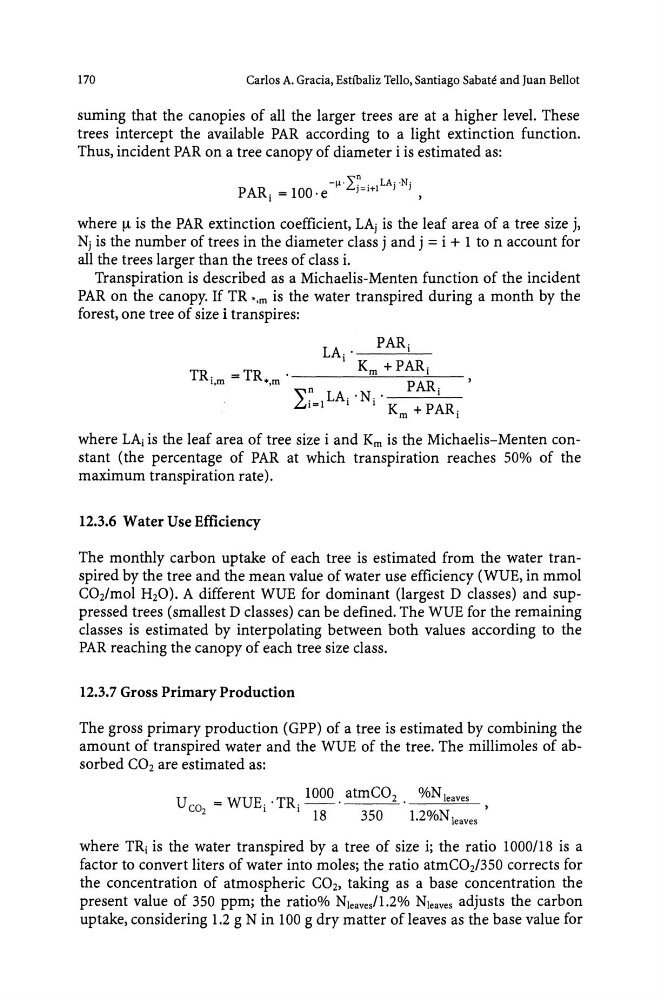
Thus, incident PAR on a tree canopy of diameter i is estimated as:
_fl·~n
LA .. N.
PAR. =100.e L.j=i+l J J
1
,
where I.t is the PAR extinction coefficient, LAj is the leaf area of a tree size j,
Nj is the number of trees in the diameter class j and j = i + 1 to n account for
all the trees larger than the trees of class i.
Transpiration is described as a Michaelis-Menten function of the incident
PAR on the canopy. If TR -,m is the water transpired during a month by the
forest, one tree of size i transpires:
LA.' PARj
TR. =TR.
1 Km +PAR j
1,m
·,m
n
PAR.
~
LA"N.'
1
~j"'l
1
1 K + PAR.
m
1
where LAj is the leaf area of tree size i and Km is the Michaelis-Menten constant (the percentage of PAR at which transpiration reaches 50% of the
maximum transpiration rate).
12.3.6 Water Use Efficiency
The monthly carbon uptake of each tree is estimated from the water transpired by the tree and the mean value of water use efficiency (WUE, in mmol
COz/mol HzO). A different WUE for dominant (largest D classes) and suppressed trees (smallest D classes) can be defined. The WUE for the remaining
classes is estimated by interpolating between both values according to the
PAR reaching the canopy of each tree size class.
12.3.7 Gross Primary Production
The gross primary production (GPP) of a tree is estimated by combining the
amount of transpired water and the WUE of the tree. The millimoles of absorbed CO2 are estimated as:
U co = WUE. 'TR. 1000. atmCOz . %Nleaves ,
2
1
1
18
350
1.2%N leaves
where TRj is the water transpired by a tree of size i; the ratio 1000/18 is a
factor to convert liters of water into moles; the ratio atmCOz/350 corrects for
the concentration of atmospheric CO2, taking as a base concentration the
present value of 350 ppm; the ratio% Nleaves/1.2% Nleaves adjusts the carbon
uptake, considering 1.2 g N in 100 g dry matter of leaves as the base value for
Carlos A. Gracia, Esubaliz Tello, Santiago Sabate and Juan Bellot
suming that the canopies of all the larger trees are at a higher level. These
trees intercept the available PAR according to a light extinction function.
Thus, incident PAR on a tree canopy of diameter i is estimated as:
_fl·~n
LA .. N.
PAR. =100.e L.j=i+l J J
1
,
where I.t is the PAR extinction coefficient, LAj is the leaf area of a tree size j,
Nj is the number of trees in the diameter class j and j = i + 1 to n account for
all the trees larger than the trees of class i.
Transpiration is described as a Michaelis-Menten function of the incident
PAR on the canopy. If TR -,m is the water transpired during a month by the
forest, one tree of size i transpires:
LA.' PARj
TR. =TR.
1 Km +PAR j
1,m
·,m
n
PAR.
~
LA"N.'
1
~j"'l
1
1 K + PAR.
m
1
where LAj is the leaf area of tree size i and Km is the Michaelis-Menten constant (the percentage of PAR at which transpiration reaches 50% of the
maximum transpiration rate).
12.3.6 Water Use Efficiency
The monthly carbon uptake of each tree is estimated from the water transpired by the tree and the mean value of water use efficiency (WUE, in mmol
COz/mol HzO). A different WUE for dominant (largest D classes) and suppressed trees (smallest D classes) can be defined. The WUE for the remaining
classes is estimated by interpolating between both values according to the
PAR reaching the canopy of each tree size class.
12.3.7 Gross Primary Production
The gross primary production (GPP) of a tree is estimated by combining the
amount of transpired water and the WUE of the tree. The millimoles of absorbed CO2 are estimated as:
U co = WUE. 'TR. 1000. atmCOz . %Nleaves ,
2
1
1
18
350
1.2%N leaves
where TRj is the water transpired by a tree of size i; the ratio 1000/18 is a
factor to convert liters of water into moles; the ratio atmCOz/350 corrects for
the concentration of atmospheric CO2, taking as a base concentration the
present value of 350 ppm; the ratio% Nleaves/1.2% Nleaves adjusts the carbon
uptake, considering 1.2 g N in 100 g dry matter of leaves as the base value for