

168
Carlos A. Gracia, Esubaliz Tello, Santiago Sabate and Juan Bellot
13. During favourable periods in which GPP exceeds respiration and carbon
storage demand, the remaining NPP is allocated to new tissues.
14. Due to a scarcity of data on the dynamics of fine roots, the proportion of
leaves and fine roots is assumed to be constant; thus, the formation or
shedding of leaves implies the formation or mortality of the proportional
amount of fine root mass.
12.3 Constant Parameters Used by GOTILWA
GOTILWA uses a set of constant values to define different processes such as
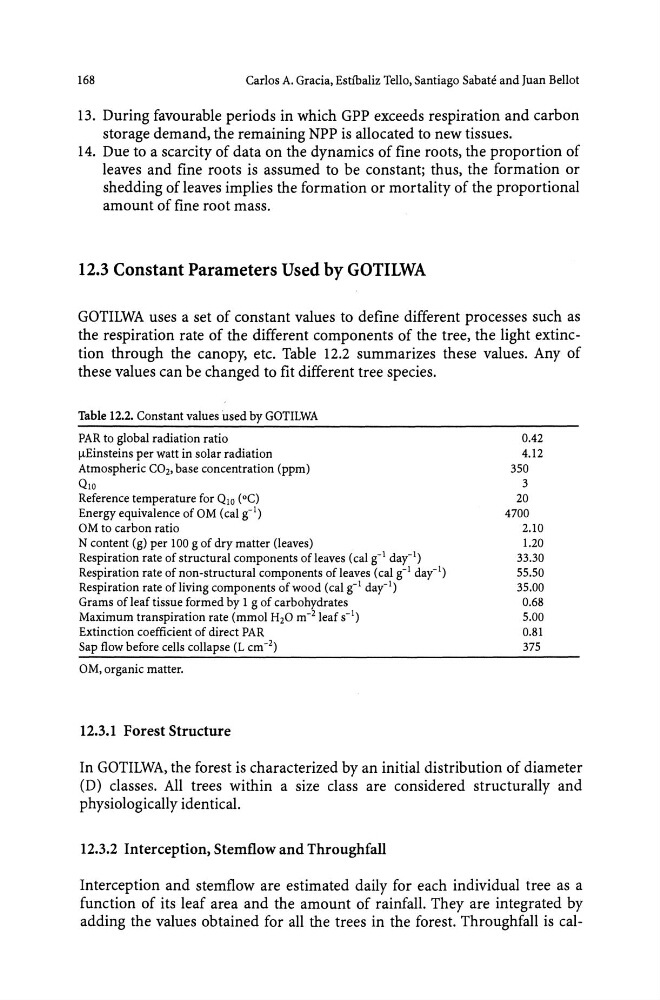
the respiration rate of the different components of the tree, the light extinction through the canopy, etc. Table 12.2 summarizes these values. Any of
these values can be changed to fit different tree species.
Table 12.2. Constant values used by GOTILWA
PAR to global radiation ratio
IlEinsteins per watt in solar radiation
Atmospheric COz, base concentration (ppm)
QIO
Reference temperature for QIO (oC)
Energy equivalence of OM (cal g-I)
OM to carbon ratio
N content (g) per 100 g of dry matter (leaves)
Respiration rate of structural components of leaves (cal g-I day-I)
Respiration rate of non-structural components ofleaves (cal g-I day-I)
Respiration rate of living components of wood (cal g-I day-I)
Grams of leaf tissue formed by 1 g of carbohydrates
Maximum transpiration rate (mmol HzO m-zleaf S-I)
Extinction coefficient of direct PAR
Sap flow before cells collapse (L cm-z)
OM, organic matter.
12.3.1 Forest Structure
0.42
4.12
350
3
20
4700
2.10
1.20
33.30
55.50
35.00
0.68
5.00
0.81
375
In GOTILWA, the forest is characterized by an initial distribution of diameter
(D) classes. All trees within a size class are considered structurally and
physiologically identical.
12.3.2 Interception, Stemflow and Throughfall
Interception and stemflow are estimated daily for each individual tree as a
function of its leaf area and the amount of rainfall. They are integrated by
adding the values obtained for all the trees in the forest. Throughfall is cal-
Carlos A. Gracia, Esubaliz Tello, Santiago Sabate and Juan Bellot
13. During favourable periods in which GPP exceeds respiration and carbon
storage demand, the remaining NPP is allocated to new tissues.
14. Due to a scarcity of data on the dynamics of fine roots, the proportion of
leaves and fine roots is assumed to be constant; thus, the formation or
shedding of leaves implies the formation or mortality of the proportional
amount of fine root mass.
12.3 Constant Parameters Used by GOTILWA
GOTILWA uses a set of constant values to define different processes such as
the respiration rate of the different components of the tree, the light extinction through the canopy, etc. Table 12.2 summarizes these values. Any of
these values can be changed to fit different tree species.
Table 12.2. Constant values used by GOTILWA
PAR to global radiation ratio
IlEinsteins per watt in solar radiation
Atmospheric COz, base concentration (ppm)
QIO
Reference temperature for QIO (oC)
Energy equivalence of OM (cal g-I)
OM to carbon ratio
N content (g) per 100 g of dry matter (leaves)
Respiration rate of structural components of leaves (cal g-I day-I)
Respiration rate of non-structural components ofleaves (cal g-I day-I)
Respiration rate of living components of wood (cal g-I day-I)
Grams of leaf tissue formed by 1 g of carbohydrates
Maximum transpiration rate (mmol HzO m-zleaf S-I)
Extinction coefficient of direct PAR
Sap flow before cells collapse (L cm-z)
OM, organic matter.
12.3.1 Forest Structure
0.42
4.12
350
3
20
4700
2.10
1.20
33.30
55.50
35.00
0.68
5.00
0.81
375
In GOTILWA, the forest is characterized by an initial distribution of diameter
(D) classes. All trees within a size class are considered structurally and
physiologically identical.
12.3.2 Interception, Stemflow and Throughfall
Interception and stemflow are estimated daily for each individual tree as a
function of its leaf area and the amount of rainfall. They are integrated by
adding the values obtained for all the trees in the forest. Throughfall is cal-