

Modelling Canopy Gas Exchange During Summer Drought
157
800~------------------~
~ 600
E
E
W 400
- ,
-' 0)
~
0)
W
:::l
~
4
16
14
12
10
8
1
2
--0-- Moderate
- 6 - - Severe
3
4
5
2 -2
LAI, m m
6
7
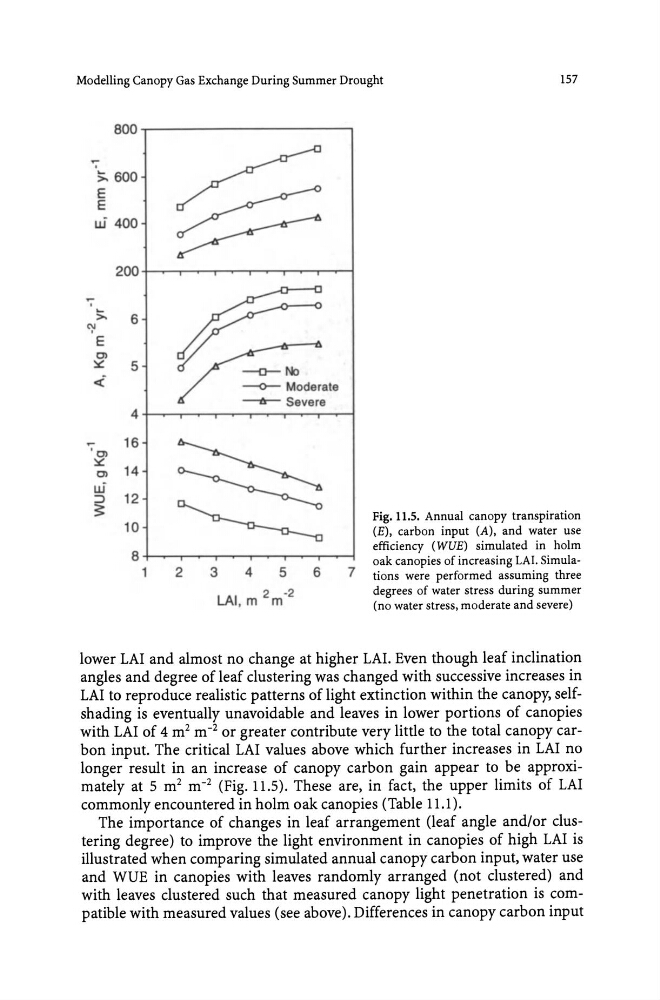
Fig. 11.5. Annual canopy transpiration
(E), carbon input (A), and water use
efficiency (WUE) simulated in holm
oak canopies of increasing LA!. Simulations were performed assuming three
degrees of water stress during summer
(no water stress, moderate and severe)
lower LAI and almost no change at higher LA!. Even though leaf inclination
angles and degree of leaf clustering was changed with successive increases in
LAI to reproduce realistic patterns of light extinction within the canopy, selfshading is eventually unavoidable and leaves in lower portions of canopies
with LAI of 4 m 2 m- 2 or greater contribute very little to the total canopy carbon input. The critical LAI values above which further increases in LAI no
longer result in an increase of canopy carbon gain appear to be approximately at 5 m 2 m- 2 (Fig. 11.5). These are, in fact, the upper limits of LAI
commonly encountered in holm oak canopies (Table 11.1).
The importance of changes in leaf arrangement (leaf angle and/or clustering degree) to improve the light environment in canopies of high LAI is
illustrated when comparing simulated annual canopy carbon input, water use
and WUE in canopies with leaves randomly arranged (not clustered) and
with leaves clustered such that measured canopy light penetration is compatible with measured values (see above). Differences in canopy carbon input
157
800~------------------~
~ 600
E
E
W 400
- ,
-' 0)
~
0)
W
:::l
~
4
16
14
12
10
8
1
2
--0-- Moderate
- 6 - - Severe
3
4
5
2 -2
LAI, m m
6
7
Fig. 11.5. Annual canopy transpiration
(E), carbon input (A), and water use
efficiency (WUE) simulated in holm
oak canopies of increasing LA!. Simulations were performed assuming three
degrees of water stress during summer
(no water stress, moderate and severe)
lower LAI and almost no change at higher LA!. Even though leaf inclination
angles and degree of leaf clustering was changed with successive increases in
LAI to reproduce realistic patterns of light extinction within the canopy, selfshading is eventually unavoidable and leaves in lower portions of canopies
with LAI of 4 m 2 m- 2 or greater contribute very little to the total canopy carbon input. The critical LAI values above which further increases in LAI no
longer result in an increase of canopy carbon gain appear to be approximately at 5 m 2 m- 2 (Fig. 11.5). These are, in fact, the upper limits of LAI
commonly encountered in holm oak canopies (Table 11.1).
The importance of changes in leaf arrangement (leaf angle and/or clustering degree) to improve the light environment in canopies of high LAI is
illustrated when comparing simulated annual canopy carbon input, water use
and WUE in canopies with leaves randomly arranged (not clustered) and
with leaves clustered such that measured canopy light penetration is compatible with measured values (see above). Differences in canopy carbon input