

156
AnnaSala
11.4 Physiological vs. Structural Adjustments as Mechanisms
to Cope with Summer Drought
Annual water use, carbon input and water use efficiency were simulated in a
series of canopies with LAI varying from 2 to 6 m 2 m- 2 , a range commonly
found in holm oak stands (Table 11.1). Micrometeorological, physiological
and structural inputs were based on those described in Sala and Tenhunen
(1996) . For each LAI, simulations were conducted assuming three degrees of
water availability during summer, each corresponding to a distinct seasonal
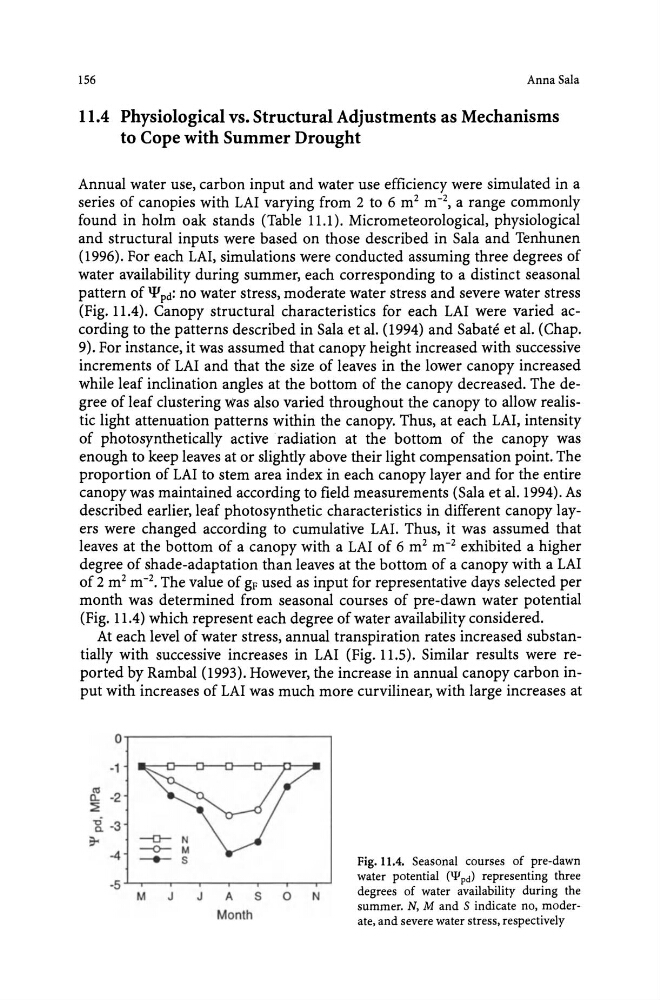
pattern of'll pd: no water stress, moderate water stress and severe water stress
(Fig. 11.4). Canopy structural characteristics for each LAI were varied according to the patterns described in Sala et al. (1994) and Sabate et al. (Chap.
9). For instance, it was assumed that canopy height increased with successive
increments of LAI and that the size of leaves in the lower canopy increased
while leaf inclination angles at the bottom of the canopy decreased. The degree of leaf clustering was also varied throughout the canopy to allow realistic light attenuation patterns within the canopy. Thus, at each LAI, intensity
of photosynthetically active radiation at the bottom of the canopy was
enough to keep leaves at or slightly above their light compensation point. The
proportion of LAI to stem area index in each canopy layer and for the entire
canopy was maintained according to field measurements (Sala et al. 1994). As
described earlier, leaf photosynthetic characteristics in different canopy layers were changed according to cumulative LAI. Thus, it was assumed that
leaves at the bottom of a canopy with a LAI of 6 m 2 m- 2 exhibited a higher
degree of shade-adaptation than leaves at the bottom of a canopy with aLAI
of 2 m 2 m- 2 • The value of gF used as input for representative days selected per
month was determined from seasonal courses of pre-dawn water potential
(Fig. 11.4) which represent each degree of water availability considered.
At each level of water stress, annual transpiration rates increased substantially with successive increases in LAI (Fig. 11.5). Similar results were reported by Rambal (1993). However, the increase in annual canopy carbon input with increases of LAI was much more curvilinear, with large increases at
0
-1
('II -2
D..
~
"[ -3
3-4
-5
- 0 -
- 0 -
---M
J
N
M
5
J
A S O N
Month
Fig. 11.4. Seasonal courses of pre-dawn
water potential (IP pd) representing three
degrees of water availability during the
summer. N, M and S indicate no, moderate, and severe water stress, respectively
AnnaSala
11.4 Physiological vs. Structural Adjustments as Mechanisms
to Cope with Summer Drought
Annual water use, carbon input and water use efficiency were simulated in a
series of canopies with LAI varying from 2 to 6 m 2 m- 2 , a range commonly
found in holm oak stands (Table 11.1). Micrometeorological, physiological
and structural inputs were based on those described in Sala and Tenhunen
(1996) . For each LAI, simulations were conducted assuming three degrees of
water availability during summer, each corresponding to a distinct seasonal
pattern of'll pd: no water stress, moderate water stress and severe water stress
(Fig. 11.4). Canopy structural characteristics for each LAI were varied according to the patterns described in Sala et al. (1994) and Sabate et al. (Chap.
9). For instance, it was assumed that canopy height increased with successive
increments of LAI and that the size of leaves in the lower canopy increased
while leaf inclination angles at the bottom of the canopy decreased. The degree of leaf clustering was also varied throughout the canopy to allow realistic light attenuation patterns within the canopy. Thus, at each LAI, intensity
of photosynthetically active radiation at the bottom of the canopy was
enough to keep leaves at or slightly above their light compensation point. The
proportion of LAI to stem area index in each canopy layer and for the entire
canopy was maintained according to field measurements (Sala et al. 1994). As
described earlier, leaf photosynthetic characteristics in different canopy layers were changed according to cumulative LAI. Thus, it was assumed that
leaves at the bottom of a canopy with a LAI of 6 m 2 m- 2 exhibited a higher
degree of shade-adaptation than leaves at the bottom of a canopy with aLAI
of 2 m 2 m- 2 • The value of gF used as input for representative days selected per
month was determined from seasonal courses of pre-dawn water potential
(Fig. 11.4) which represent each degree of water availability considered.
At each level of water stress, annual transpiration rates increased substantially with successive increases in LAI (Fig. 11.5). Similar results were reported by Rambal (1993). However, the increase in annual canopy carbon input with increases of LAI was much more curvilinear, with large increases at
0
-1
('II -2
D..
~
"[ -3
3-4
-5
- 0 -
- 0 -
---M
J
N
M
5
J
A S O N
Month
Fig. 11.4. Seasonal courses of pre-dawn
water potential (IP pd) representing three
degrees of water availability during the
summer. N, M and S indicate no, moderate, and severe water stress, respectively