

Leaf Traits and Canopy Organization
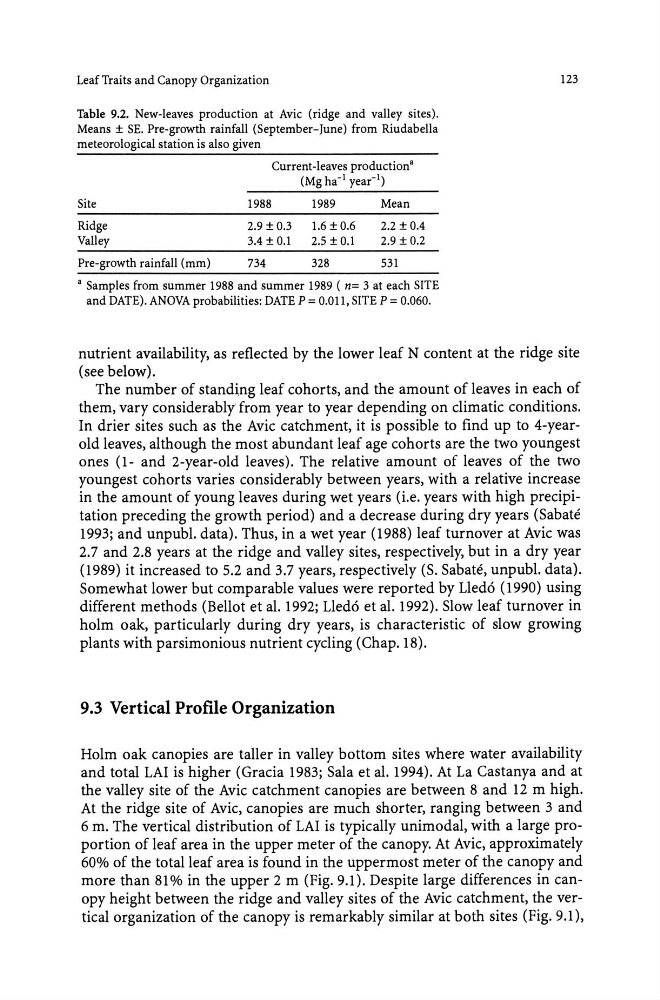
Table 9.2. New-leaves production at Avic (ridge and valley sites).
Means ± SE. Pre-growth rainfall (September-June) from Riudabella
meteorological station is also given
Site
Ridge
Valley
Pre-growth rainfall (mm)
Current -leaves production'
(Mg ha- I year-I)
1988
1989
Mean
2.9 ± 0.3 1.6 ± 0.6
2.2 ± 0.4
3.4 ± 0.1 2.5 ± 0.1
2.9 ± 0.2
734
328
531
a Samples from summer 1988 and summer 1989 ( n= 3 at each SITE
and DATE). ANOVA probabilities: DATE P = 0.011, SITE P = 0.060.
123
nutrient availability, as reflected by the lower leaf N content at the ridge site
(see below).
The number of standing leaf cohorts, and the amount of leaves in each of
them, vary considerably from year to year depending on climatic conditions.
In drier sites such as the Avic catchment, it is possible to find up to 4-yearold leaves, although the most abundant leaf age cohorts are the two youngest
ones (1- and 2-year-old leaves). The relative amount of leaves of the two
youngest cohorts varies considerably between years, with a relative increase
in the amount of young leaves during wet years (Le. years with high precipitation preceding the growth period) and a decrease during dry years (Sabate
1993; and unpubl. data). Thus, in a wet year (1988) leaf turnover at Avic was
2.7 and 2.8 years at the ridge and valley sites, respectively, but in a dry year
(1989) it increased to 5.2 and 3.7 years, respectively (S. Sabate, unpubl. data).
Somewhat lower but comparable values were reported by Lled6 (1990) using
different methods (Bellot et al. 1992; Lled6 et al. 1992). Slow leaf turnover in
holm oak, particularly during dry years, is characteristic of slow growing
plants with parsimonious nutrient cycling (Chap. 18).
9.3 Vertical Profile Organization
Holm oak canopies are taller in valley bottom sites where water availability
and total LAI is higher (Gracia 1983; Sala et al. 1994). At La Castanya and at
the valley site of the Avic catchment canopies are between 8 and 12 m high.
At the ridge site of Avic, canopies are much shorter, ranging between 3 and
6 m. The vertical distribution of LAI is typically unimodal, with a large proportion of leaf area in the upper meter of the canopy. At Avic, approximately
60% of the total leaf area is found in the uppermost meter of the canopy and
more than 81 % in the upper 2 m (Fig. 9.1). Despite large differences in canopy height between the ridge and valley sites of the Avic catchment, the vertical organization of the canopy is remarkably similar at both sites (Fig. 9.1),
Table 9.2. New-leaves production at Avic (ridge and valley sites).
Means ± SE. Pre-growth rainfall (September-June) from Riudabella
meteorological station is also given
Site
Ridge
Valley
Pre-growth rainfall (mm)
Current -leaves production'
(Mg ha- I year-I)
1988
1989
Mean
2.9 ± 0.3 1.6 ± 0.6
2.2 ± 0.4
3.4 ± 0.1 2.5 ± 0.1
2.9 ± 0.2
734
328
531
a Samples from summer 1988 and summer 1989 ( n= 3 at each SITE
and DATE). ANOVA probabilities: DATE P = 0.011, SITE P = 0.060.
123
nutrient availability, as reflected by the lower leaf N content at the ridge site
(see below).
The number of standing leaf cohorts, and the amount of leaves in each of
them, vary considerably from year to year depending on climatic conditions.
In drier sites such as the Avic catchment, it is possible to find up to 4-yearold leaves, although the most abundant leaf age cohorts are the two youngest
ones (1- and 2-year-old leaves). The relative amount of leaves of the two
youngest cohorts varies considerably between years, with a relative increase
in the amount of young leaves during wet years (Le. years with high precipitation preceding the growth period) and a decrease during dry years (Sabate
1993; and unpubl. data). Thus, in a wet year (1988) leaf turnover at Avic was
2.7 and 2.8 years at the ridge and valley sites, respectively, but in a dry year
(1989) it increased to 5.2 and 3.7 years, respectively (S. Sabate, unpubl. data).
Somewhat lower but comparable values were reported by Lled6 (1990) using
different methods (Bellot et al. 1992; Lled6 et al. 1992). Slow leaf turnover in
holm oak, particularly during dry years, is characteristic of slow growing
plants with parsimonious nutrient cycling (Chap. 18).
9.3 Vertical Profile Organization
Holm oak canopies are taller in valley bottom sites where water availability
and total LAI is higher (Gracia 1983; Sala et al. 1994). At La Castanya and at
the valley site of the Avic catchment canopies are between 8 and 12 m high.
At the ridge site of Avic, canopies are much shorter, ranging between 3 and
6 m. The vertical distribution of LAI is typically unimodal, with a large proportion of leaf area in the upper meter of the canopy. At Avic, approximately
60% of the total leaf area is found in the uppermost meter of the canopy and
more than 81 % in the upper 2 m (Fig. 9.1). Despite large differences in canopy height between the ridge and valley sites of the Avic catchment, the vertical organization of the canopy is remarkably similar at both sites (Fig. 9.1),