

122
Santiago Sabate, Anna Sala and Carlos A. Gracia
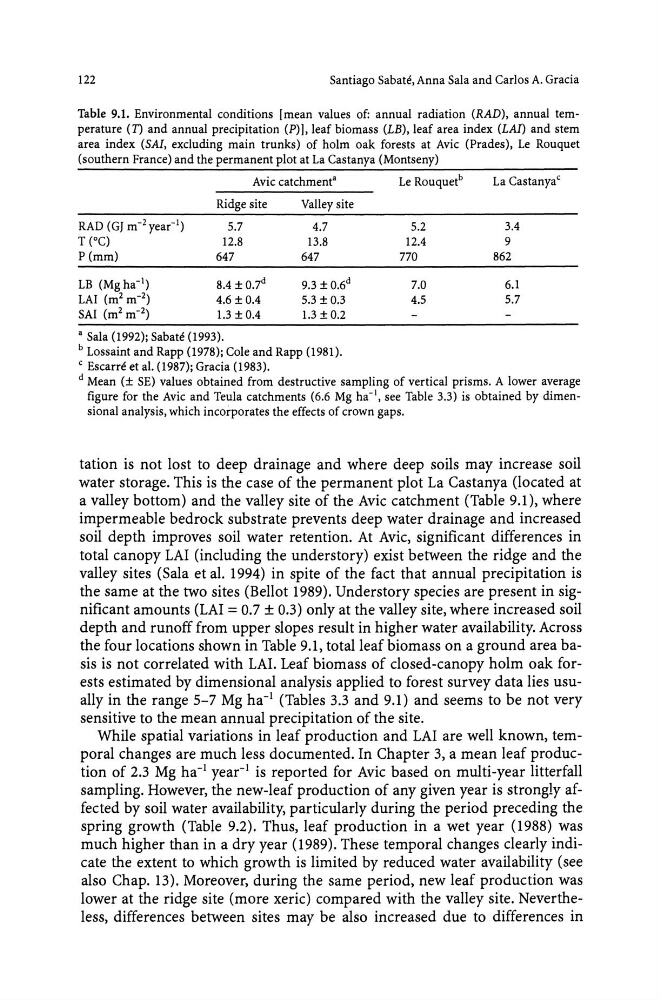
Table 9.1. Environmental conditions [mean values of: annual radiation (RAD), annual temperature (T) and annual precipitation (P»), leaf biomass (LB), leaf area index (LAI) and stem
area index (SAl, excluding main trunks) of holm oak forests at Avic (Prades), Le Rouquet
(southern France) and the permanent plot at La Castanya (Montseny)
Avic catchment"
Ridge site
RAD (GJ m- 2 year- 1 )
5.7
T (OC)
12.8
P{mm)
647
LB (Mgha- 1 )
8.4±0.7 d
LAI (m 2 m- 2 )
4.6 ± 0.4
SAl (m 2 m- 2 )
1.3 ± 0.4
• Sala (1992); Sabate (1993).
Valley site
4.7
13.8
647
9.3 ±0.6 d
5.3 ±0.3
1.3 ± 0.2
b Lossaint and Rapp (1978); Cole and Rapp (1981).
C Escarre et al. (1987); Gracia (1983).
Le Rouquet b
5.2
12.4
770
7.0
4.5
La Castanya C
3.4
9
862
6.1
5.7
d Mean (± SE) values obtained from destructive sampling of vertical prisms. A lower average
figure for the Avic and Teula catchments (6.6 Mg ha- 1 , see Table 3.3) is obtained by dimensional analysis, which incorporates the effects of crown gaps.
tation is not lost to deep drainage and where deep soils may increase soil
water storage. This is the case of the permanent plot La Castanya (located at
a valley bottom) and the valley site of the Avic catchment (Table 9.1), where
impermeable bedrock substrate prevents deep water drainage and increased
soil depth improves soil water retention. At Avic, significant differences in
total canopy LAI (including the understory) exist between the ridge and the
valley sites (Sala et al. 1994) in spite of the fact that annual precipitation is
the same at the two sites (Bellot 1989). Understory species are present in significant amounts (LAI = 0.7 ± 0.3) only at the valley site, where increased soil
depth and runoff from upper slopes result in higher water availability. Across
the four locations shown in Table 9.1, total leaf biomass on a ground area basis is not correlated with LAI. Leaf biomass of closed-canopy holm oak forests estimated by dimensional analysis applied to forest survey data lies usually in the range 5-7 Mg ha- J (Tables 3.3 and 9.1) and seems to be not very
sensitive to the mean annual precipitation of the site.
While spatial variations in leaf production and LAI are well known, temporal changes are much less documented. In Chapter 3, a mean leaf production of 2.3 Mg ha- J year- J is reported for Avic based on multi-year litterfall
sampling. However, the new-leaf production of any given year is strongly affected by soil water availability, particularly during the period preceding the
spring growth (Table 9.2). Thus, leaf production in a wet year (1988) was
much higher than in a dry year (1989). These temporal changes clearly indicate the extent to which growth is limited by reduced water availability (see
also Chap. 13). Moreover, during the same period, new leaf production was
lower at the ridge site (more xeric) compared with the valley site. Nevertheless, differences between sites may be also increased due to differences in
Santiago Sabate, Anna Sala and Carlos A. Gracia
Table 9.1. Environmental conditions [mean values of: annual radiation (RAD), annual temperature (T) and annual precipitation (P»), leaf biomass (LB), leaf area index (LAI) and stem
area index (SAl, excluding main trunks) of holm oak forests at Avic (Prades), Le Rouquet
(southern France) and the permanent plot at La Castanya (Montseny)
Avic catchment"
Ridge site
RAD (GJ m- 2 year- 1 )
5.7
T (OC)
12.8
P{mm)
647
LB (Mgha- 1 )
8.4±0.7 d
LAI (m 2 m- 2 )
4.6 ± 0.4
SAl (m 2 m- 2 )
1.3 ± 0.4
• Sala (1992); Sabate (1993).
Valley site
4.7
13.8
647
9.3 ±0.6 d
5.3 ±0.3
1.3 ± 0.2
b Lossaint and Rapp (1978); Cole and Rapp (1981).
C Escarre et al. (1987); Gracia (1983).
Le Rouquet b
5.2
12.4
770
7.0
4.5
La Castanya C
3.4
9
862
6.1
5.7
d Mean (± SE) values obtained from destructive sampling of vertical prisms. A lower average
figure for the Avic and Teula catchments (6.6 Mg ha- 1 , see Table 3.3) is obtained by dimensional analysis, which incorporates the effects of crown gaps.
tation is not lost to deep drainage and where deep soils may increase soil
water storage. This is the case of the permanent plot La Castanya (located at
a valley bottom) and the valley site of the Avic catchment (Table 9.1), where
impermeable bedrock substrate prevents deep water drainage and increased
soil depth improves soil water retention. At Avic, significant differences in
total canopy LAI (including the understory) exist between the ridge and the
valley sites (Sala et al. 1994) in spite of the fact that annual precipitation is
the same at the two sites (Bellot 1989). Understory species are present in significant amounts (LAI = 0.7 ± 0.3) only at the valley site, where increased soil
depth and runoff from upper slopes result in higher water availability. Across
the four locations shown in Table 9.1, total leaf biomass on a ground area basis is not correlated with LAI. Leaf biomass of closed-canopy holm oak forests estimated by dimensional analysis applied to forest survey data lies usually in the range 5-7 Mg ha- J (Tables 3.3 and 9.1) and seems to be not very
sensitive to the mean annual precipitation of the site.
While spatial variations in leaf production and LAI are well known, temporal changes are much less documented. In Chapter 3, a mean leaf production of 2.3 Mg ha- J year- J is reported for Avic based on multi-year litterfall
sampling. However, the new-leaf production of any given year is strongly affected by soil water availability, particularly during the period preceding the
spring growth (Table 9.2). Thus, leaf production in a wet year (1988) was
much higher than in a dry year (1989). These temporal changes clearly indicate the extent to which growth is limited by reduced water availability (see
also Chap. 13). Moreover, during the same period, new leaf production was
lower at the ridge site (more xeric) compared with the valley site. Nevertheless, differences between sites may be also increased due to differences in