

124
Santiago Sabate, Anna Sala and Carlos A. Gracia
c=J Q. ilex leaves <1 year-old
_
Other species' leaves
CJ Q. ilex leaves 1 year or older
11
11
10
10
I
9
9 .........
8
8 .s
1:
...
7
7 .s:::.
C)
OJ
'0;
6
6 'CD
.s:::.
5
5
.s:::.
>.
>.
a. 4
4
a.
0
0
&::
3
3
c:
~
~
0
2
2 0
1
Valley site
Ridge site
1
a
a
a 0.5 1.0 1.5 2.0 a 0.5 1.0 1.5 2.0
Leaf Area Index, m 2 m--2
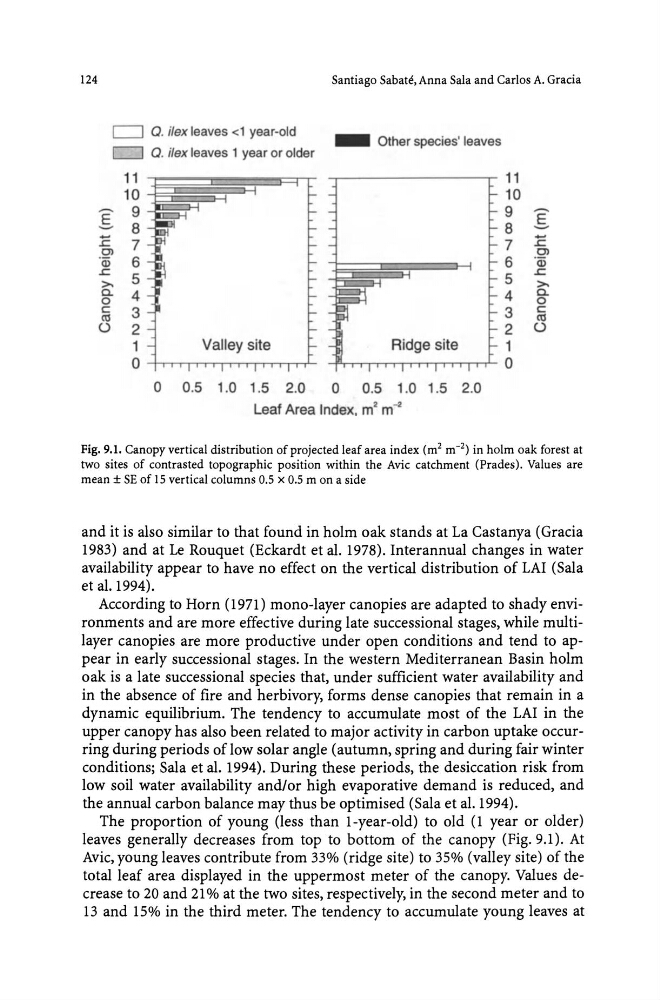
Fig. 9.1. Canopy vertical distribution of projected leaf area index (m 2 m- 2 ) in holm oak forest at
two sites of contrasted topographic position within the Avic catchment (Prades). Values are
mean ± SE of 15 vertical columns 0.5 x 0.5 m on a side
and it is also similar to that found in holm oak stands at La Castanya (Gracia
1983) and at Le Rouquet (Eckardt et al. 1978). Interannual changes in water
availability appear to have no effect on the vertical distribution of LAI (Sala
et al.1994).
According to Horn (1971) mono-layer canopies are adapted to shady environments and are more effective during late successional stages, while multilayer canopies are more productive under open conditions and tend to appear in early successional stages. In the western Mediterranean Basin holm
oak is a late successional species that, under sufficient water availability and
in the absence of fire and herbivory, forms dense canopies that remain in a
dynamic equilibrium. The tendency to accumulate most of the LAI in the
upper canopy has also been related to major activity in carbon uptake occurring during periods of low solar angle (autumn, spring and during fair winter
conditions; Sala et al. 1994). During these periods, the desiccation risk from
low soil water availability and/or high evaporative demand is reduced, and
the annual carbon balance may thus be optimised (Sala et al. 1994).
The proportion of young (less than I-year-old) to old (1 year or older)
leaves generally decreases from top to bottom of the canopy (Fig. 9.1). At
Avic, young leaves contribute from 33% (ridge site) to 35% (valley site) of the
total leaf area displayed in the uppermost meter of the canopy. Values decrease to 20 and 21 % at the two sites, respectively, in the second meter and to
13 and 15% in the third meter. The tendency to accumulate young leaves at
Santiago Sabate, Anna Sala and Carlos A. Gracia
c=J Q. ilex leaves <1 year-old
_
Other species' leaves
CJ Q. ilex leaves 1 year or older
11
11
10
10
I
9
9 .........
8
8 .s
1:
...
7
7 .s:::.
C)
OJ
'0;
6
6 'CD
.s:::.
5
5
.s:::.
>.
>.
a. 4
4
a.
0
0
&::
3
3
c:
~
~
0
2
2 0
1
Valley site
Ridge site
1
a
a
a 0.5 1.0 1.5 2.0 a 0.5 1.0 1.5 2.0
Leaf Area Index, m 2 m--2
Fig. 9.1. Canopy vertical distribution of projected leaf area index (m 2 m- 2 ) in holm oak forest at
two sites of contrasted topographic position within the Avic catchment (Prades). Values are
mean ± SE of 15 vertical columns 0.5 x 0.5 m on a side
and it is also similar to that found in holm oak stands at La Castanya (Gracia
1983) and at Le Rouquet (Eckardt et al. 1978). Interannual changes in water
availability appear to have no effect on the vertical distribution of LAI (Sala
et al.1994).
According to Horn (1971) mono-layer canopies are adapted to shady environments and are more effective during late successional stages, while multilayer canopies are more productive under open conditions and tend to appear in early successional stages. In the western Mediterranean Basin holm
oak is a late successional species that, under sufficient water availability and
in the absence of fire and herbivory, forms dense canopies that remain in a
dynamic equilibrium. The tendency to accumulate most of the LAI in the
upper canopy has also been related to major activity in carbon uptake occurring during periods of low solar angle (autumn, spring and during fair winter
conditions; Sala et al. 1994). During these periods, the desiccation risk from
low soil water availability and/or high evaporative demand is reduced, and
the annual carbon balance may thus be optimised (Sala et al. 1994).
The proportion of young (less than I-year-old) to old (1 year or older)
leaves generally decreases from top to bottom of the canopy (Fig. 9.1). At
Avic, young leaves contribute from 33% (ridge site) to 35% (valley site) of the
total leaf area displayed in the uppermost meter of the canopy. Values decrease to 20 and 21 % at the two sites, respectively, in the second meter and to
13 and 15% in the third meter. The tendency to accumulate young leaves at