

112
Miguel A. Zavala
adults that reproduce at a constant rate and disperse their seeds to random
locations within the stand.
Seedling mortality functions were calibrated from experimental studies by
Espelta (1996). These studies indicate a positive dependence of holm oak and
Aleppo pine survival on water availability and a strong negative effect of light
on holm oak and only a moderately negative effect on Aleppo pine. Sapling
mortality probability is modelled as a logistic function of light availability,
with the inflection point reflecting the maximum degree of shade, measured
as the percentage of full sunlight that a sapling can tolerate: Lp for the pine
and Lo for the oak (Lo > Lp). In each generation, light is measured as a percentage of total photosynthetic available radiation (PAR) and follows an exponential decay that depends on each species' basal area and light extinction
coefficients (Beer's law). For simplicity, the effect of holm oak resprouting
and sapling mortality dependence on water are not considered in these
simulations, but their inclusion does not change the broad qualitative results
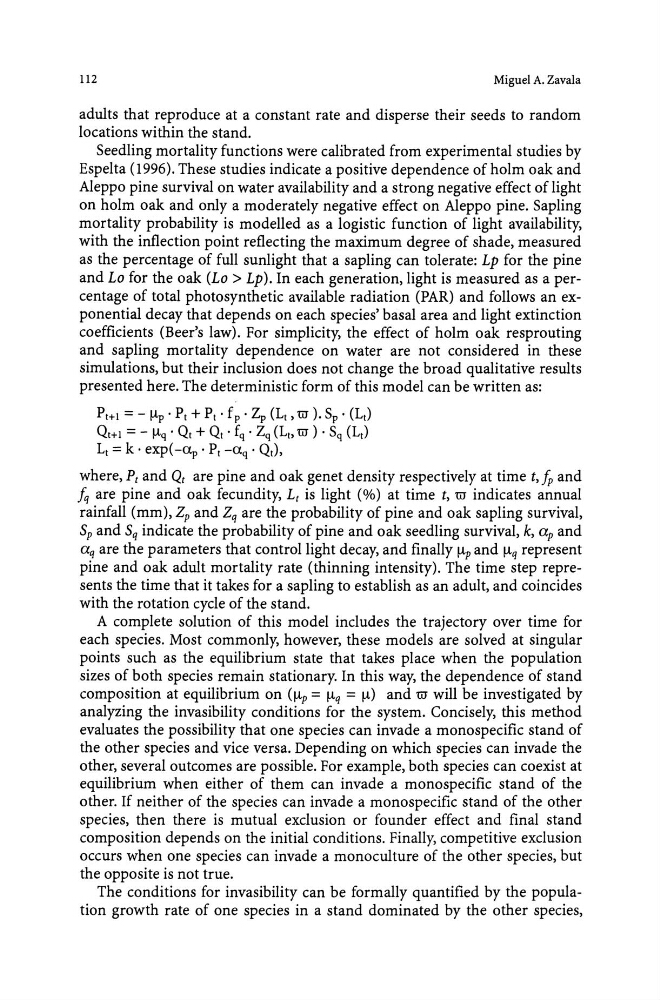
presented here. The deterministic form of this model can be written as:
PI+! = - !!p . PI + PI . f p . Zp (LI ,W ). Sp . (LI )
Ot+! = - !!q . 01 + 01 . fq . Zq (LI> W ) • Sq (LI)
LI = k· exp(-up ' PI -uq ' 01),
where, Pt and Qt are pine and oak genet density respectively at time t, fP and
fq are pine and oak fecundity, L t is light (%) at time t, W indicates annual
rainfall (mm), Zp and Zq are the probability of pine and oak sapling survival,
Sp and Sq indicate the probability of pine and oak seedling survival, k, ap and
aq are the parameters that control light decay, and finally !!p and !!q represent
pine and oak adult mortality rate (thinning intensity). The time step represents the time that it takes for a sapling to establish as an adult, and coincides
with the rotation cycle of the stand.
A complete solution of this model includes the trajectory over time for
each species. Most commonly, however, these models are solved at singular
points such as the equilibrium state that takes place when the population
sizes of both species remain stationary. In this way, the dependence of stand
composition at equilibrium on (!!p = !!q =!!) and W will be investigated by
analyzing the invasibility conditions for the system. Concisely, this method
evaluates the possibility that one species can invade a mono specific stand of
the other species and vice versa. Depending on which species can invade the
other, several outcomes are possible. For example, both species can coexist at
equilibrium when either of them can invade a monospecific stand of the
other. If neither of the species can invade a monospecific stand of the other
species, then there is mutual exclusion or founder effect and final stand
composition depends on the initial conditions. Finally, competitive exclusion
occurs when one species can invade a mono culture of the other species, but
the opposite is not true.
The conditions for invasibility can be formally quantified by the population growth rate of one species in a stand dominated by the other species,
Miguel A. Zavala
adults that reproduce at a constant rate and disperse their seeds to random
locations within the stand.
Seedling mortality functions were calibrated from experimental studies by
Espelta (1996). These studies indicate a positive dependence of holm oak and
Aleppo pine survival on water availability and a strong negative effect of light
on holm oak and only a moderately negative effect on Aleppo pine. Sapling
mortality probability is modelled as a logistic function of light availability,
with the inflection point reflecting the maximum degree of shade, measured
as the percentage of full sunlight that a sapling can tolerate: Lp for the pine
and Lo for the oak (Lo > Lp). In each generation, light is measured as a percentage of total photosynthetic available radiation (PAR) and follows an exponential decay that depends on each species' basal area and light extinction
coefficients (Beer's law). For simplicity, the effect of holm oak resprouting
and sapling mortality dependence on water are not considered in these
simulations, but their inclusion does not change the broad qualitative results
presented here. The deterministic form of this model can be written as:
PI+! = - !!p . PI + PI . f p . Zp (LI ,W ). Sp . (LI )
Ot+! = - !!q . 01 + 01 . fq . Zq (LI> W ) • Sq (LI)
LI = k· exp(-up ' PI -uq ' 01),
where, Pt and Qt are pine and oak genet density respectively at time t, fP and
fq are pine and oak fecundity, L t is light (%) at time t, W indicates annual
rainfall (mm), Zp and Zq are the probability of pine and oak sapling survival,
Sp and Sq indicate the probability of pine and oak seedling survival, k, ap and
aq are the parameters that control light decay, and finally !!p and !!q represent
pine and oak adult mortality rate (thinning intensity). The time step represents the time that it takes for a sapling to establish as an adult, and coincides
with the rotation cycle of the stand.
A complete solution of this model includes the trajectory over time for
each species. Most commonly, however, these models are solved at singular
points such as the equilibrium state that takes place when the population
sizes of both species remain stationary. In this way, the dependence of stand
composition at equilibrium on (!!p = !!q =!!) and W will be investigated by
analyzing the invasibility conditions for the system. Concisely, this method
evaluates the possibility that one species can invade a mono specific stand of
the other species and vice versa. Depending on which species can invade the
other, several outcomes are possible. For example, both species can coexist at
equilibrium when either of them can invade a monospecific stand of the
other. If neither of the species can invade a monospecific stand of the other
species, then there is mutual exclusion or founder effect and final stand
composition depends on the initial conditions. Finally, competitive exclusion
occurs when one species can invade a mono culture of the other species, but
the opposite is not true.
The conditions for invasibility can be formally quantified by the population growth rate of one species in a stand dominated by the other species,