

A Model of Stand Dynamics for Holm Oak-Aleppo Pine Forests
8.4 Mechanistic Models of Stand Dynamics
in Mixed Holm Oak-Aleppo Pine Forests
III
Correlational top-down models provide a quantitative description of largescale forest structure in relation to environmental gradients. However, ecologists and foresters are mainly concerned with the identification of the species-specific traits that control stand composition. In Mediterranean forests,
the interaction of soil moisture and radiation appears as the main determinant of stand development (Olazabal 1916; Gonzalez Vazquez 1947; Espelta
1996), so patterns in stand dynamics and composition might be explained in
terms of species-specific responses to light intensity and soil moisture.
In the case of mixed holm oak-Aleppo pine forests these two species show
throughout their life cycle remarkable differences in the way they respond to
light and water availability, particularly during the seedling and sapling
stages (Espelta et al. 1995). The effect of these traits on stand composition for
different levels of management and rainfall can be investigated with an analytical model of stand dynamics calibrated from experimental data. The
model determines stand dynamics for patches situated along a rainfall gradient; within a stand, however, soil moisture is spatially uniform. Plants are
tracked individually starting from a given number of adult pines and oaks
that are randomly dispersed in the population. In each rotation, management
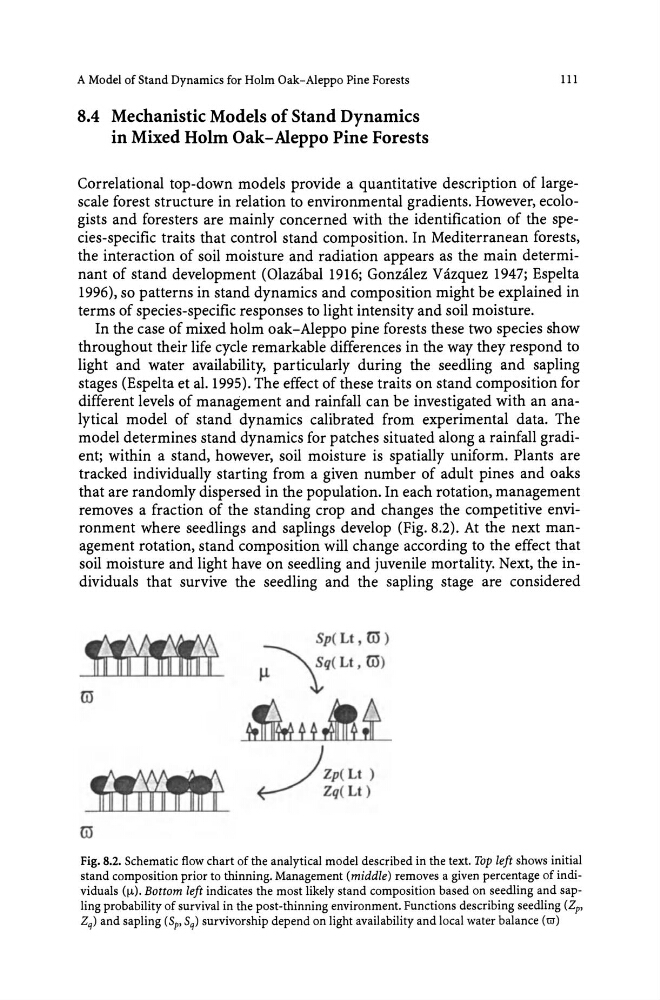
removes a fraction of the standing crop and changes the competitive environment where seedlings and saplings develop (Fig. 8.2). At the next management rotation, stand composition will change according to the effect that
soil moisture and light have on seedling and juvenile mortality. Next, the individuals that survive the seedling and the sapling stage are considered
m
Sp( Lt , m )
~q( Lt . rn)
&**,m~
}zp( Lt )
~ Zq( Lt )
Fig. 8.2. Schematic flow chart of the analytical model described in the text. Top left shows initial
stand composition prior to thinning. Management (middle) removes a given percentage of individuals (fA). Bottom left indicates the most likely stand composition based on seedling and sapling probability of survival in the post-thinning environment. Functions describing seedling (Zp,
Zq) and sapling (Sp, Sq) survivorship depend on light availability and local water balance (ro)
8.4 Mechanistic Models of Stand Dynamics
in Mixed Holm Oak-Aleppo Pine Forests
III
Correlational top-down models provide a quantitative description of largescale forest structure in relation to environmental gradients. However, ecologists and foresters are mainly concerned with the identification of the species-specific traits that control stand composition. In Mediterranean forests,
the interaction of soil moisture and radiation appears as the main determinant of stand development (Olazabal 1916; Gonzalez Vazquez 1947; Espelta
1996), so patterns in stand dynamics and composition might be explained in
terms of species-specific responses to light intensity and soil moisture.
In the case of mixed holm oak-Aleppo pine forests these two species show
throughout their life cycle remarkable differences in the way they respond to
light and water availability, particularly during the seedling and sapling
stages (Espelta et al. 1995). The effect of these traits on stand composition for
different levels of management and rainfall can be investigated with an analytical model of stand dynamics calibrated from experimental data. The
model determines stand dynamics for patches situated along a rainfall gradient; within a stand, however, soil moisture is spatially uniform. Plants are
tracked individually starting from a given number of adult pines and oaks
that are randomly dispersed in the population. In each rotation, management
removes a fraction of the standing crop and changes the competitive environment where seedlings and saplings develop (Fig. 8.2). At the next management rotation, stand composition will change according to the effect that
soil moisture and light have on seedling and juvenile mortality. Next, the individuals that survive the seedling and the sapling stage are considered
m
Sp( Lt , m )
~q( Lt . rn)
&**,m~
}zp( Lt )
~ Zq( Lt )
Fig. 8.2. Schematic flow chart of the analytical model described in the text. Top left shows initial
stand composition prior to thinning. Management (middle) removes a given percentage of individuals (fA). Bottom left indicates the most likely stand composition based on seedling and sapling probability of survival in the post-thinning environment. Functions describing seedling (Zp,
Zq) and sapling (Sp, Sq) survivorship depend on light availability and local water balance (ro)