

100
Javier Retana, Josep Maria Espelta, Marc Gracia and Miquel Riba
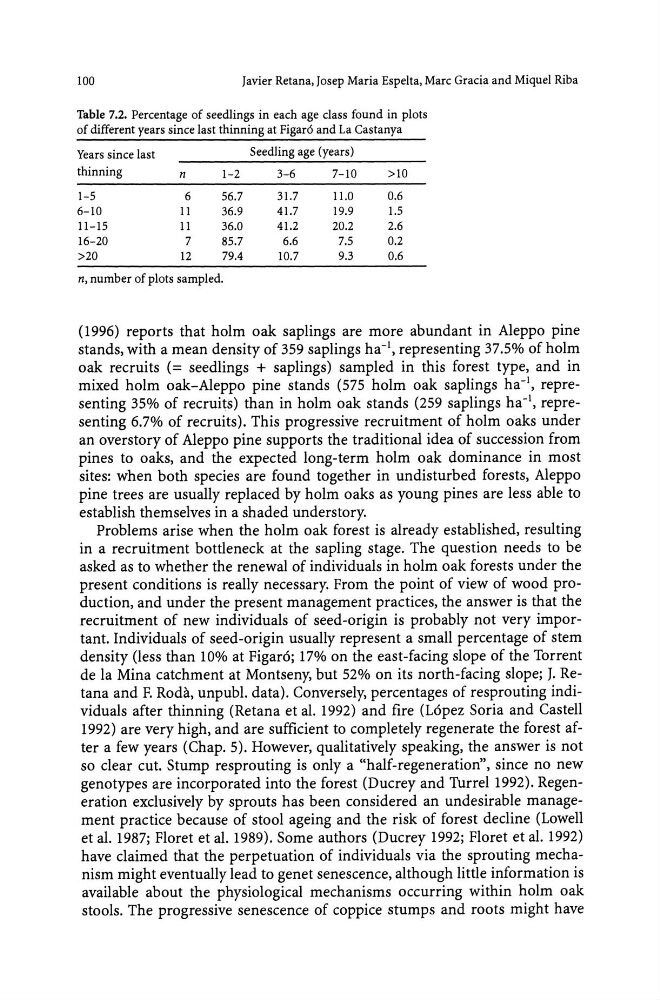
Table 7.2. Percentage of seedlings in each age class found in plots
of different years since last thinning at Figaro and La Castanya
Years since last
Seedling age (years)
thinning
n
1-2
3-6
7-10
>10
1-5
6
56.7
31.7
11.0
0.6
6-10
11
36.9
41.7
19.9
1.5
11-15
11
36.0
41.2
20.2
2.6
16-20
7
85.7
6.6
7.5
0.2
>20
12
79.4
10.7
9.3
0.6
n, number of plots sampled.
(1996) reports that holm oak saplings are more abundant in Aleppo pine
stands, with a mean density of 359 saplings ha- 1 , representing 37.5% of holm
oak recruits (= seedlings + saplings) sampled in this forest type, and in
mixed holm oak-Aleppo pine stands (575 holm oak saplings ha- 1 , representing 35% of recruits) than in holm oak stands (259 saplings ha- 1 , representing 6.7% of recruits). This progressive recruitment of holm oaks under
an overs tory of Aleppo pine supports the traditional idea of succession from
pines to oaks, and the expected long-term holm oak dominance in most
sites: when both species are found together in undisturbed forests, Aleppo
pine trees are usually replaced by holm oaks as young pines are less able to
establish themselves in a shaded understory.
Problems arise when the holm oak forest is already established, resulting
in a recruitment bottleneck at the sapling stage. The question needs to be
asked as to whether the renewal of individuals in holm oak forests under the
present conditions is really necessary. From the point of view of wood production, and under the present management practices, the answer is that the
recruitment of new individuals of seed-origin is probably not very important. Individuals of seed-origin usually represent a small percentage of stem
density (less than 10% at Figar6; 17% on the east-facing slope of the Torrent
de la Mina catchment at Montseny, but 52% on its north-facing slope; J. Retana and F. Roda, unpubl. data). Conversely, percentages of resprouting individuals after thinning (Retana et al. 1992) and fire (L6pez Soria and Castell
1992) are very high, and are sufficient to completely regenerate the forest after a few years (Chap. 5). However, qualitatively speaking, the answer is not
so clear cut. Stump resprouting is only a "half-regeneration", since no new
genotypes are incorporated into the forest (Ducrey and Turrel1992). Regeneration exclusively by sprouts has been considered an undesirable management practice because of stool ageing and the risk of forest decline (Lowell
et al. 1987; Floret et al. 1989). Some authors (Ducrey 1992; Floret et al. 1992)
have claimed that the perpetuation of individuals via the sprouting mechanism might eventually lead to genet senescence, although little information is
available about the physiological mechanisms occurring within holm oak
stools. The progressive senescence of coppice stumps and roots might have
Javier Retana, Josep Maria Espelta, Marc Gracia and Miquel Riba
Table 7.2. Percentage of seedlings in each age class found in plots
of different years since last thinning at Figaro and La Castanya
Years since last
Seedling age (years)
thinning
n
1-2
3-6
7-10
>10
1-5
6
56.7
31.7
11.0
0.6
6-10
11
36.9
41.7
19.9
1.5
11-15
11
36.0
41.2
20.2
2.6
16-20
7
85.7
6.6
7.5
0.2
>20
12
79.4
10.7
9.3
0.6
n, number of plots sampled.
(1996) reports that holm oak saplings are more abundant in Aleppo pine
stands, with a mean density of 359 saplings ha- 1 , representing 37.5% of holm
oak recruits (= seedlings + saplings) sampled in this forest type, and in
mixed holm oak-Aleppo pine stands (575 holm oak saplings ha- 1 , representing 35% of recruits) than in holm oak stands (259 saplings ha- 1 , representing 6.7% of recruits). This progressive recruitment of holm oaks under
an overs tory of Aleppo pine supports the traditional idea of succession from
pines to oaks, and the expected long-term holm oak dominance in most
sites: when both species are found together in undisturbed forests, Aleppo
pine trees are usually replaced by holm oaks as young pines are less able to
establish themselves in a shaded understory.
Problems arise when the holm oak forest is already established, resulting
in a recruitment bottleneck at the sapling stage. The question needs to be
asked as to whether the renewal of individuals in holm oak forests under the
present conditions is really necessary. From the point of view of wood production, and under the present management practices, the answer is that the
recruitment of new individuals of seed-origin is probably not very important. Individuals of seed-origin usually represent a small percentage of stem
density (less than 10% at Figar6; 17% on the east-facing slope of the Torrent
de la Mina catchment at Montseny, but 52% on its north-facing slope; J. Retana and F. Roda, unpubl. data). Conversely, percentages of resprouting individuals after thinning (Retana et al. 1992) and fire (L6pez Soria and Castell
1992) are very high, and are sufficient to completely regenerate the forest after a few years (Chap. 5). However, qualitatively speaking, the answer is not
so clear cut. Stump resprouting is only a "half-regeneration", since no new
genotypes are incorporated into the forest (Ducrey and Turrel1992). Regeneration exclusively by sprouts has been considered an undesirable management practice because of stool ageing and the risk of forest decline (Lowell
et al. 1987; Floret et al. 1989). Some authors (Ducrey 1992; Floret et al. 1992)
have claimed that the perpetuation of individuals via the sprouting mechanism might eventually lead to genet senescence, although little information is
available about the physiological mechanisms occurring within holm oak
stools. The progressive senescence of coppice stumps and roots might have