

Seedling Recruitment
eedling Recruitment
350
300
........ 250
E
u
'-' 200
lI
150
(!)
W
I
100
SO
0
0
Seedlings
- - Sprouts
2
4
6
8
10
12
14
AGE (years)
99
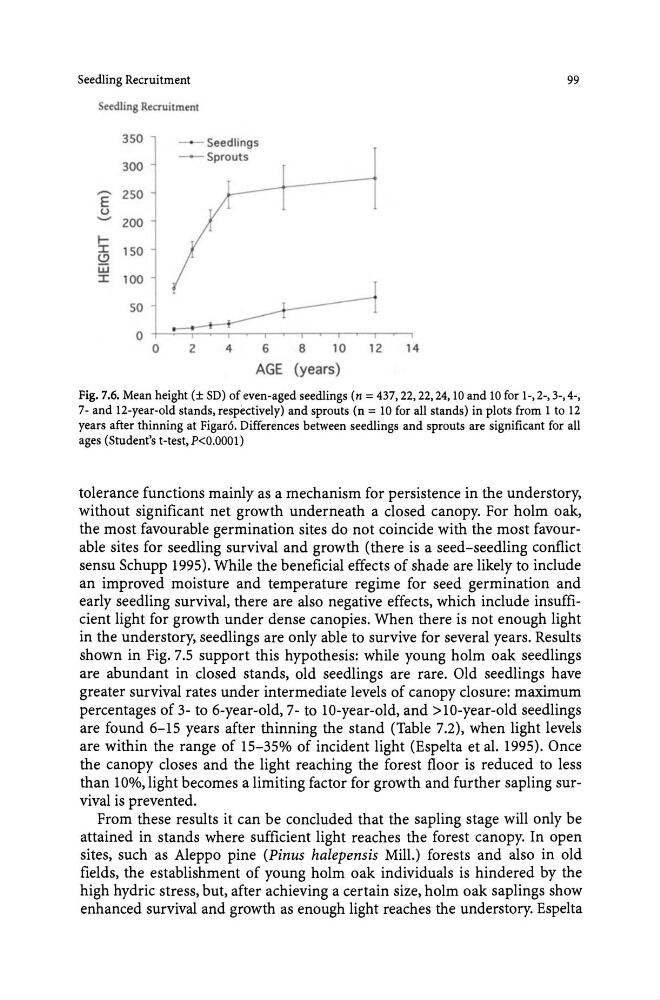
Fig. 7.6. Mean height (± SO) of even-aged seedlings (n = 437,22,22,24,10 and 10 for 1-,2-,3-,4-,
7- and 12-year-old stands, respectively) and sprouts (n = 10 for all stands) in plots from 1 to 12
years after thinning at Figar6. Differences between seedlings and sprouts are significant for all
ages (Student's Hest, P
without significant net growth underneath a closed canopy. For holm oak,
the most favourable germination sites do not coincide with the most favourable sites for seedling survival and growth (there is a seed-seedling conflict
sensu Schupp 1995). While the beneficial effects of shade are likely to include
an improved moisture and temperature regime for seed germination and
early seedling survival, there are also negative effects, which include insufficient light for growth under dense canopies. When there is not enough light
in the understory, seedlings are only able to survive for several years. Results
shown in Fig. 7.5 support this hypothesis: while young holm oak seedlings
are abundant in closed stands, old seedlings are rare. Old seedlings have
greater survival rates under intermediate levels of canopy closure: maximum
percentages of 3- to 6-year-old, 7- to 10-year-old, and >10-year-old seedlings
are found 6-15 years after thinning the stand (Table 7.2), when light levels
are within the range of 15-35% of incident light (Espelta et al. 1995). Once
the canopy closes and the light reaching the forest floor is reduced to less
than 10%, light becomes a limiting factor for growth and further sapling survival is prevented.
From these results it can be concluded that the sapling stage will only be
attained in stands where sufficient light reaches the forest canopy. In open
sites, such as Aleppo pine (Pinus halepensis Mill.) forests and also in old
fields, the establishment of young holm oak individuals is hindered by the
high hydric stress, but, after achieving a certain size, holm oak saplings show
enhanced survival and growth as enough light reaches the understory. Espelta
eedling Recruitment
350
300
........ 250
E
u
'-' 200
lI
150
(!)
W
I
100
SO
0
0
Seedlings
- - Sprouts
2
4
6
8
10
12
14
AGE (years)
99
Fig. 7.6. Mean height (± SO) of even-aged seedlings (n = 437,22,22,24,10 and 10 for 1-,2-,3-,4-,
7- and 12-year-old stands, respectively) and sprouts (n = 10 for all stands) in plots from 1 to 12
years after thinning at Figar6. Differences between seedlings and sprouts are significant for all
ages (Student's Hest, P
without significant net growth underneath a closed canopy. For holm oak,
the most favourable germination sites do not coincide with the most favourable sites for seedling survival and growth (there is a seed-seedling conflict
sensu Schupp 1995). While the beneficial effects of shade are likely to include
an improved moisture and temperature regime for seed germination and
early seedling survival, there are also negative effects, which include insufficient light for growth under dense canopies. When there is not enough light
in the understory, seedlings are only able to survive for several years. Results
shown in Fig. 7.5 support this hypothesis: while young holm oak seedlings
are abundant in closed stands, old seedlings are rare. Old seedlings have
greater survival rates under intermediate levels of canopy closure: maximum
percentages of 3- to 6-year-old, 7- to 10-year-old, and >10-year-old seedlings
are found 6-15 years after thinning the stand (Table 7.2), when light levels
are within the range of 15-35% of incident light (Espelta et al. 1995). Once
the canopy closes and the light reaching the forest floor is reduced to less
than 10%, light becomes a limiting factor for growth and further sapling survival is prevented.
From these results it can be concluded that the sapling stage will only be
attained in stands where sufficient light reaches the forest canopy. In open
sites, such as Aleppo pine (Pinus halepensis Mill.) forests and also in old
fields, the establishment of young holm oak individuals is hindered by the
high hydric stress, but, after achieving a certain size, holm oak saplings show
enhanced survival and growth as enough light reaches the understory. Espelta