

64
U. Schreiber et al.
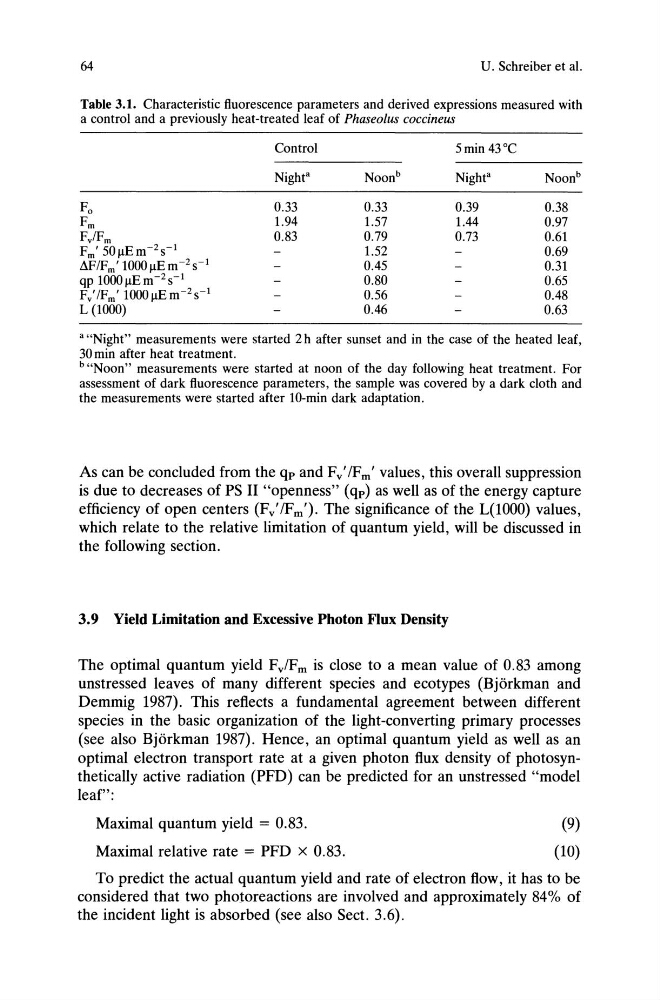
Table 3.1. Characteristic fluorescence parameters and derived expressions measured with
a control and a previously heat-treated leaf of Phaseo/us coccineus
Control
5 min 43°C
Night"
Noon b
Night"
Noon b
Fo
0.33
0.33
0.39
0.38
Fm
1.94
1.57
1.44
0.97
F)Fm
0.83
0.79
0.73
0.61
Fm' 5OIlEm-2s-1
1.52
0.69
dFIF m ' 1000 IlE m- 2 S-I
0.45
0.31
qp 1000IlEm- 2 s- 1
0.80
0.65
Fv'/Fm'1000IlEm-2s-1
0.56
0.48
L (1000)
0.46
0.63
a "Night" measurements were started 2 h after sunset and in the case of the heated leaf,
30 min after heat treatment.
b "Noon" measurements were started at noon of the day following heat treatment. For
assessment of dark fluorescence parameters, the sample was covered by a dark cloth and
the measurements were started after lO-min dark adaptation.
As can be concluded from the qp and Fv' !Fm ' values, this overall suppression
is due to decreases of PS II "openness" (qp) as well as of the energy capture
efficiency of open centers (Fv' !Fm '). The significance of the L(lOOO) values,
which relate to the relative limitation of quantum yield, will be discussed in
the following section.
3.9 Yield Limitation and Excessive Photon Flux Density
The optimal quantum yield F)Fm is close to a mean value of 0.83 among
unstressed leaves of many different species and ecotypes (Bjorkman and
Demmig 1987). This reflects a fundamental agreement between different
species in the basic organization of the light -converting primary processes
(see also Bjorkman 1987). Hence, an optimal quantum yield as well as an
optimal electron transport rate at a given photon flux density of photosynthetically active radiation (PFD) can be predicted for an unstressed "model
leaf":
Maximal quantum yield = 0.83.
Maximal relative rate = PFD x 0.83.
(9)
(10)
To predict the actual quantum yield and rate of electron flow, it has to be
considered that two pholoreactions are involved and approximately 84 % of
the incident light is absorbed (see also Sect. 3.6).
U. Schreiber et al.
Table 3.1. Characteristic fluorescence parameters and derived expressions measured with
a control and a previously heat-treated leaf of Phaseo/us coccineus
Control
5 min 43°C
Night"
Noon b
Night"
Noon b
Fo
0.33
0.33
0.39
0.38
Fm
1.94
1.57
1.44
0.97
F)Fm
0.83
0.79
0.73
0.61
Fm' 5OIlEm-2s-1
1.52
0.69
dFIF m ' 1000 IlE m- 2 S-I
0.45
0.31
qp 1000IlEm- 2 s- 1
0.80
0.65
Fv'/Fm'1000IlEm-2s-1
0.56
0.48
L (1000)
0.46
0.63
a "Night" measurements were started 2 h after sunset and in the case of the heated leaf,
30 min after heat treatment.
b "Noon" measurements were started at noon of the day following heat treatment. For
assessment of dark fluorescence parameters, the sample was covered by a dark cloth and
the measurements were started after lO-min dark adaptation.
As can be concluded from the qp and Fv' !Fm ' values, this overall suppression
is due to decreases of PS II "openness" (qp) as well as of the energy capture
efficiency of open centers (Fv' !Fm '). The significance of the L(lOOO) values,
which relate to the relative limitation of quantum yield, will be discussed in
the following section.
3.9 Yield Limitation and Excessive Photon Flux Density
The optimal quantum yield F)Fm is close to a mean value of 0.83 among
unstressed leaves of many different species and ecotypes (Bjorkman and
Demmig 1987). This reflects a fundamental agreement between different
species in the basic organization of the light -converting primary processes
(see also Bjorkman 1987). Hence, an optimal quantum yield as well as an
optimal electron transport rate at a given photon flux density of photosynthetically active radiation (PFD) can be predicted for an unstressed "model
leaf":
Maximal quantum yield = 0.83.
Maximal relative rate = PFD x 0.83.
(9)
(10)
To predict the actual quantum yield and rate of electron flow, it has to be
considered that two pholoreactions are involved and approximately 84 % of
the incident light is absorbed (see also Sect. 3.6).