

Nonintrusive Indicator for Rapid Assessment of In Vivo Photosynthesis
63
600
450
control
E
u..
-- u..
~v
<:l
300
v
~~
><
0
. /
5 min 43°C
u..
0...
150
'..;IV
o
o
500
1000
1500
2000
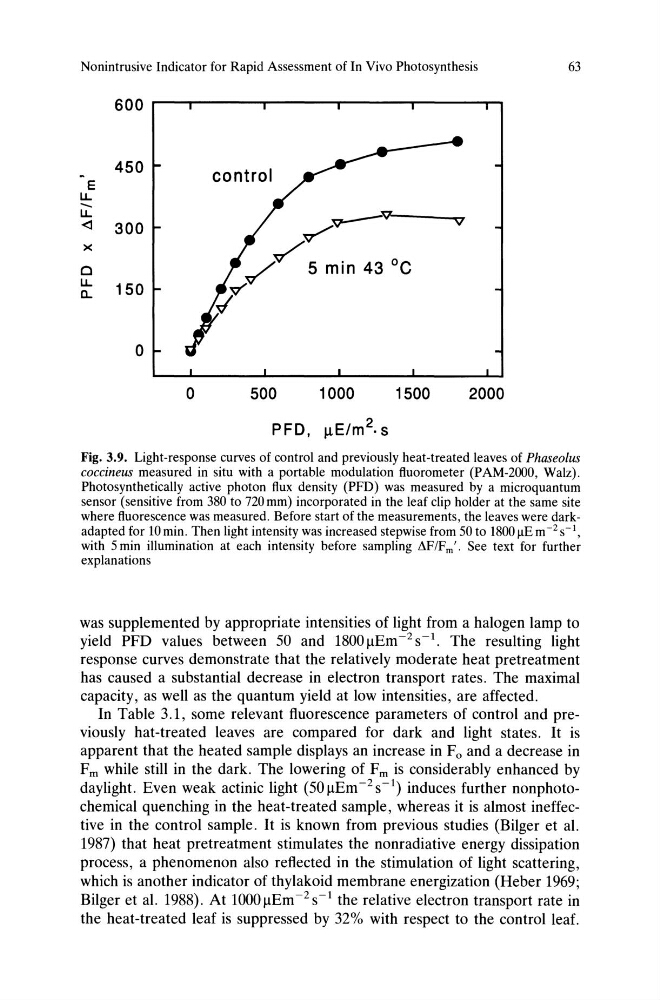
Fig. 3.9. Light-response curves of control and previously heat-treated leaves of Phaseolus
coccineus measured in situ with a portable modulation fluorometer (PAM-2000, Walz).
Photosynthetically active photon flux density (PFD) was measured by a micro quantum
sensor (sensitive from 380 to 720 mm) incorporated in the leaf clip holder at the same site
where fluorescence was measured. Before start of the measurements, the leaves were darkadapted for 10 min. Then light intensity was increased stepwise from 50 to 1800 IlE m -2 S-I,
with 5 min illumination at each intensity before sampling ~F/Fm'. See text for further
explanations
was supplemented by appropriate intensities of light from a halogen lamp to
yield PFD values between 50 and 1800I1Em-2s-1. The resulting light
response curves demonstrate that the relatively moderate heat pretreatment
has caused a substantial decrease in electron transport rates. The maximal
capacity, as well as the quantum yield at low intensities, are affected.
In Table 3.1, some relevant fluorescence parameters of control and previously hat-treated leaves are compared for dark and light states. It is
apparent that the heated sample displays an increase in Fo and a decrease in
Fm while still in the dark. The lowering of Fm is considerably enhanced by
daylight. Even weak actinic light (50 I1Em-2 S-I) induces further nonphotochemical quenching in the heat-treated sample, whereas it is almost ineffective in the control sample. It is known from previous studies (Bilger et al.
1987) that heat pretreatment stimulates the nonradiative energy dissipation
process, a phenomenon also reflected in the stimulation of light scattering,
which is another indicator of thylakoid membrane energization (Heber 1969;
Bilger et al. 1988). At 1000I1Em-2s-1 the relative electron transport rate in
the heat-treated leaf is suppressed by 32% with respect to the control leaf.
63
600
450
control
E
u..
-- u..
~v
<:l
300
v
~~
><
0
. /
5 min 43°C
u..
0...
150
'..;IV
o
o
500
1000
1500
2000
Fig. 3.9. Light-response curves of control and previously heat-treated leaves of Phaseolus
coccineus measured in situ with a portable modulation fluorometer (PAM-2000, Walz).
Photosynthetically active photon flux density (PFD) was measured by a micro quantum
sensor (sensitive from 380 to 720 mm) incorporated in the leaf clip holder at the same site
where fluorescence was measured. Before start of the measurements, the leaves were darkadapted for 10 min. Then light intensity was increased stepwise from 50 to 1800 IlE m -2 S-I,
with 5 min illumination at each intensity before sampling ~F/Fm'. See text for further
explanations
was supplemented by appropriate intensities of light from a halogen lamp to
yield PFD values between 50 and 1800I1Em-2s-1. The resulting light
response curves demonstrate that the relatively moderate heat pretreatment
has caused a substantial decrease in electron transport rates. The maximal
capacity, as well as the quantum yield at low intensities, are affected.
In Table 3.1, some relevant fluorescence parameters of control and previously hat-treated leaves are compared for dark and light states. It is
apparent that the heated sample displays an increase in Fo and a decrease in
Fm while still in the dark. The lowering of Fm is considerably enhanced by
daylight. Even weak actinic light (50 I1Em-2 S-I) induces further nonphotochemical quenching in the heat-treated sample, whereas it is almost ineffective in the control sample. It is known from previous studies (Bilger et al.
1987) that heat pretreatment stimulates the nonradiative energy dissipation
process, a phenomenon also reflected in the stimulation of light scattering,
which is another indicator of thylakoid membrane energization (Heber 1969;
Bilger et al. 1988). At 1000I1Em-2s-1 the relative electron transport rate in
the heat-treated leaf is suppressed by 32% with respect to the control leaf.