

60
U. Schreiber et al.
change methods like Oz polarography and infrared gas analysis encounter
principal difficulties. In particular, this is true for the combination of Mehler
reaction and ascorbate peroxidase reaction, which results in zero net Oz
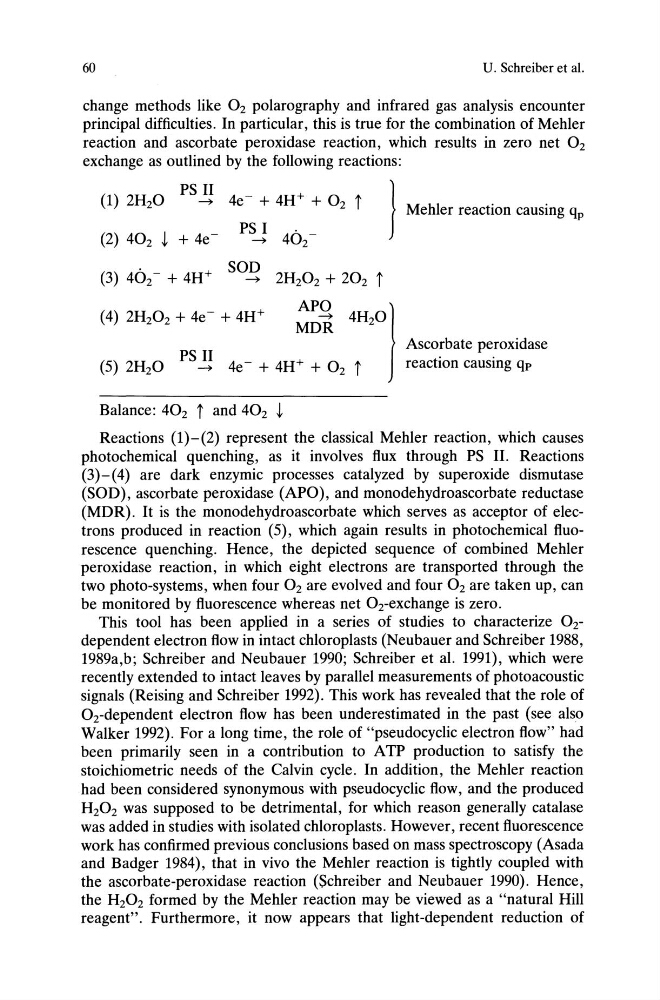
exchange as outlined by the following reactions:
(2) 40 z ~ + 4e- P~ 40 z -
} Mehler reaction eaus;ng qp
(3) 40 z - + 4H+ SO,.!? 2H z O z + 20 z t
(4) 2HzOz + 4e- + 4H+
~~% 4HZO}
PS II
(5) 2HzO
~ 4e- + 4H+ + Oz t
Ascorbate peroxidase
reaction causing qp
Balance: 40z t and 40z ~
Reactions (1)-(2) represent the classical Mehler reaction, which causes
photochemical quenching, as it involves flux through PS II. Reactions
(3)-(4) are dark enzymic processes catalyzed by superoxide dismutase
(SOD), ascorbate peroxidase (APO), and mono de hydro ascorbate reductase
(MDR). It is the monodehydroascorbate which serves as acceptor of electrons produced in reaction (5), which again results in photochemical fluorescence quenching. Hence, the depicted sequence of combined Mehler
peroxidase reaction, in which eight electrons are transported through the
two photo-systems, when four Oz are evolved and four Oz are taken up, can
be monitored by fluorescence whereas net Oz-exchange is zero.
This tool has been applied in a series of studies to characterize Ozdependent electron flow in intact chloroplasts (Neubauer and Schreiber 1988,
1989a,b; Schreiber and Neubauer 1990; Schreiber et al. 1991), which were
recently extended to intact leaves by parallel measurements of photo acoustic
signals (Reising and Schreiber 1992). This work has revealed that the role of
Oz-dependent electron flow has been underestimated in the past (see also
Walker 1992). For a long time, the role of "pseudocyclic electron flow" had
been primarily seen in a contribution to A TP production to satisfy the
stoichiometric needs of the Calvin cycle. In addition, the Mehler reaction
had been considered synonymous with pseudocyclic flow, and the produced
HzOz was supposed to be detrimental, for which reason generally catalase
was added in studies with isolated chloroplasts. However, recent fluorescence
work has confirmed previous conclusions based on mass spectroscopy (As ada
and Badger 1984), that in vivo the Mehler reaction is tightly coupled with
the ascorbate-peroxidase reaction (Schreiber and Neubauer 1990). Hence,
the HzOz formed by the Mehler reaction may be viewed as a "natural Hill
reagent". Furthermore, it now appears that light-dependent reduction of
U. Schreiber et al.
change methods like Oz polarography and infrared gas analysis encounter
principal difficulties. In particular, this is true for the combination of Mehler
reaction and ascorbate peroxidase reaction, which results in zero net Oz
exchange as outlined by the following reactions:
(2) 40 z ~ + 4e- P~ 40 z -
} Mehler reaction eaus;ng qp
(3) 40 z - + 4H+ SO,.!? 2H z O z + 20 z t
(4) 2HzOz + 4e- + 4H+
~~% 4HZO}
PS II
(5) 2HzO
~ 4e- + 4H+ + Oz t
Ascorbate peroxidase
reaction causing qp
Balance: 40z t and 40z ~
Reactions (1)-(2) represent the classical Mehler reaction, which causes
photochemical quenching, as it involves flux through PS II. Reactions
(3)-(4) are dark enzymic processes catalyzed by superoxide dismutase
(SOD), ascorbate peroxidase (APO), and mono de hydro ascorbate reductase
(MDR). It is the monodehydroascorbate which serves as acceptor of electrons produced in reaction (5), which again results in photochemical fluorescence quenching. Hence, the depicted sequence of combined Mehler
peroxidase reaction, in which eight electrons are transported through the
two photo-systems, when four Oz are evolved and four Oz are taken up, can
be monitored by fluorescence whereas net Oz-exchange is zero.
This tool has been applied in a series of studies to characterize Ozdependent electron flow in intact chloroplasts (Neubauer and Schreiber 1988,
1989a,b; Schreiber and Neubauer 1990; Schreiber et al. 1991), which were
recently extended to intact leaves by parallel measurements of photo acoustic
signals (Reising and Schreiber 1992). This work has revealed that the role of
Oz-dependent electron flow has been underestimated in the past (see also
Walker 1992). For a long time, the role of "pseudocyclic electron flow" had
been primarily seen in a contribution to A TP production to satisfy the
stoichiometric needs of the Calvin cycle. In addition, the Mehler reaction
had been considered synonymous with pseudocyclic flow, and the produced
HzOz was supposed to be detrimental, for which reason generally catalase
was added in studies with isolated chloroplasts. However, recent fluorescence
work has confirmed previous conclusions based on mass spectroscopy (As ada
and Badger 1984), that in vivo the Mehler reaction is tightly coupled with
the ascorbate-peroxidase reaction (Schreiber and Neubauer 1990). Hence,
the HzOz formed by the Mehler reaction may be viewed as a "natural Hill
reagent". Furthermore, it now appears that light-dependent reduction of