

Nonintrusive Indicator for Rapid Assessment of In Vivo Photosynthesis
59
+C0 2
A
B 0.8
I
'co~rT
0.6 [>
"Tl
......
~
0.4
"Tl
'......--3
'0
~\
Q)
-C02
t +C0 2
0.2
';;'
3 min
if AL on
Q)
-CO2
U
0.0
C
0
120
240
360
Q)
0
Time, s
C/)
Q)
...
0
Fo
:::J
U.
\
"fr AL on t + C0 2
t ML on
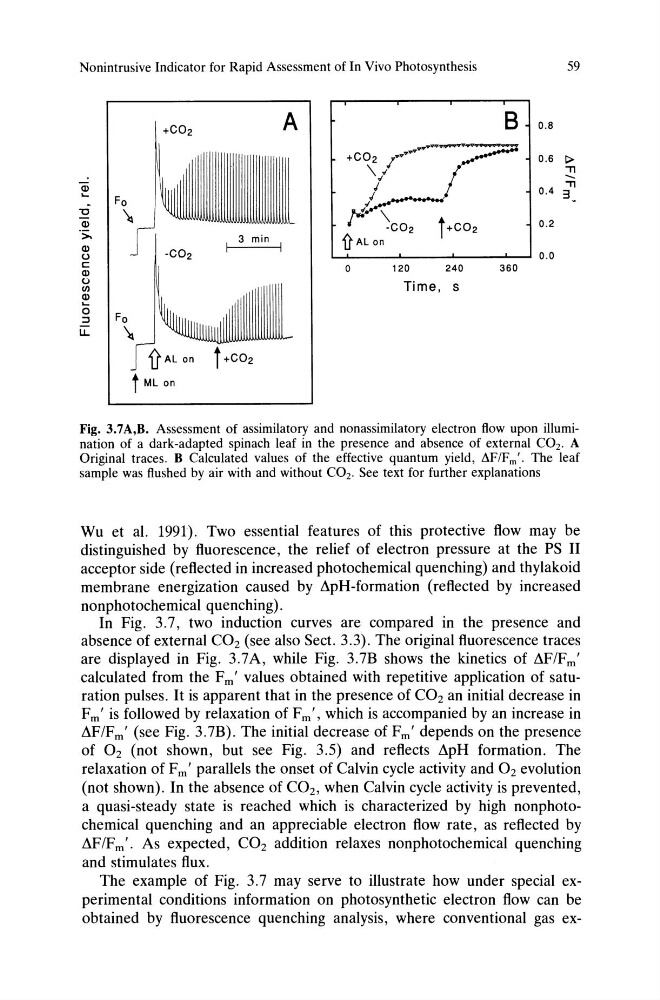
Fig. 3.7 A,B. Assessment of assimilatory and non assimilatory electron flow upon illumination of a dark-adapted spinach leaf in the presence and absence of external CO2, A
Original traces. B Calculated values of the effective quantum yield, ~F/Fm'. The leaf
sample was flushed by air with and without CO2, See text for further explanations
Wu et al. 1991). Two essential features of this protective flow may be
distinguished by fluorescence, the relief of electron pressure at the PS II
acceptor side (reflected in increased photochemical quenching) and thylakoid
membrane energization caused by LlpH-formation (reflected by increased
nonphotochemical quenching).
In Fig. 3.7, two induction curves are compared in the presence and
absence of external CO2 (see also Sect. 3.3). The original fluorescence traces
are displayed in Fig. 3.7A, while Fig. 3.7B shows the kinetics of LlFIFm '
calculated from the Fm' values obtained with repetitive application of saturation pulses. It is apparent that in the presence of CO2 an initial decrease in
Fm' is followed by relaxation of Fm', which is accompanied by an increase in
LlFIF m ' (see Fig. 3.7B). The initial decrease of Fm' depends on the presence
of O 2 (not shown, but see Fig. 3.5) and reflects LlpH formation. The
relaxation of Fm' parallels the onset of Calvin cycle activity and O2 evolution
(not shown). In the absence of CO2, when Calvin cycle activity is prevented,
a quasi-steady state is reached which is characterized by high nonphotochemical quenching and an appreciable electron flow rate, as reflected by
LlFIF m '. As expected, CO2 addition relaxes nonphotochemical quenching
and stimulates flux.
The example of Fig. 3.7 may serve to illustrate how under special experimental conditions information on photosynthetic electron flow can be
obtained by fluorescence quenching analysis, where conventional gas ex-
59
+C0 2
A
B 0.8
I
'co~rT
0.6 [>
"Tl
......
~
0.4
"Tl
'......--3
'0
~\
Q)
-C02
t +C0 2
0.2
';;'
3 min
if AL on
Q)
-CO2
U
0.0
C
0
120
240
360
Q)
0
Time, s
C/)
Q)
...
0
Fo
:::J
U.
\
"fr AL on t + C0 2
t ML on
Fig. 3.7 A,B. Assessment of assimilatory and non assimilatory electron flow upon illumination of a dark-adapted spinach leaf in the presence and absence of external CO2, A
Original traces. B Calculated values of the effective quantum yield, ~F/Fm'. The leaf
sample was flushed by air with and without CO2, See text for further explanations
Wu et al. 1991). Two essential features of this protective flow may be
distinguished by fluorescence, the relief of electron pressure at the PS II
acceptor side (reflected in increased photochemical quenching) and thylakoid
membrane energization caused by LlpH-formation (reflected by increased
nonphotochemical quenching).
In Fig. 3.7, two induction curves are compared in the presence and
absence of external CO2 (see also Sect. 3.3). The original fluorescence traces
are displayed in Fig. 3.7A, while Fig. 3.7B shows the kinetics of LlFIFm '
calculated from the Fm' values obtained with repetitive application of saturation pulses. It is apparent that in the presence of CO2 an initial decrease in
Fm' is followed by relaxation of Fm', which is accompanied by an increase in
LlFIF m ' (see Fig. 3.7B). The initial decrease of Fm' depends on the presence
of O 2 (not shown, but see Fig. 3.5) and reflects LlpH formation. The
relaxation of Fm' parallels the onset of Calvin cycle activity and O2 evolution
(not shown). In the absence of CO2, when Calvin cycle activity is prevented,
a quasi-steady state is reached which is characterized by high nonphotochemical quenching and an appreciable electron flow rate, as reflected by
LlFIF m '. As expected, CO2 addition relaxes nonphotochemical quenching
and stimulates flux.
The example of Fig. 3.7 may serve to illustrate how under special experimental conditions information on photosynthetic electron flow can be
obtained by fluorescence quenching analysis, where conventional gas ex-