

58
U. Schreiber et al.
Charge recombination had been previously suggested to be responsible
for nonphotochemical quenching by Schreiber and Neubauer (1987, 1989,
1990) on the basis of the finding that a number of factors, which cause a
weakening of the PS II donor side and a stimulation of recombination
luminescence, also induce a lowering of Fm and a corresponding increase
in qN'
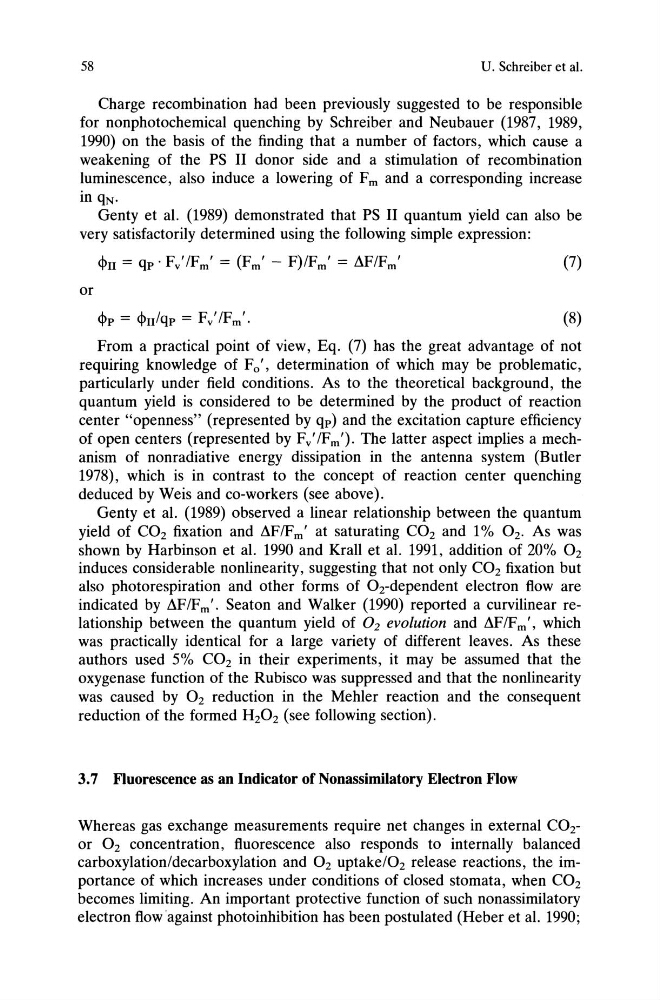
Genty et al. (1989) demonstrated that PS II quantum yield can also be
very satisfactorily determined using the following simple expression:
(7)
or
(8)
From a practical point of view, Eq. (7) has the great advantage of not
requiring knowledge of Fa', determination of which may be problematic,
particularly under field conditions. As to the theoretical background, the
quantum yield is considered to be determined by the product of reaction
center "openness" (represented by qp) and the excitation capture efficiency
of open centers (represented by Fy' IFm'). The latter aspect implies a mechanism of nonradiative energy dissipation in the antenna system (Butler
1978), which is in contrast to the concept of reaction center quenching
deduced by Weis and co-workers (see above).
Genty et al. (1989) observed a linear relationship between the quantum
yield of CO 2 fixation and ilFlFm ' at saturating CO2 and 1% O2, As was
shown by Harbinson et al. 1990 and Krall et al. 1991, addition of 20% O2
induces considerable nonlinearity, suggesting that not only CO2 fixation but
also photo respiration and other forms of 02-dependent electron flow are
indicated by ilFlFm '. Seaton and Walker (1990) reported a curvilinear relationship between the quantum yield of O2 evolution and ilFlFm ', which
was practically identical for a large variety of different leaves. As these
authors used 5% CO2 in their experiments, it may be assumed that the
oxygenase function of the Rubisco was suppressed and that the nonlinearity
was caused by O2 reduction in the Mehler reaction and the consequent
reduction of the formed H20 2 (see following section).
3.7 Fluorescence as an Indicator of Nonassimilatory Electron Flow
Whereas gas exchange measurements require net changes in external CO2or O2 concentration, fluorescence also responds to internally balanced
carboxylation/decarboxylation and O2 uptake/02 release reactions, the importance of which increases under conditions of closed stomata, when CO 2
becomes limiting. An important protective function of such nonassimilatory
electron flow 'against photoinhibition has been postulated (Heber et al. 1990;
U. Schreiber et al.
Charge recombination had been previously suggested to be responsible
for nonphotochemical quenching by Schreiber and Neubauer (1987, 1989,
1990) on the basis of the finding that a number of factors, which cause a
weakening of the PS II donor side and a stimulation of recombination
luminescence, also induce a lowering of Fm and a corresponding increase
in qN'
Genty et al. (1989) demonstrated that PS II quantum yield can also be
very satisfactorily determined using the following simple expression:
(7)
or
(8)
From a practical point of view, Eq. (7) has the great advantage of not
requiring knowledge of Fa', determination of which may be problematic,
particularly under field conditions. As to the theoretical background, the
quantum yield is considered to be determined by the product of reaction
center "openness" (represented by qp) and the excitation capture efficiency
of open centers (represented by Fy' IFm'). The latter aspect implies a mechanism of nonradiative energy dissipation in the antenna system (Butler
1978), which is in contrast to the concept of reaction center quenching
deduced by Weis and co-workers (see above).
Genty et al. (1989) observed a linear relationship between the quantum
yield of CO 2 fixation and ilFlFm ' at saturating CO2 and 1% O2, As was
shown by Harbinson et al. 1990 and Krall et al. 1991, addition of 20% O2
induces considerable nonlinearity, suggesting that not only CO2 fixation but
also photo respiration and other forms of 02-dependent electron flow are
indicated by ilFlFm '. Seaton and Walker (1990) reported a curvilinear relationship between the quantum yield of O2 evolution and ilFlFm ', which
was practically identical for a large variety of different leaves. As these
authors used 5% CO2 in their experiments, it may be assumed that the
oxygenase function of the Rubisco was suppressed and that the nonlinearity
was caused by O2 reduction in the Mehler reaction and the consequent
reduction of the formed H20 2 (see following section).
3.7 Fluorescence as an Indicator of Nonassimilatory Electron Flow
Whereas gas exchange measurements require net changes in external CO2or O2 concentration, fluorescence also responds to internally balanced
carboxylation/decarboxylation and O2 uptake/02 release reactions, the importance of which increases under conditions of closed stomata, when CO 2
becomes limiting. An important protective function of such nonassimilatory
electron flow 'against photoinhibition has been postulated (Heber et al. 1990;