

Nonintrusive Indicator for Rapid Assessment of In Vivo Photosynthesis
57
(1)
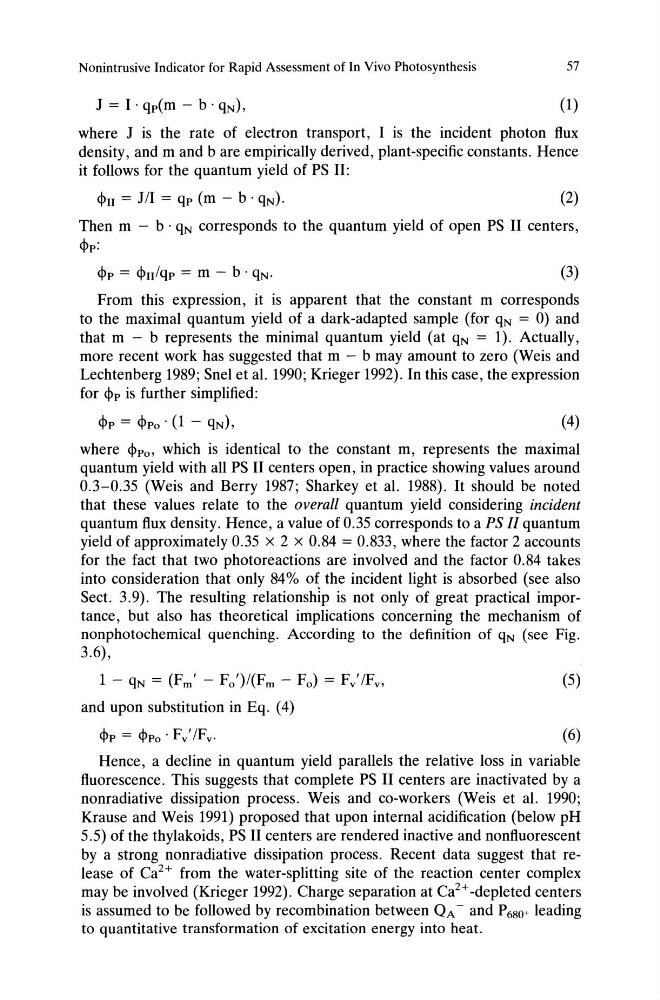
where J is the rate of electron transport, I is the incident photon flux
density, and m and b are empirically derived, plant-specific constants. Hence
it follows for the quantum yield of PS II:
Then m - b· qN corresponds to the quantum yield of open PS II centers,
From this expression, it is apparent that the constant m corresponds
to the maximal quantum yield of a dark-adapted sample (for qN = 0) and
that m - b represents the minimal quantum yield (at qN = 1). Actually,
more recent work has suggested that m - b may amount to zero (Weis and
Lechtenberg 1989; Snel et al. 1990; Krieger 1992). In this case, the expression
for
where
0.3-0.35 (Weis and Berry 1987; Sharkey et al. 1988). It should be noted
that these values relate to the overall quantum yield considering incident
quantum flux density. Hence, a value of 0.35 corresponds to a PS II quantum
yield of approximately 0.35 x 2 x 0.84 = 0.833, where the factor 2 accounts
for the fact that two photoreactions are involved and the factor 0.84 takes
into consideration that only 84% of the incident light is absorbed (see also
Sect. 3.9). The resulting relationship is not only of great practical importance, but also has theoretical implications concerning the mechanism of
nonphotochemical quenching. According to the definition of qN (see Fig.
3.6),
1 - qN = (Fm' - Fo')/(Fm - Fo) = Fv' /Fy,
and upon substitution in Eq. (4)
(5)
Hence, a decline in quantum yield parallels the relative loss in variable
fluorescence. This suggests that complete PS II centers are inactivated by a
nonradiative dissipation process. We is and co-workers (Weis et al. 1990;
Krause and Weis 1991) proposed that upon internal acidification (below pH
5.5) of the thylakoids, PS II centers are rendered inactive and nonfluorescent
by a strong nonradiative dissipation process. Recent data suggest that release of Ca 2 + from the water-splitting site of the reaction center complex
may be involved (Krieger 1992). Charge separation at Ca 2 + -depleted centers
is assumed to be followed by recombination between QA - and P 680+ leading
to quantitative transformation of excitation energy into heat.
57
(1)
where J is the rate of electron transport, I is the incident photon flux
density, and m and b are empirically derived, plant-specific constants. Hence
it follows for the quantum yield of PS II:
Then m - b· qN corresponds to the quantum yield of open PS II centers,
From this expression, it is apparent that the constant m corresponds
to the maximal quantum yield of a dark-adapted sample (for qN = 0) and
that m - b represents the minimal quantum yield (at qN = 1). Actually,
more recent work has suggested that m - b may amount to zero (Weis and
Lechtenberg 1989; Snel et al. 1990; Krieger 1992). In this case, the expression
for
where
0.3-0.35 (Weis and Berry 1987; Sharkey et al. 1988). It should be noted
that these values relate to the overall quantum yield considering incident
quantum flux density. Hence, a value of 0.35 corresponds to a PS II quantum
yield of approximately 0.35 x 2 x 0.84 = 0.833, where the factor 2 accounts
for the fact that two photoreactions are involved and the factor 0.84 takes
into consideration that only 84% of the incident light is absorbed (see also
Sect. 3.9). The resulting relationship is not only of great practical importance, but also has theoretical implications concerning the mechanism of
nonphotochemical quenching. According to the definition of qN (see Fig.
3.6),
1 - qN = (Fm' - Fo')/(Fm - Fo) = Fv' /Fy,
and upon substitution in Eq. (4)
(5)
Hence, a decline in quantum yield parallels the relative loss in variable
fluorescence. This suggests that complete PS II centers are inactivated by a
nonradiative dissipation process. We is and co-workers (Weis et al. 1990;
Krause and Weis 1991) proposed that upon internal acidification (below pH
5.5) of the thylakoids, PS II centers are rendered inactive and nonfluorescent
by a strong nonradiative dissipation process. Recent data suggest that release of Ca 2 + from the water-splitting site of the reaction center complex
may be involved (Krieger 1992). Charge separation at Ca 2 + -depleted centers
is assumed to be followed by recombination between QA - and P 680+ leading
to quantitative transformation of excitation energy into heat.