

56
U. Schreiber et al.
which tolerates a ratio of 1: 10 6 between modulated fluorescence and
nonmodulated background signal (Schreiber 1986; Schreiber et al. 1986;
Schreiber and Bilger 1987).
In Fig. 3.6, schematic traces of a measurement of modulated chlorophyll
fluorescence are shown, with the characteristic fluorescence levels and
quenching coefficients being defined in agreement with a proposal for standard nomenclature at a recent fluorescence workshop (van Kooten and Snel
1990).
While the sample is still in the dark-adapted state, the minimal and
maximal yields, Fo and Fm, are determined. The ratio (Fm - Fo)/Fm =
Fv/Fm is a convenient measure of the potential maximal PS II quantum yield
of a given sample (see reviews by Butler 1978; Bjorkman 1987). During illumination, the fluorescence yield, F, undergoes complex changes. With the
help of saturation pulses the changed levels of maximal yield, Fm', are determined, with Fm - Fm' representing nonphotochemically quenched fluorescence and Fm' - F representing photochemically quenched fluorescence.
So-called quenching coefficients qp and qN have been defined (originally
called qQ and qE) for quantification of photochemical and nonphotochemical
quenching, respectively (Dietz et al. 1985; Schreiber et al. 1986). In the
original definitions it was assumed that only variable fluorescence is quenched
nonphotochemically. However, it has been shown that Fo is also lowered by
,1pH-dependent nonphotochemical quenching (Bilger and Schreiber 1986).
Therefore, correct calculation of qp and qN requires previous determination
of Fo'.
Fo' can be determined upon sample darkening and application of weak
far-red background light for PS I-driven QA oxidation. Knowledge of Fo'
is indispensable in order to obtain information on the extent of PS II
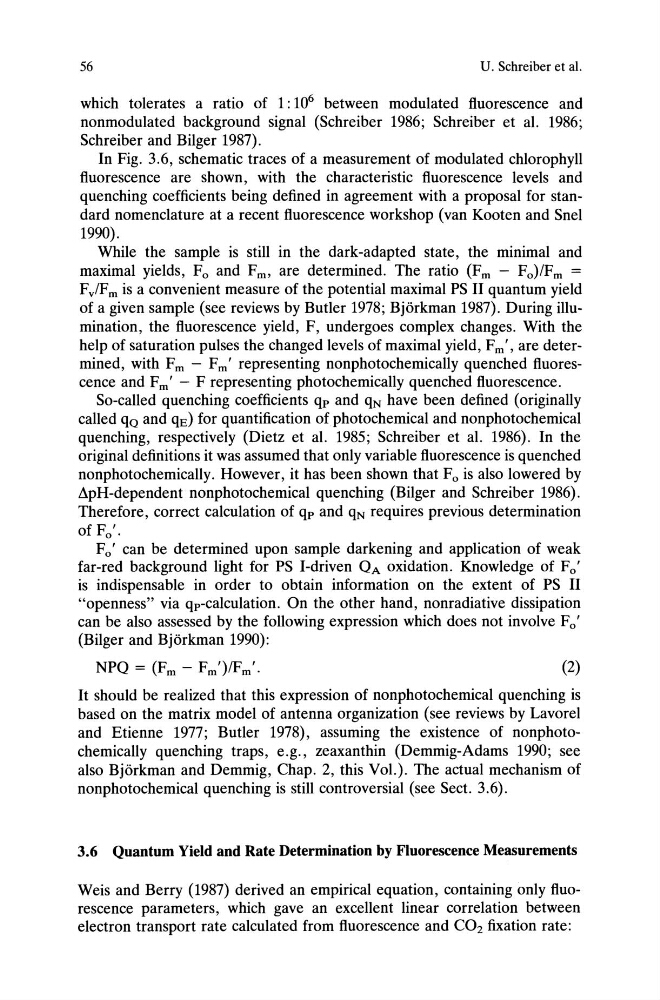
"openness" via qp-calculation. On the other hand, nonradiative dissipation
can be also assessed by the following expression which does not involve Fo'
(Bilger and Bjorkman 1990):
(2)
It should be realized that this expression of nonphotochemical quenching is
based on the matrix model of antenna organization (see reviews by Lavorel
and Etienne 1977; Butler 1978), assuming the existence of nonphotochemically quenching traps, e.g., zeaxanthin (Demmig-Adams 1990; see
also Bjorkman and Demmig, Chap. 2, this Vol.). The actual mechanism of
nonphotochemical quenching is still controversial (see Sect. 3.6).
3.6 Quantum Yield and Rate Determination by Fluorescence Measurements
Weis and Berry (1987) derived an empirical equation, containing only fluorescence parameters, which gave an excellent linear correlation between
electron transport rate calculated from fluorescence and CO2 fixation rate:
U. Schreiber et al.
which tolerates a ratio of 1: 10 6 between modulated fluorescence and
nonmodulated background signal (Schreiber 1986; Schreiber et al. 1986;
Schreiber and Bilger 1987).
In Fig. 3.6, schematic traces of a measurement of modulated chlorophyll
fluorescence are shown, with the characteristic fluorescence levels and
quenching coefficients being defined in agreement with a proposal for standard nomenclature at a recent fluorescence workshop (van Kooten and Snel
1990).
While the sample is still in the dark-adapted state, the minimal and
maximal yields, Fo and Fm, are determined. The ratio (Fm - Fo)/Fm =
Fv/Fm is a convenient measure of the potential maximal PS II quantum yield
of a given sample (see reviews by Butler 1978; Bjorkman 1987). During illumination, the fluorescence yield, F, undergoes complex changes. With the
help of saturation pulses the changed levels of maximal yield, Fm', are determined, with Fm - Fm' representing nonphotochemically quenched fluorescence and Fm' - F representing photochemically quenched fluorescence.
So-called quenching coefficients qp and qN have been defined (originally
called qQ and qE) for quantification of photochemical and nonphotochemical
quenching, respectively (Dietz et al. 1985; Schreiber et al. 1986). In the
original definitions it was assumed that only variable fluorescence is quenched
nonphotochemically. However, it has been shown that Fo is also lowered by
,1pH-dependent nonphotochemical quenching (Bilger and Schreiber 1986).
Therefore, correct calculation of qp and qN requires previous determination
of Fo'.
Fo' can be determined upon sample darkening and application of weak
far-red background light for PS I-driven QA oxidation. Knowledge of Fo'
is indispensable in order to obtain information on the extent of PS II
"openness" via qp-calculation. On the other hand, nonradiative dissipation
can be also assessed by the following expression which does not involve Fo'
(Bilger and Bjorkman 1990):
(2)
It should be realized that this expression of nonphotochemical quenching is
based on the matrix model of antenna organization (see reviews by Lavorel
and Etienne 1977; Butler 1978), assuming the existence of nonphotochemically quenching traps, e.g., zeaxanthin (Demmig-Adams 1990; see
also Bjorkman and Demmig, Chap. 2, this Vol.). The actual mechanism of
nonphotochemical quenching is still controversial (see Sect. 3.6).
3.6 Quantum Yield and Rate Determination by Fluorescence Measurements
Weis and Berry (1987) derived an empirical equation, containing only fluorescence parameters, which gave an excellent linear correlation between
electron transport rate calculated from fluorescence and CO2 fixation rate: