

Nonintrusive Indicator for Rapid Assessment of In Vivo Photosynthesis
55
assimilatory and non assimilatory electron flow) and nonphotochemical (due
to increased heat formation), which have to be separated in order to interpret the fluorescence information. In practice, separation and quantification
of the two types of quenching is achieved by the saturation pulse method
(Schreiber et al. 1986).
3.5 The Saturation Pulse Method
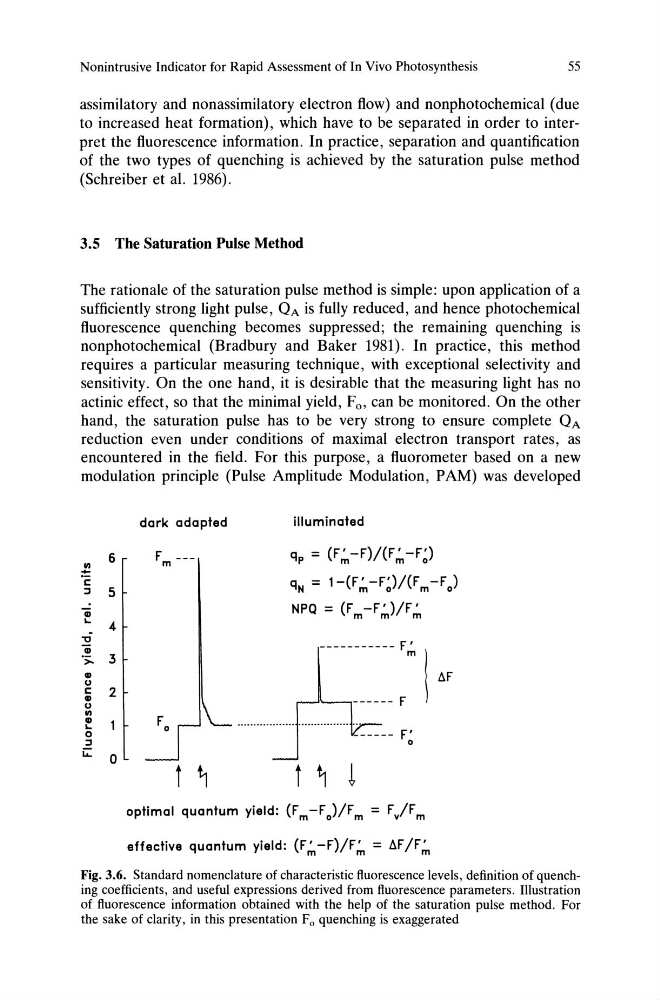
The rationale of the saturation pulse method is simple: upon application of a
sufficiently strong light pulse, QA is fully reduced, and hence photochemical
fluorescence quenching becomes suppressed; the remaining quenching is
nonphotochemical (Bradbury and Baker 1981). In practice, this method
requires a particular measuring technique, with exceptional selectivity and
sensitivity. On the one hand, it is desirable that the measuring light has no
actinic effect, so that the minimal yield, F 0' can be monitored. On the other
hand, the saturation pulse has to be very strong to ensure complete QA
reduction even under conditions of maximal electron transport rates, as
encountered in the field. For this purpose, a fluorometer based on a new
modulation principle (Pulse Amplitude Modulation, PAM) was developed
CD
...
CD
6
5
';>' 3
CD
u
~
2
u
1/1
CD
... o
:J
G:
o
dark adapted
F --m
t 1
illuminated
qp = (F';' -F)/(F';' -F~)
qN = 1-(F';' -F~)/(F m -F 0)
NPQ = (F m -F';')/F ~
----------- F' m
optimal quantum yield: (F m -Fo)/F m = F/F m
effective quantum yield: (F~ -F)/F':' = ~F /F':'
Fig. 3.6. Standard nomenclature of characteristic fluorescence levels, definition of quenching coefficients, and useful expressions derived from fluorescence parameters. Illustration
of fluorescence information obtained with the help of the saturation pulse method. For
the sake of clarity, in this presentation Fo quenching is exaggerated
55
assimilatory and non assimilatory electron flow) and nonphotochemical (due
to increased heat formation), which have to be separated in order to interpret the fluorescence information. In practice, separation and quantification
of the two types of quenching is achieved by the saturation pulse method
(Schreiber et al. 1986).
3.5 The Saturation Pulse Method
The rationale of the saturation pulse method is simple: upon application of a
sufficiently strong light pulse, QA is fully reduced, and hence photochemical
fluorescence quenching becomes suppressed; the remaining quenching is
nonphotochemical (Bradbury and Baker 1981). In practice, this method
requires a particular measuring technique, with exceptional selectivity and
sensitivity. On the one hand, it is desirable that the measuring light has no
actinic effect, so that the minimal yield, F 0' can be monitored. On the other
hand, the saturation pulse has to be very strong to ensure complete QA
reduction even under conditions of maximal electron transport rates, as
encountered in the field. For this purpose, a fluorometer based on a new
modulation principle (Pulse Amplitude Modulation, PAM) was developed
CD
...
CD
6
5
';>' 3
CD
u
~
2
u
1/1
CD
... o
:J
G:
o
dark adapted
F --m
t 1
illuminated
qp = (F';' -F)/(F';' -F~)
qN = 1-(F';' -F~)/(F m -F 0)
NPQ = (F m -F';')/F ~
----------- F' m
optimal quantum yield: (F m -Fo)/F m = F/F m
effective quantum yield: (F~ -F)/F':' = ~F /F':'
Fig. 3.6. Standard nomenclature of characteristic fluorescence levels, definition of quenching coefficients, and useful expressions derived from fluorescence parameters. Illustration
of fluorescence information obtained with the help of the saturation pulse method. For
the sake of clarity, in this presentation Fo quenching is exaggerated