

54
U. Schreiber et al.
3.4 Slow Fluorescence Induction Kinetics and Fluorescence Quenching
Under Steady-State Conditions
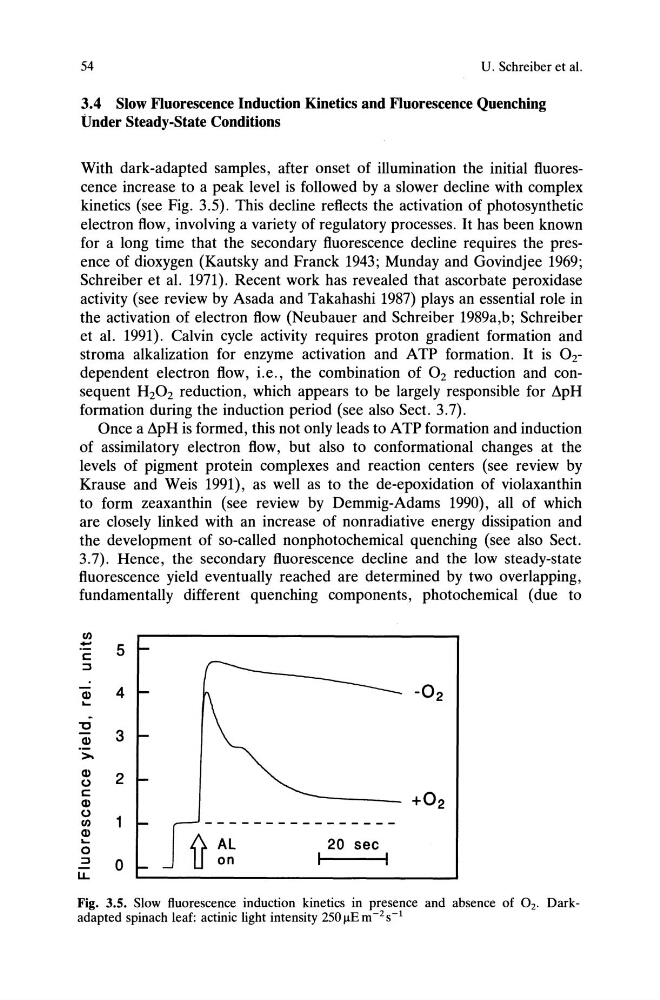
With dark-adapted samples, after onset of illumination the initial fluorescence increase to a peak level is followed by a slower decline with complex
kinetics (see Fig. 3.5). This decline reflects the activation of photosynthetic
electron flow, involving a variety of regulatory processes. It has been known
for a long time that the secondary fluorescence decline requires the presence of dioxygen (Kautsky and Franck 1943; Munday and Govindjee 1969;
Schreiber et al. 1971). Recent work has revealed that ascorbate peroxidase
activity (see review by Asada and Takahashi 1987) plays an essential role in
the activation of electron flow (Neubauer and Schreiber 1989a,b; Schreiber
et al. 1991). Calvin cycle activity requires proton gradient formation and
stroma alkalization for enzyme activation and ATP formation. It is Ozdependent electron flow, i.e., the combination of O2 reduction and consequent H20 2 reduction, which appears to be largely responsible for i\pH
formation during the induction period (see also Sect. 3.7).
Once a i\pH is formed, this not only leads to ATP formation and induction
of assimilatory electron flow, but also to conformational changes at the
levels of pigment protein complexes and reaction centers (see review by
Krause and Weis 1991), as well as to the de-epoxidation of violaxanthin
to form zeaxanthin (see review by Demmig-Adams 1990), all of which
are closely linked with an increase of nonradiative energy dissipation and
the development of so-called nonphotochemical quenching (see also Sect.
3.7). Hence, the secondary fluorescence decline and the low steady-state
fluorescence yield eventually reached are determined by two overlapping,
fundamentally different quenching components, photochemical (due to
w
c::
:::l
- Q)
I -
-
"0
Q)
>Q)
(.)
c::
Q)
(.)
w
Q)
I -
0
:::l
I..L
5
4
3
2
1
0
/). AL
U on
20 sec
I
I
Fig. 3.5. Slow fluorescence induction kinetics in presence and absence of 02' Darkadapted spinach leaf: actinic light intensity 250 IlE m- 2 s- 1
U. Schreiber et al.
3.4 Slow Fluorescence Induction Kinetics and Fluorescence Quenching
Under Steady-State Conditions
With dark-adapted samples, after onset of illumination the initial fluorescence increase to a peak level is followed by a slower decline with complex
kinetics (see Fig. 3.5). This decline reflects the activation of photosynthetic
electron flow, involving a variety of regulatory processes. It has been known
for a long time that the secondary fluorescence decline requires the presence of dioxygen (Kautsky and Franck 1943; Munday and Govindjee 1969;
Schreiber et al. 1971). Recent work has revealed that ascorbate peroxidase
activity (see review by Asada and Takahashi 1987) plays an essential role in
the activation of electron flow (Neubauer and Schreiber 1989a,b; Schreiber
et al. 1991). Calvin cycle activity requires proton gradient formation and
stroma alkalization for enzyme activation and ATP formation. It is Ozdependent electron flow, i.e., the combination of O2 reduction and consequent H20 2 reduction, which appears to be largely responsible for i\pH
formation during the induction period (see also Sect. 3.7).
Once a i\pH is formed, this not only leads to ATP formation and induction
of assimilatory electron flow, but also to conformational changes at the
levels of pigment protein complexes and reaction centers (see review by
Krause and Weis 1991), as well as to the de-epoxidation of violaxanthin
to form zeaxanthin (see review by Demmig-Adams 1990), all of which
are closely linked with an increase of nonradiative energy dissipation and
the development of so-called nonphotochemical quenching (see also Sect.
3.7). Hence, the secondary fluorescence decline and the low steady-state
fluorescence yield eventually reached are determined by two overlapping,
fundamentally different quenching components, photochemical (due to
w
c::
:::l
- Q)
I -
-
"0
Q)
>Q)
(.)
c::
Q)
(.)
w
Q)
I -
0
:::l
I..L
5
4
3
2
1
0
/). AL
U on
20 sec
I
I
Fig. 3.5. Slow fluorescence induction kinetics in presence and absence of 02' Darkadapted spinach leaf: actinic light intensity 250 IlE m- 2 s- 1