

Nonintrusive Indicator for Rapid Assessment of In Vivo Photosynthesis
53
The fluorescence rise upon onset of actinic illumination is complex. At
moderate light intensities, a rapid initial rise is separated by an intermediate
level (or dip) from a major slow rise phase. At high intensity, the rise becomes
polyphasic (Delosme 1967; Neubauer and Schreiber 1987; Schreiber and
Neubauer 1987). It has been proposed that the fluorescence rise to the
intermediate level reflects closure of PS II~ centers (Melis 1985, 1991;
Govindjee 1990). However, an initial fluorescence rise in the presence of an
oxidized plastoquinone pool can also be predicted from known properties of
charge accumulation at the two-electron gate OB (Velthuys and Amesz
1974). In this case, illumination initially causes the semiquinone anion OB -
to accumulate, in equilibrium with some OA -, before OB= is formed, which
can then be reoxidized by the plastoquinone pool.
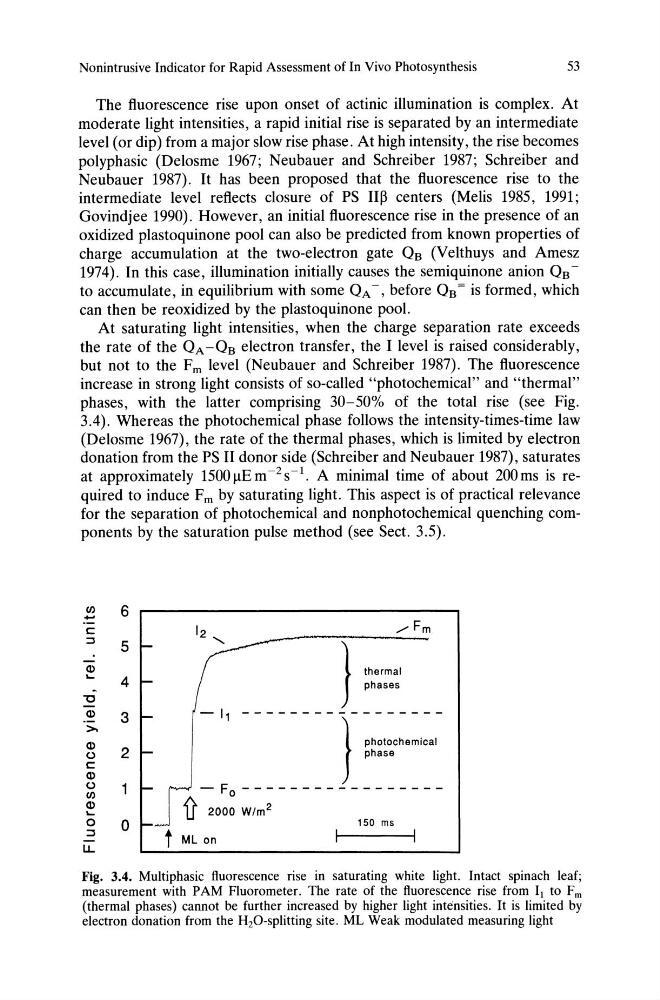
At saturating light intensities, when the charge separation rate exceeds
the rate of the OA -OB electron transfer, the I level is raised considerably,
but not to the Fm level (Neubauer and Schreiber 1987). The fluorescence
increase in strong light consists of so-called "photochemical" and "thermal"
phases, with the latter comprising 30-50% of the total rise (see Fig.
3.4). Whereas the photochemical phase follows the intensity-times-time law
(Delosme 1967), the rate of the thermal phases, which is limited by electron
donation from the PS II donor side (Schreiber and Neubauer 1987), saturates
at approximately 1500 IlE m -2 s -1. A minimal time of about 200 ms is required to induce Fm by saturating light. This aspect is of practical relevance
for the separation of photochemical and nonphotochemical quenching components by the saturation pulse method (see Sect. 3.5).
C/)
-
-
"C
Q)
>.
Q)
o
c::
Q)
o
C/)
Q)
.....
o
::J
U.
6
5
4
3
2
o
}
thermal
phases
- 11 - - - - - - - - - - - - - - - - -
}
photochemical
phase
- Fo - - - - - - - - - - - - - - - - -
if 2000 W/m 2
150 ms
t ML on
Fig. 3.4. Multiphasic fluorescence rise in saturating white light. Intact spinach leaf;
measurement with PAM Fluorometer. The rate of the fluorescence rise from 11 to Fm
(thermal phases) cannot be further increased by higher light intensities. It is limited by
electron donation from the H20-splitting site. ML Weak modulated measuring light
53
The fluorescence rise upon onset of actinic illumination is complex. At
moderate light intensities, a rapid initial rise is separated by an intermediate
level (or dip) from a major slow rise phase. At high intensity, the rise becomes
polyphasic (Delosme 1967; Neubauer and Schreiber 1987; Schreiber and
Neubauer 1987). It has been proposed that the fluorescence rise to the
intermediate level reflects closure of PS II~ centers (Melis 1985, 1991;
Govindjee 1990). However, an initial fluorescence rise in the presence of an
oxidized plastoquinone pool can also be predicted from known properties of
charge accumulation at the two-electron gate OB (Velthuys and Amesz
1974). In this case, illumination initially causes the semiquinone anion OB -
to accumulate, in equilibrium with some OA -, before OB= is formed, which
can then be reoxidized by the plastoquinone pool.
At saturating light intensities, when the charge separation rate exceeds
the rate of the OA -OB electron transfer, the I level is raised considerably,
but not to the Fm level (Neubauer and Schreiber 1987). The fluorescence
increase in strong light consists of so-called "photochemical" and "thermal"
phases, with the latter comprising 30-50% of the total rise (see Fig.
3.4). Whereas the photochemical phase follows the intensity-times-time law
(Delosme 1967), the rate of the thermal phases, which is limited by electron
donation from the PS II donor side (Schreiber and Neubauer 1987), saturates
at approximately 1500 IlE m -2 s -1. A minimal time of about 200 ms is required to induce Fm by saturating light. This aspect is of practical relevance
for the separation of photochemical and nonphotochemical quenching components by the saturation pulse method (see Sect. 3.5).
C/)
-
-
"C
Q)
>.
Q)
o
c::
Q)
o
C/)
Q)
.....
o
::J
U.
6
5
4
3
2
o
}
thermal
phases
- 11 - - - - - - - - - - - - - - - - -
}
photochemical
phase
- Fo - - - - - - - - - - - - - - - - -
if 2000 W/m 2
150 ms
t ML on
Fig. 3.4. Multiphasic fluorescence rise in saturating white light. Intact spinach leaf;
measurement with PAM Fluorometer. The rate of the fluorescence rise from 11 to Fm
(thermal phases) cannot be further increased by higher light intensities. It is limited by
electron donation from the H20-splitting site. ML Weak modulated measuring light