

Nonintrusive Indicator for Rapid Assessment of In Vivo Photosynthesis
61
monodehydroascorbate is decisive for membrane energization, with all its
implications for regulation and photoprotection (Schreiber et al. 1991).
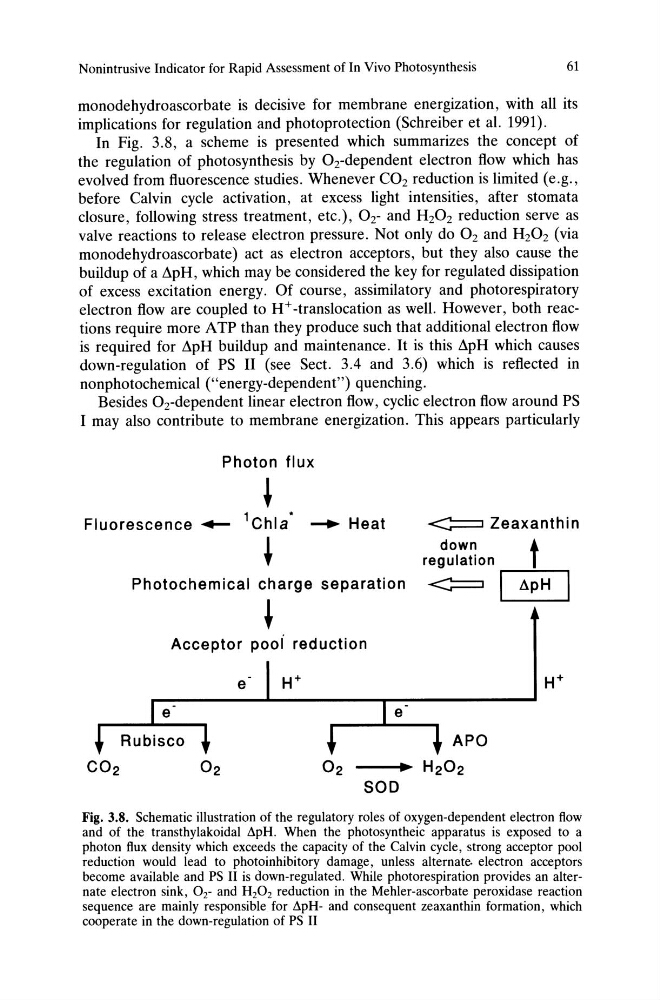
In Fig. 3.8, a scheme is presented which summarizes the concept of
the regulation of photosynthesis by Or dependent electron flow which has
evolved from fluorescence studies. Whenever CO2 reduction is limited (e.g.,
before Calvin cycle activation, at excess light intensities, after stomata
closure, following stress treatment, etc.), Or and H20 2 reduction serve as
valve reactions to release electron pressure. Not only do O2 and H20 2 (via
monodehydroascorbate) act as electron acceptors, but they also cause the
buildup of a L1pH, which may be considered the key for regulated dissipation
of excess excitation energy. Of course, assimilatory and photo respiratory
electron flow are coupled to H+ -translocation as well. However, both reactions require more ATP than they produce such that additional electron flow
is required for L1pH buildup and maintenance. It is this L1pH which causes
down-regulation of PS II (see Sect. 3.4 and 3.6) which is reflected in
nonphotochemical ("energy-dependent") quenching.
Besides 02-dependent linear electron flow, cyclic electron flow around PS
I may also contribute to membrane energization. This appears particularly
Photon flux
~
Fluorescence ..... 1 Chla* --. Heat
~ Zeaxanthin
~
Photochemical charge separation
~
down
t
regulation
~ 1r--- L1 "';"'PH----'
Acceptor pool reduction
e
SOD
Fig. 3.8. Schematic illustration of the regulatory roles of oxygen-dependent electron flow
and of the transthylakoidal ~pH. When the photosyntheic apparatus is exposed to a
photon flux density which exceeds the capacity of the Calvin cycle, strong acceptor pool
reduction would lead to photoinhibitory damage, unless alternate electron acceptors
become available and PS II is down-regulated. While photorespiration provides an alternate electron sink, OT and H20 2 reduction in the Mehler-ascorbate peroxidase reaction
sequence are mainly responsible for ~pH- and consequent zeaxanthin formation, which
cooperate in the down-regulation of PS II
61
monodehydroascorbate is decisive for membrane energization, with all its
implications for regulation and photoprotection (Schreiber et al. 1991).
In Fig. 3.8, a scheme is presented which summarizes the concept of
the regulation of photosynthesis by Or dependent electron flow which has
evolved from fluorescence studies. Whenever CO2 reduction is limited (e.g.,
before Calvin cycle activation, at excess light intensities, after stomata
closure, following stress treatment, etc.), Or and H20 2 reduction serve as
valve reactions to release electron pressure. Not only do O2 and H20 2 (via
monodehydroascorbate) act as electron acceptors, but they also cause the
buildup of a L1pH, which may be considered the key for regulated dissipation
of excess excitation energy. Of course, assimilatory and photo respiratory
electron flow are coupled to H+ -translocation as well. However, both reactions require more ATP than they produce such that additional electron flow
is required for L1pH buildup and maintenance. It is this L1pH which causes
down-regulation of PS II (see Sect. 3.4 and 3.6) which is reflected in
nonphotochemical ("energy-dependent") quenching.
Besides 02-dependent linear electron flow, cyclic electron flow around PS
I may also contribute to membrane energization. This appears particularly
Photon flux
~
Fluorescence ..... 1 Chla* --. Heat
~ Zeaxanthin
~
Photochemical charge separation
~
down
t
regulation
~ 1r--- L1 "';"'PH----'
Acceptor pool reduction
e
SOD
Fig. 3.8. Schematic illustration of the regulatory roles of oxygen-dependent electron flow
and of the transthylakoidal ~pH. When the photosyntheic apparatus is exposed to a
photon flux density which exceeds the capacity of the Calvin cycle, strong acceptor pool
reduction would lead to photoinhibitory damage, unless alternate electron acceptors
become available and PS II is down-regulated. While photorespiration provides an alternate electron sink, OT and H20 2 reduction in the Mehler-ascorbate peroxidase reaction
sequence are mainly responsible for ~pH- and consequent zeaxanthin formation, which
cooperate in the down-regulation of PS II