

32
o. Bjorkman and B. Demmig-Adams
Prunus ilicifolia in partial shade in the winter; the weed Malva parviflora in
the open in the winter; and Gossypium hirsutum (cotton) under intense
summer sunlight in the San Joaquin Valley. All plants had an adequate
supply of water. During the experimental treatments the leaves were restrained to prevent leaf movements and were held normal to the light beam.
Wavelengths <500 nm were excluded from the actinic beam in experiments
with leaves in which chloroplast movements can induce significant changes
in absorptance.
No differences were detected among the four species in the efficiency of
energy conversion, determined in the absence of any excess light. This is in
accordance with previous studies involving a large number of ecologically
diverse species which showed that this efficiency is remarkably constant as
long as the plants have not been subjected to severe stress (see Bjorkman
and Demmig 1987). However, the responses to an increased PFD were
strikingly different among the different species. In Oxalis, the efficiency fell
precipitously as the PFD was increased, even at quite modest PFDs, and
the rate of PS II photochemistry reached a maximum at PFDs of around
250 ~mol photons m -2 s -1; moreover, further increases in PFD led to a
decline in this already very low maximum rate. In Prunus, the efficiency
showed a strong decline already at very moderate PFDs and the rate reached
a
Q..
Z
5 ,---,----,---,----,---,----,---,,---,--.
4
3
2
----...
~T"
~
Prunus
Oxalis
"7
~alva
/
Gossypium
O~~~--L-~--~--~---L---L--J-~
o
500
1000
1500
-2 -1
PFD, fl-mol m s
2000
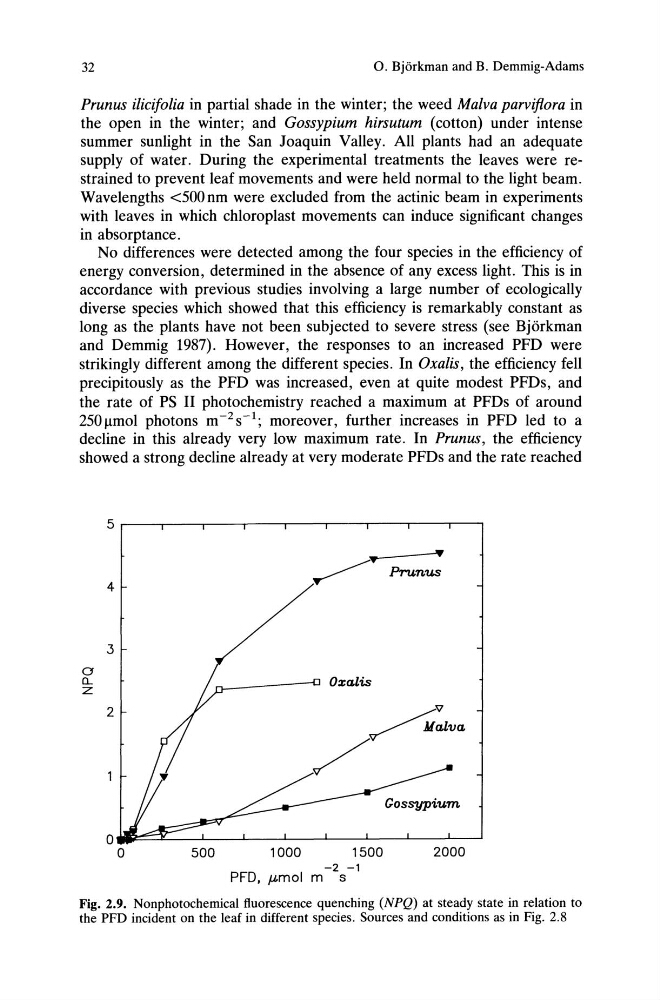
Fig. 2.9. Nonphotochemical fluorescence quenching (NPQ) at steady state in relation to
the PFD incident on the leaf in different species. Sources and conditions as in Fig. 2.8
o. Bjorkman and B. Demmig-Adams
Prunus ilicifolia in partial shade in the winter; the weed Malva parviflora in
the open in the winter; and Gossypium hirsutum (cotton) under intense
summer sunlight in the San Joaquin Valley. All plants had an adequate
supply of water. During the experimental treatments the leaves were restrained to prevent leaf movements and were held normal to the light beam.
Wavelengths <500 nm were excluded from the actinic beam in experiments
with leaves in which chloroplast movements can induce significant changes
in absorptance.
No differences were detected among the four species in the efficiency of
energy conversion, determined in the absence of any excess light. This is in
accordance with previous studies involving a large number of ecologically
diverse species which showed that this efficiency is remarkably constant as
long as the plants have not been subjected to severe stress (see Bjorkman
and Demmig 1987). However, the responses to an increased PFD were
strikingly different among the different species. In Oxalis, the efficiency fell
precipitously as the PFD was increased, even at quite modest PFDs, and
the rate of PS II photochemistry reached a maximum at PFDs of around
250 ~mol photons m -2 s -1; moreover, further increases in PFD led to a
decline in this already very low maximum rate. In Prunus, the efficiency
showed a strong decline already at very moderate PFDs and the rate reached
a
Q..
Z
5 ,---,----,---,----,---,----,---,,---,--.
4
3
2
----...
~T"
~
Prunus
Oxalis
"7
~alva
/
Gossypium
O~~~--L-~--~--~---L---L--J-~
o
500
1000
1500
-2 -1
PFD, fl-mol m s
2000
Fig. 2.9. Nonphotochemical fluorescence quenching (NPQ) at steady state in relation to
the PFD incident on the leaf in different species. Sources and conditions as in Fig. 2.8