

Regulation of Photosynthetic Light Energy Capture
~ 0.8
-
II)
' E
Q)
.s::.
0
0.6
0
- 0
.s::.
a.
W 0.4
a..
- 0
>0
0.2
c
Q)
'0
-
- w
0.0
1000
>- L.
- 800
.!!!
E
Q)
.s::.
0
0
600
- 0
.s::.
a.
VI
400
a..
- 0
Q)
- 200
0
~
500
GOSSypiUffi
-----'''1
Malva
'V
Prunus
----------~~~----~.
Oxalis
1000
1500
2000
-2 -1
PFD. JLmol m
s
31
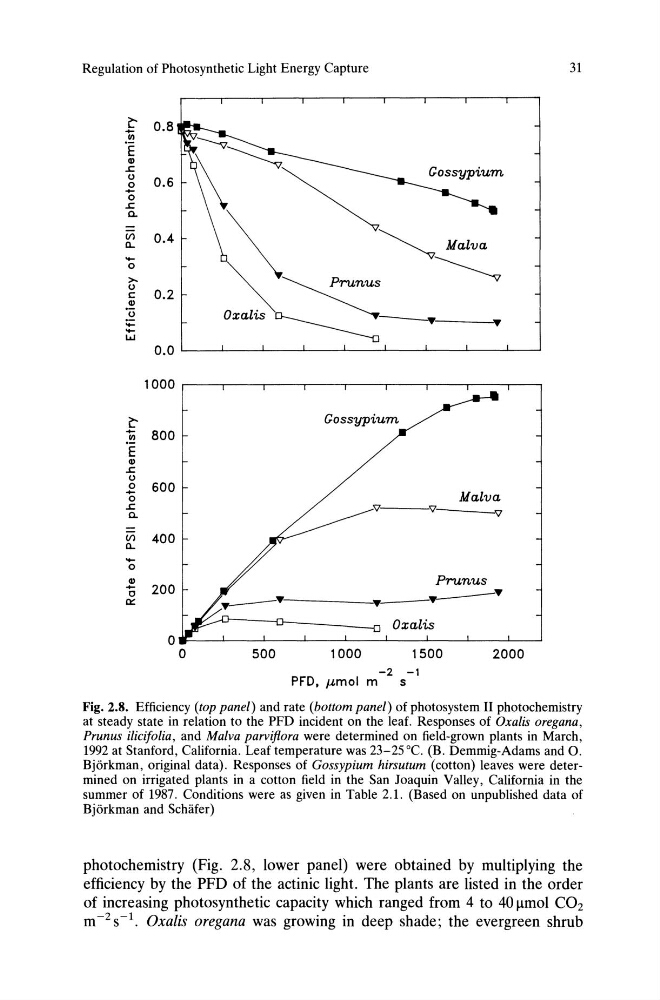
Fig. 2.S. Efficiency (top panel) and rate (bottom panel) of photosystem II photochemistry
at steady state in relation to the PFD incident on the leaf. Responses of Oxalis oregana,
Prunus ilicifolia, and Malva parvifiora were determined on field-grown plants in March,
1992 at Stanford, California. Leaf temperature was 23-25 DC. (B. Demmig-Adams and o.
Bjorkman, original data). Responses of Gossypium hirsutum (cotton) leaves were determined on irrigated plants in a cotton field in the San Joaquin Valley, California in the
summer of 1987. Conditions were as given in Table 2.1. (Based on unpublished data of
Bjorkman and Schafer)
photochemistry (Fig. 2.8, lower panel) were obtained by multiplying the
efficiency by the PFD of the actinic light. The plants are listed in the order
of increasing photosynthetic capacity which ranged from 4 to 40/lmol COz
m-Zs- 1 . Oxalis oregana was growing in deep shade; the evergreen shrub
~ 0.8
-
II)
' E
Q)
.s::.
0
0.6
0
- 0
.s::.
a.
W 0.4
a..
- 0
>0
0.2
c
Q)
'0
-
- w
0.0
1000
>- L.
- 800
.!!!
E
Q)
.s::.
0
0
600
- 0
.s::.
a.
VI
400
a..
- 0
Q)
- 200
0
~
500
GOSSypiUffi
-----'''1
Malva
'V
Prunus
----------~~~----~.
Oxalis
1000
1500
2000
-2 -1
PFD. JLmol m
s
31
Fig. 2.S. Efficiency (top panel) and rate (bottom panel) of photosystem II photochemistry
at steady state in relation to the PFD incident on the leaf. Responses of Oxalis oregana,
Prunus ilicifolia, and Malva parvifiora were determined on field-grown plants in March,
1992 at Stanford, California. Leaf temperature was 23-25 DC. (B. Demmig-Adams and o.
Bjorkman, original data). Responses of Gossypium hirsutum (cotton) leaves were determined on irrigated plants in a cotton field in the San Joaquin Valley, California in the
summer of 1987. Conditions were as given in Table 2.1. (Based on unpublished data of
Bjorkman and Schafer)
photochemistry (Fig. 2.8, lower panel) were obtained by multiplying the
efficiency by the PFD of the actinic light. The plants are listed in the order
of increasing photosynthetic capacity which ranged from 4 to 40/lmol COz
m-Zs- 1 . Oxalis oregana was growing in deep shade; the evergreen shrub