

Regulation of Photosynthetic Light Energy Capture
33
a plateau above 500llmol photons m- 2 S-l. In Malva the decline in efficiency
was much less pronounced and the rate did not reach its maximum up to
PFDs of about lOOOllmol photons m- 2 s- 1 . Lastly, in field-grown cotton the
decline in efficiency was even more gradual and the rate did not reach
saturation until the PFD approached full sunlight. It is noteworthy that the
light responses of the rate of PS II photochemistry and the relative lightsaturated rates among the different species show strong resemblances to the
corresponding light responses and light-saturated rates of CO2 uptake (not
shown). These findings give further support to the notion that simple determinations of (Fm' - F)/Fm' can provide a rapid and convenient method for
nondestructive estimates of photosynthetic performance in the field.
The responses of NPQ to increasing PFD in these four species are shown
in Fig. 2.9. In Oxalis, a high NPQ was present even at quite low PFDs but
2000
I rn 1600
N
I E 1200
0
E
::t 800
ci
LL
0..
400
0
1.0
5 0.8
'-... La
L0.6
0
>.
()
c
0.4
Q)
'u ;;::::
'+w
0.2
0.0
4
.........
\
efficiency ./~
~~
~
I Qr/Qt 'v'\,
~'
6 8 10 12 14 16 18 20 4 6 8 10 12 14 16 18 20
Time of day
Time of day
1.0
0.8
0.6 a
0..
z
0.4
0.2
0.0
100
N
I
80 E
0
E
60 ::t
N
40
I...
0
«
20 >"
0
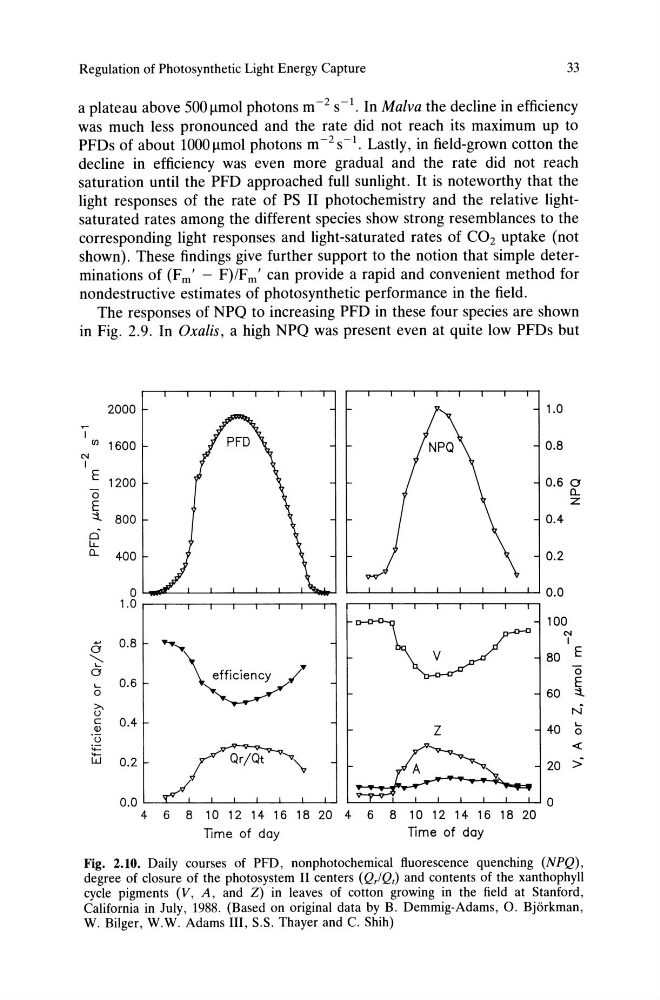
Fig. 2.10. Daily courses of PFD, nonphotochemical fluorescence quenching (NPQ) ,
degree of closure of the photo system II centers (Q/Q,) and contents of the xanthophyll
cycle pigments (V, A, and Z) in leaves of cotton growing in the field at Stanford,
California in July, 1988. (Based on original data by B. Demmig-Adams, O. Bjorkman,
W. Bilger, W.W. Adams III, S.S. Thayer and C. Shih)
33
a plateau above 500llmol photons m- 2 S-l. In Malva the decline in efficiency
was much less pronounced and the rate did not reach its maximum up to
PFDs of about lOOOllmol photons m- 2 s- 1 . Lastly, in field-grown cotton the
decline in efficiency was even more gradual and the rate did not reach
saturation until the PFD approached full sunlight. It is noteworthy that the
light responses of the rate of PS II photochemistry and the relative lightsaturated rates among the different species show strong resemblances to the
corresponding light responses and light-saturated rates of CO2 uptake (not
shown). These findings give further support to the notion that simple determinations of (Fm' - F)/Fm' can provide a rapid and convenient method for
nondestructive estimates of photosynthetic performance in the field.
The responses of NPQ to increasing PFD in these four species are shown
in Fig. 2.9. In Oxalis, a high NPQ was present even at quite low PFDs but
2000
I rn 1600
N
I E 1200
0
E
::t 800
ci
LL
0..
400
0
1.0
5 0.8
'-... La
L0.6
0
>.
()
c
0.4
Q)
'u ;;::::
'+w
0.2
0.0
4
.........
\
efficiency ./~
~~
~
I Qr/Qt 'v'\,
~'
6 8 10 12 14 16 18 20 4 6 8 10 12 14 16 18 20
Time of day
Time of day
1.0
0.8
0.6 a
0..
z
0.4
0.2
0.0
100
N
I
80 E
0
E
60 ::t
N
40
I...
0
«
20 >"
0
Fig. 2.10. Daily courses of PFD, nonphotochemical fluorescence quenching (NPQ) ,
degree of closure of the photo system II centers (Q/Q,) and contents of the xanthophyll
cycle pigments (V, A, and Z) in leaves of cotton growing in the field at Stanford,
California in July, 1988. (Based on original data by B. Demmig-Adams, O. Bjorkman,
W. Bilger, W.W. Adams III, S.S. Thayer and C. Shih)