

Photosynthesis of Vascular Plants
419
60
wild oat
wheat
wild oat
wheat
~
E
0
'----"
CJ control
-0
. - . UV-8
C
::J
40
0
L
(J)
(j)
>
0
..0
20
0
+-'
-.C
CJ1
(j)
I
0
0.4
0.0
0.4
120
0
120
LAI
Canopy net photosynthesis
(mmol co 2 . m- 2 . d- 1 )
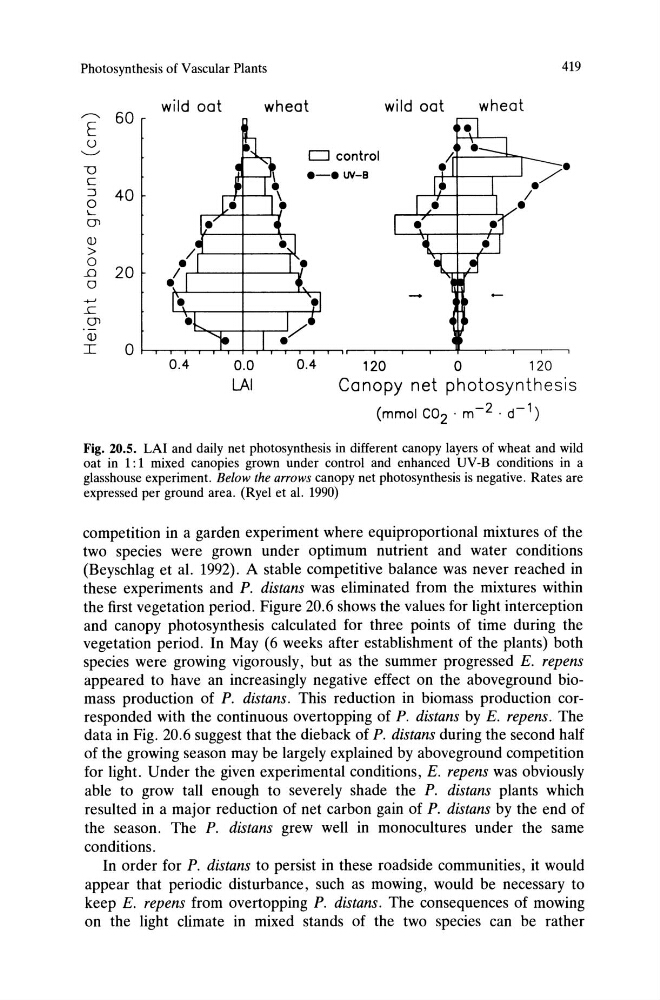
Fig. 20.5. LAI and daily net photosynthesis in different canopy layers of wheat and wild
oat in 1: 1 mixed canopies grown under control and enhanced UV-B conditions in a
glasshouse experiment. Below the arrows canopy net photosynthesis is negative. Rates are
expressed per ground area. (Ryel et al. 1990)
competition in a garden experiment where equiproportional mixtures of the
two species were grown under optimum nutrient and water conditions
(Beyschlag et al. 1992). A stable competitive balance was never reached in
these experiments and P. dis tans was eliminated from the mixtures within
the first vegetation period. Figure 20.6 shows the values for light interception
and canopy photosynthesis calculated for three points of time during the
vegetation period. In May (6 weeks after establishment of the plants) both
species were growing vigorously, but as the summer progressed E. repens
appeared to have an increasingly negative effect on the aboveground biomass production of P. dis tans . This reduction in biomass production corresponded with the continuous overtopping of P. distans by E. repens. The
data in Fig. 20.6 suggest that the die back of P. distans during the second half
of the growing season may be largely explained by aboveground competition
for light. Under the given experimental conditions, E. repens was obviously
able to grow tall enough to severely shade the P. distans plants which
resulted in a major reduction of net carbon gain of P. distans by the end of
the season. The P. dis tans grew well in monocultures under the same
conditions.
In order for P. distans to persist in these roadside communities, it would
appear that periodic disturbance, such as mowing, would be necessary to
keep E. repens from overtopping P. distans. The consequences of mowing
on the light climate in mixed stands of the two species can be rather
419
60
wild oat
wheat
wild oat
wheat
~
E
0
'----"
CJ control
-0
. - . UV-8
C
::J
40
0
L
(J)
(j)
>
0
..0
20
0
+-'
-.C
CJ1
(j)
I
0
0.4
0.0
0.4
120
0
120
LAI
Canopy net photosynthesis
(mmol co 2 . m- 2 . d- 1 )
Fig. 20.5. LAI and daily net photosynthesis in different canopy layers of wheat and wild
oat in 1: 1 mixed canopies grown under control and enhanced UV-B conditions in a
glasshouse experiment. Below the arrows canopy net photosynthesis is negative. Rates are
expressed per ground area. (Ryel et al. 1990)
competition in a garden experiment where equiproportional mixtures of the
two species were grown under optimum nutrient and water conditions
(Beyschlag et al. 1992). A stable competitive balance was never reached in
these experiments and P. dis tans was eliminated from the mixtures within
the first vegetation period. Figure 20.6 shows the values for light interception
and canopy photosynthesis calculated for three points of time during the
vegetation period. In May (6 weeks after establishment of the plants) both
species were growing vigorously, but as the summer progressed E. repens
appeared to have an increasingly negative effect on the aboveground biomass production of P. dis tans . This reduction in biomass production corresponded with the continuous overtopping of P. distans by E. repens. The
data in Fig. 20.6 suggest that the die back of P. distans during the second half
of the growing season may be largely explained by aboveground competition
for light. Under the given experimental conditions, E. repens was obviously
able to grow tall enough to severely shade the P. distans plants which
resulted in a major reduction of net carbon gain of P. distans by the end of
the season. The P. dis tans grew well in monocultures under the same
conditions.
In order for P. distans to persist in these roadside communities, it would
appear that periodic disturbance, such as mowing, would be necessary to
keep E. repens from overtopping P. distans. The consequences of mowing
on the light climate in mixed stands of the two species can be rather